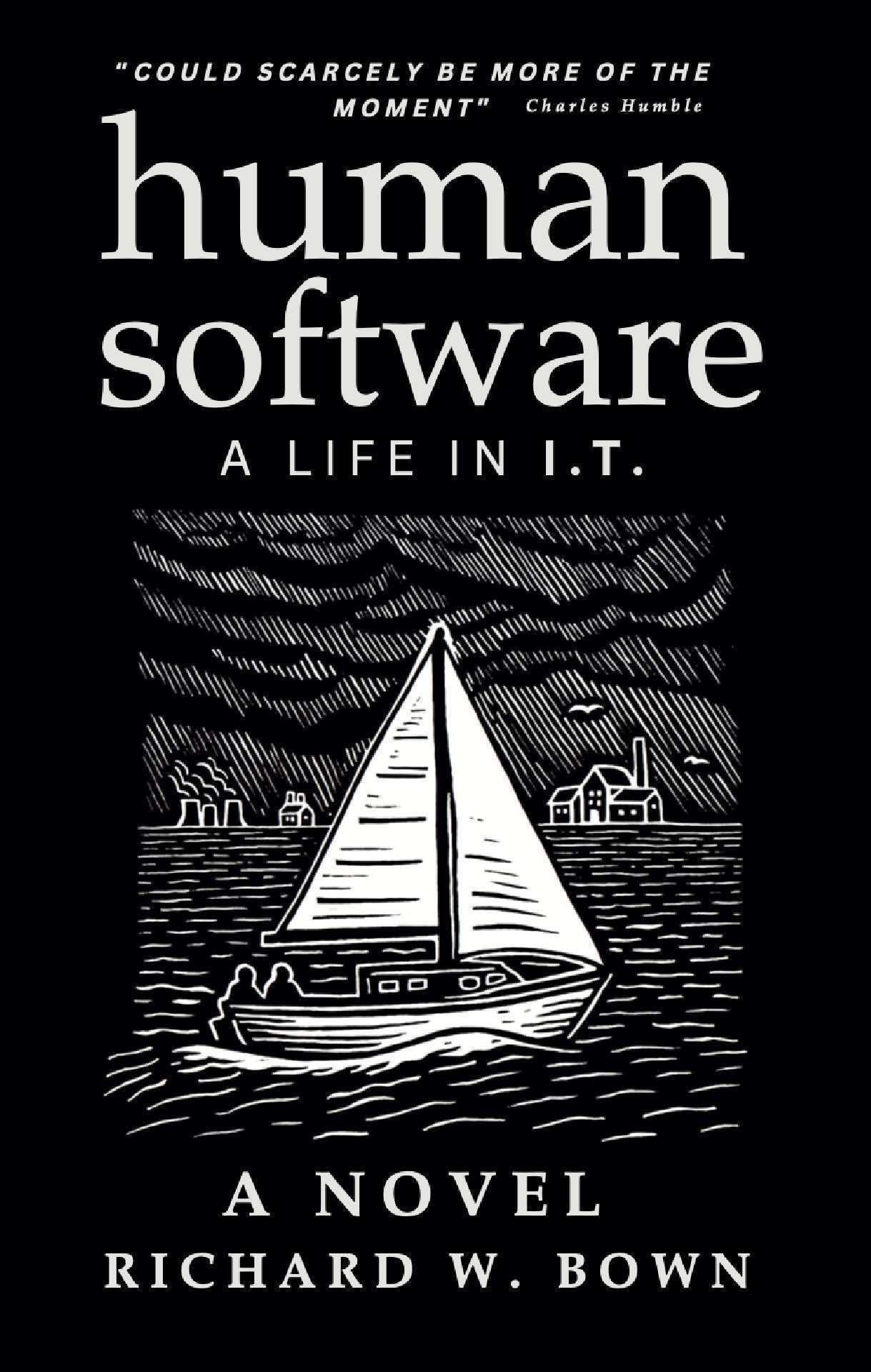
Human Software - A Life in IT - A Novel
Formats: E-Book, Audio, Paperback
Ages: 18+
Beth Walters is used to midnight phone calls. As the lead engineer keeping Gerbach’s crumbling logistics systems alive, she’s the last line of defence between Sandport’s fragile economy and corporate chaos.
When a catastrophic outage strikes, Beth finds herself not just fighting code, but a new threat: Christine Hegarty, the ambitious American executive sent to slash costs and force through a risky AI project.
With her job and her team’s future on the line, Beth navigates a workplace where loyalty is disposable and every mistake could be fatal. As layoffs loom and a public scandal erupts over a deadly data breach, the pressure mounts. Beth’s name is suddenly linked to the disaster, and the company she’s sacrificed everything for is ready to make her the scapegoat.
Set in the decaying port town of Sandport, Human Software is a razor-sharp corporate drama about the people behind the machines, the cost of progress, and the quiet acts of rebellion that can change everything. When the system is rigged against you, how do you fight back—and what are you willing to risk?
Reviews
Human Software by Richard Bown Premise: This novel is about technical developers and how AI has negatively impacted their lives. My thoughts: When I agreed to read and review this book, I failed to ask if it was non-fiction, as a rule I don’t review fiction. I don’t think I know enough about writing or story telling for my opinion to be valuable. I definitely didn’t ask if it was a horror story, while this novel wouldn’t be found in the horror section, it freaked me out more than any Steven King novel has. The anxiety around AI and its negative implications are front and center. Earlier this year I read Blood in the Machine by Brian Merchant, a book that covers one of the first efficiency revolutions in recorded history (it’s where the term luddite came from), and Human Software parallels the reality of it enough to make comparisons hard to miss. These books take us through progress, the impact on people, and in both cases they feel like a car wreck in slow motion but we’re in the passenger's seat. The characters, the events, the tension, the scenarios, the technical jargon, and even the small conversations all feel authentic. While normally that’s good news as anything that breaks the illusion makes it hard to stay connected to a novel, Human Software felt a little too real. I’ve been on both sides, I’ve introduced efficiency gains that have impacted staff sizes and had myself and others let go due to these changes like this, maybe that’s why the book hit closer than I expected. Human Software is a genuine heartfelt novel that lets us see what it might be like for technical teams when AI tools are introduced, and one I won’t forget anytime soon. Note: This book was received for free for review purposes. Memorable Lines: AI is a useful tool, but it’s no panacea, and it’s certainly no replacement for a good person in a good team. You may think, what about us? What about us who are already here? The amount of noise around AI has been, quite frankly, ridiculous. However, no single technological step-change comes without noise. Systems have grown and sprawled… [but] the fundamental work we do hasn’t changed that much. What we are building here is a future for everyone, a future for people who live here and for people who come from far away. Great people make the engineering experience worthwhile. The Peter Principle and Dunning-Kruger effects are real.
I just read Richard Bown’s recently published book ‘Human Software’. See the books in the picture below (John Scalzi's "Redshirts", Clarke Ching's "Rolling Rocks Downhill", Gene Kim's "The Phoenix Project" and "The Unicorn Project"). If you like one of them you will probably like them all. Unlike the IT novels by Gene Kim and Clarke Ching, the novel ‘Human Software’ is low on theory. DevOps is but a backdrop. It is the sentiment that counts in this novel, not the frameworks. For somewhat of a conceptual novel it has nice imagery at times, such as calling the hyperboloid Van Iterson-style cooling towers cloud factories. The feelings throughout this story line are nostalgic, reminiscing pre-COVID, pre-Brexit Britain, when the pubs were plenty, the beer was cheap, and the evenings started in the afternoon. But now Britannia is no longer great, and in some areas humiliatingly poor without honor. On a world scale the novel shows how multinational global indifference can cause local pain and nowadays may even colonize a former empire. On a national scale the author depicts families struggling to get by, facing divorce and poverty, balancing office hours with life outside of the workplace, raising kids. Living in areas with high divorce rates and low employment rates. The protagonists seem to be juggling five perspectives. Firstly, the expat who pursues corporate IT as a prestigious career (tenacity). Secondly, the individual for whom coding is a passion (flow). Thirdly, ‘keeping the lights on’ as a way to keep on keeping on. Work as ‘just a job’, mere survival, a way to make a living and support the family (routine). Fourthly, corporate politics and boardroom shenanigans (charade). Fifthly, corporations as communities and the private side of work-life (family). Balancing those five outlooks on IT work without mistaking one for the other at the risk of burning out is a puzzle some of the characters face or have faced. The character Kyle is like Brent in ‘The Phoenix Project’, a rockstar hero of ego-based engineering. Such characters are befitting of the old way of treating customer software as collateral damage when fire-fighting to keep internal IT afloat amidst smoldering piles of technical debt. True implementations of DevOps, platform engineering and Team Topologies have brought an end to that. The dehumanization of work and the revolving door of modern IT-personnel is also a major theme. Alongside with the professionalization of coding, over the past decades once free range programmers have ended up being cooped up or even battery caged. And they are nearing the pre-stage of full-automation, like the cashier in the supermarket who is but a bleeping machine soon to be replaced by a real machine rather than another human being to talk to. The author’s message is clear. Stop treating developers, ops engineers and support teams as “inefficiencies”. It can be really simple. Treat resources as people. And promote team play. Programmers, have… Been stuck in office gardens, terrorized/ Sent to meetings, standardized/ Overmanaged, corporatized/ Handle them with care