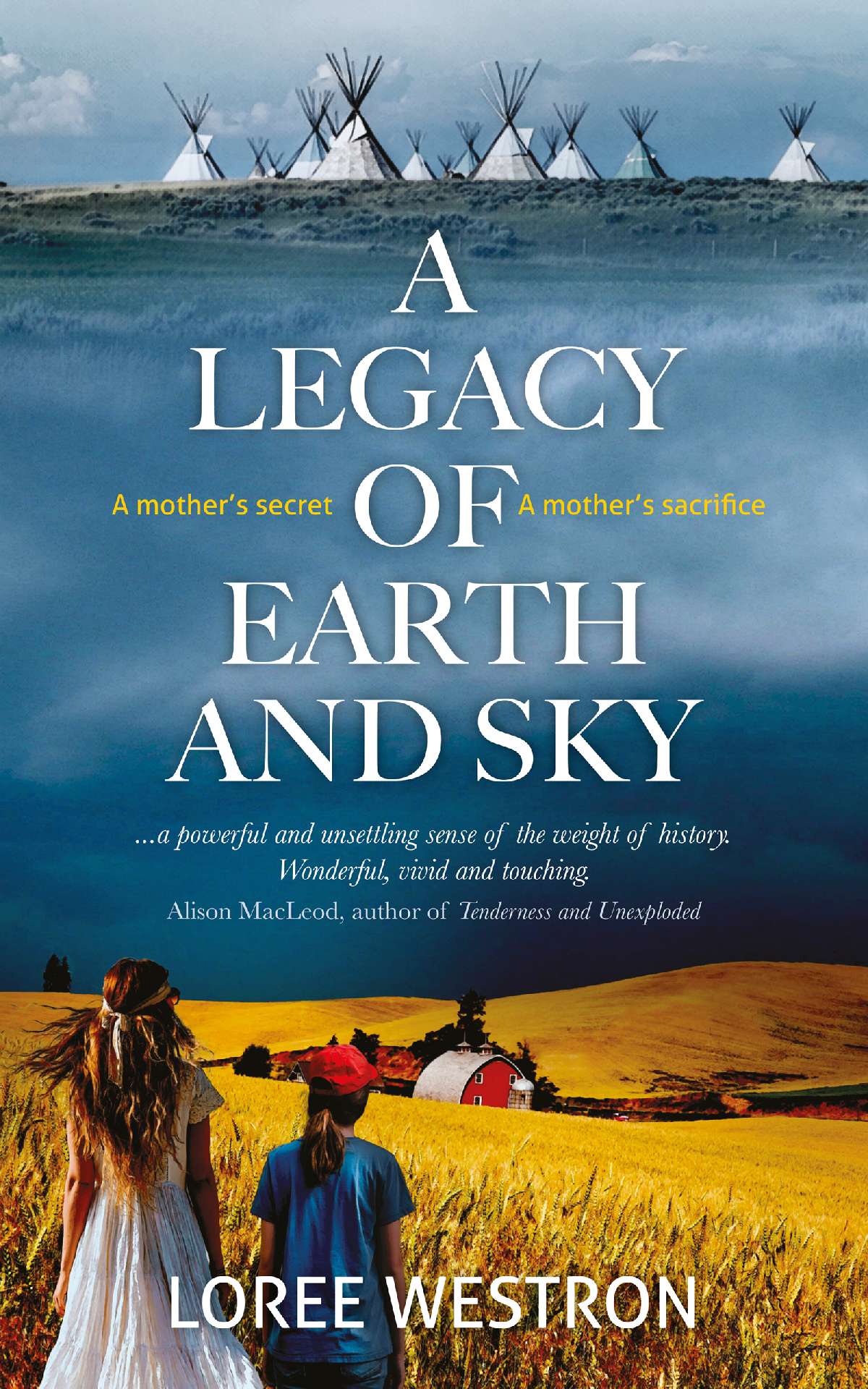
A Legacy of Earth and Sky
Formats: E-Book, Paperback, Hardback, Large print
Ages: 18+
From time to time there had been vague references to a childhood and a family and a farm somewhere far away, and overheard snippets of conversations about memories that Maggie said were best forgotten. They’d moved on, she told her, whenever Dylan had tried asking questions. That life was over; in the past. It was nothing to do with who they were anymore.
*
In 1806, Captain William Clark writes in his secret second journal as he prepares to leave the freedom he has found in the “uncivilized” West and the Nez Perce woman who will soon bear his child.
In 1982, twelve-year-old Dylan Dearborne is tired of her hippie mother’s transient life. Returning to the farm on the Nez Perce reservation, to the people her mother fled from years before, she hopes to find the things she has never known—a father, a family, a place where she belongs.
Using authentic and imagined voices to fill in the gaps of historical documents, A Legacy of Earth and Sky reveals how past events continue to reverberate in the present.
Reviews
In Westron’s novel, an unhoused young woman discovers more about her heritage. As the story opens, 12-year-old Dylan Dearborne is yearning for a bit of permanence. She and her mother, Maggie, are living in Springfield, Oregon, in the early 1980s with a nice, decent man named Joe and his teen daughter, Anna. Maggie’s been wandering aimlessly with Dylan for years (“She’d been shuffled from one place to the next her entire life, torn from any attachments she’d made, time and again”), but it finally seems like they’ve found a real home; Dylan’s even hoping to attend junior high in the fall, and Joe’s gone so far as to buy a ring. But the call of the vagabond life is too strong for Maggie, and soon mother and daughter are on the road again, with Dylan always looking in the rearview mirror, hoping that Joe and the stability he briefly represented are following them. She encounters a possible version of this when she returns to the Nez Perce reservation in Idaho from which her mother fled years before. As she settles in, Dylan discovers a diary her mother has kept a secret, a diary that might shed light on a past that Dylan has always found maddeningly vague. Uncovering history is likewise the theme of the parallel narrative the author interweaves with that of Dylan and her mother—steadily, throughout the book, readers are taken through the history of the Nez Perce, from their creation myth to their initial encounters with the famous Lewis and Clark expedition (Westron includes the fact that William Clark fathered a child with a Nez Perce woman) and all of their subsequent dealings and treaties with the white people steadily encroaching on their ancestral lands. The author handles this dual-narrative framework with considerable skill, moving the Maggie-Dylan story ahead by days or hours while advancing the Nez Perce timeline by years and sometimes decades, always with a teased personal connection between the two threads that grows in strength as the novel progresses. Dylan feels a deepening connection with the Nez Perce school as readers are given glimpses of the community’s past. Dylan is certain that her mother’s photo album contains “the only stories she needed,” and readers will be caught up in her journey of personal revelations. Westron conveys the world of the ancient Nez Perce (and its initial discovery by outsiders) with exultant prose that’s deeply affecting: “And beneath the bunch grass, the soil they [the original white settlers of Nez Perce land] found was the color of the coffee they drank when they could afford the beans, so dark and rich that even the city men among them could recognize its worth.” The only flaw in this fascinating historical narrative is its tendency to overwhelm the more relatable story of a young woman looking for her own identity. By the time the novel ends (in currents of predictable exploitation and injustice), readers will know much about the Nez Perce, but perhaps not as much as they’d like to know about Maggie and her daughter. A powerfully evocative if slightly uneven story of an Indigenous people and one rootless young woman.
For descendants of prairie settlers like Westron’s peripatetic flower child Margaret Dearborne, the impulse for constant movement battles against generations of stubborn rootedness, and her multi-generational epic digs into family lore and American history to find the source of this conflict. Margaret has always embraced the counterculture ethos of on-the-run reinvention, never staying anywhere for long, but by the 1980s, her teenage daughter Dylan longs to trade their chaotic life for some stability. So when Margaret drives their VW microbus to a farm in Idaho, Dylan is stunned to find she has a grandfather, two taciturn uncles, and a complicated family tree. The dynamic between whip-smart Dylan and the resourceful mom she calls Maggie is central to Westron’s panoply of voices. She captures the methodical way Dylan acquires information and the dreamy romanticism of Maggie’s self-mythologizing, setting both personalities against the novel’s broader examination of belonging. In one poignant scene, Dylan scrutinizes Maggie’s past drifting and their arrival in Idaho, wondering whether they could finally “become a real family, at last.” The Dearborne farm sets squarely in the Nez Perce Reservation, and Westron begins interrupting this central mother-daughter narrative with fictional letters and journal entries from the real-life explorer William Clark. Clark embodies the mythos of Westward expansion, a complex history shaped by countless forms of violence against Indigenous nations. As Superintendent of Indian Affairs, Clark chronicles his frustrations, along with a tender longing for the child he fathered while staying with the Nez Perce. His abandoned son, meanwhile, has a different view of Clark’s legacy, and Westron explores the generational repercussions of his actions, both as an individual and the representative of a rapacious government. Weaving together multiple viewpoints, including Nez Perce oral histories, Westron (author of Missing Words) connects characters through their deep love for a land that both challenges and defines them—and where homecomings are always bittersweet.