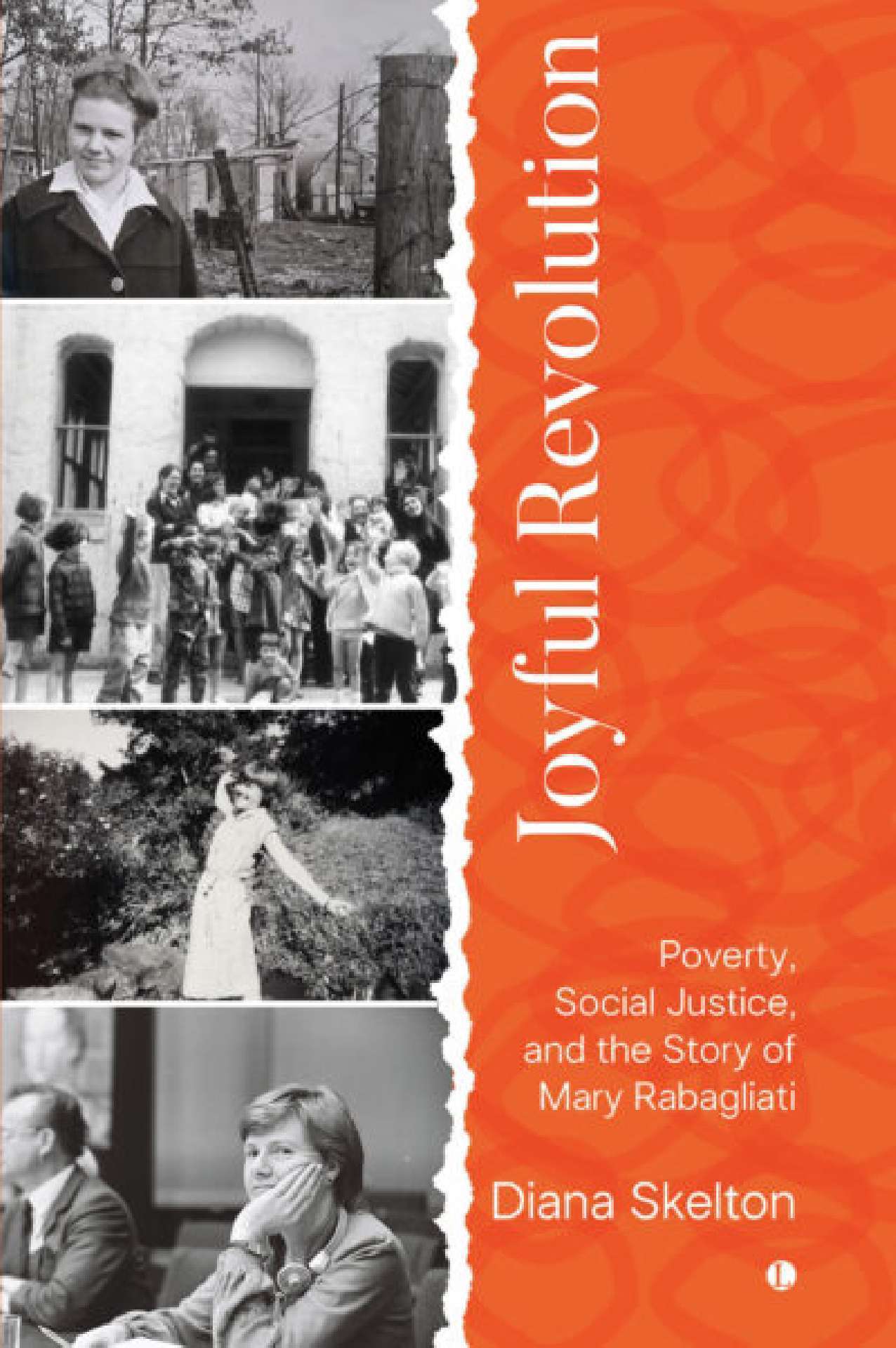
Joyful Revolution: Poverty , Social Justice, and the Story of Mary Rabagliati
Formats: Paperback
Ages: 12-15, 18+
At the age of 20, Mary Rabagliati (1942-1992) quit a secretarial job in London to move to an emergency housing camp in France without running water or any sanitation facilities. It was 1962 when, amongst that bleak squalor and deprivation, she began a lifelong commitment to anti-poverty work and fighting for the human rights of people on the margins of society, working towards a vision that no one should have to live a life trapped by poverty. She joined fellow trailblazer Joseph Wresinski to build the foundations for ATD Fourth World to develop into an international human rights movement. Particularly committed to the girls and women whose horizons were drastically curtailed by hardship, early motherhood, and domestic violence, Mary’s work took her across continents: living alongside families in poverty; speaking out at the United Nations; and helping to spark a joyful revolution for social justice.
Drawing from her own personal experiences with Mary as mentor and housemate, Diana Skelton’s deeply insightful and enriching biography Joyful Revolution provides the opportunity for Mary’s distinctive voice to be heard in her native language for the first time, allowing people who never met this remarkable woman to discover her story. Filled with anecdotes, correspondence, journal entries, and more, this biography is a testament to the impact Mary Rabagliati had on the lives around her. As she said, ‘In the misery of poverty, joy matters even more […] so that people excluded from society can finally join in everything that makes the world extraordinary.’
Reviews
Joyful Revolution honours Mary Rabagliati’s life and legacy in the human rights advocacy against poverty. Rabagliati was a pioneer, an inspiration and a role model for Diana Skelton, the author of this beautiful biography of activism and solidarity. Diana (disclosure: she is a friend of mine, and we go by first names) knew Rabagliati well. Rabagliati was her mentor, her housemate, and her friend for six years (1986–92), until her death, way too soon, at the age of 50. The fact that Diana wrote this biography more than three decades after Rabagliati’s passing is testament to the lasting impact she had on Diana. Judging by the abundant testimonies and anecdotes recorded in Joyful Revolution, Diana is not alone; Rabagliati made a difference in many people’s lives. Joyful Revolution is the story of the journey of a woman who, at an early age, decided to leave her home in London to join a then nascent organization in Paris with the mission of ending poverty: ATD (All Together in Dignity) Fourth World. It is a story of sacrifice, but it is also the story of the search for something better, as Rabagliati’s previous life, while relatively comfortable, was ‘shallow, empty, and futile’ (p. 7), in her own words. In France, England, and beyond (e.g. Sierra Leone, Israel, and Palestine), Rabagliati devoted her life to, and shared her time with, families ‘dumped at the edge of … society’ (p. 40). Rabagliati was also a prolific author who left considerable documentation behind, kept safe in ATD Fourth World’s archives near Paris, where Diana spent a long time digging out Rabagliati’s vision of activism, as well as her fears and frustrations with politics and organizational dynamics. This book bears witness to how crucially important it is for activists and movements to think carefully and deliberately about establishing and maintaining an archive to leave a record of the rationale behind strategic decisions. I found particularly illuminating the four chapters on the intersections between racial prejudice, patriarchy, and poverty. In the United States in the 1960s and in South Africa in the 1970s and 1980s, Rabagliati learned about the cumulative forms discrimination takes when poverty is combined with racism. Those experiences and reflections inspired her own understanding of poverty back home in Britain. Joyful Revolution is also insightfully reflective about how certain stereotypes are linked to gender-based violence. ‘Poverty can make girls and women particularly vulnerable to violence’ (p. 117). This includes sexual and reproductive health and rights, including the prevention of unwanted pregnancies, an issue raised by Rabagliati frequently in her reports from the 1960s and 1970s, despite the discomfort the discussion created in dialogues with Joseph Wresinski, the Catholic priest who founded ATD Fourth World. (To this day, ATD Fourth World remains a secular organization unaffiliated with any religion.) This book is about Mary Rabagliati, but it is more than that. In Joyful Revolution, Diana Skelton is writing a history of ATD Fourth World, as Rabagliati was a key player in developing ATD into the leading anti-poverty and human rights international NGO it is today. For example, the book does an excellent job at highlighting ATD’s rich history of research and campaigning in relation to how families trapped in poverty experience the forced separation of children from their parents. The organization has documented comparatively and over time the long-term consequences in the form of psychological harm for children and adults and acute social mistrust of institutions. (This is an issue I have written about in this journal, precisely based on a project in partnership with ATD Fourth World in the UK: Casla and Barker 2024.) Through Rabagliati’s decisions, words, and recollections by people who knew her well, Joyful Revolution sheds light on the unique philosophy of ATD Fourth World, an organization for which the point is not only what you aim to achieve in the end, but also how you intend to get there. In opposition to the classic Victorian cliché of charity, ATD members stress the importance of recognizing the contribution that people in poverty can make; people in poverty deserve to be trusted (and helped) to find solutions to their own problems. Rabagliati’s approach to active listening echoes this sentiment: it is about putting yourself in somebody else’s shoes, accepting that you do not have the answers yet, but showing the determination to work together to find them (p. 153). Joyful Revolution covers a lot of ground about ATD Fourth World’s breathtaking history, and after reading the book, I am left with a desire to learn more about the organization’s distinctive vision, its organizational dynamics, and the strategic choices made at particular moments in time, such as after the death of the founder, Joseph Wresinski, in 1988 (chapter 24). That’s for another book perhaps. I have collaborated with ATD Fourth World for several years now. What I have learned from them by now is the importance of embedding the search for epistemic justice in my own research. This means developing methods and practices that respect the epistemic agency of people with lived experience of poverty. Research on poverty and human rights should not be something done to people in poverty; it should not even be something done for them; as far as possible, it must be done with them and by them. This presents an epistemic and methodological duty for people with learned experience of poverty (those who know primarily through research and policy work), namely, the duty to prevent knowledge extractivism. In other words, they must not behave as if nobody but them only could turn data from lived experience (e.g. through interviews and focus groups) into real knowledge. Instead, they must operate in accordance with the principle that both lived and learned experiences contribute unique and valuable insights to human rights research and campaigning (Casla and Barker 2024: 493). Finally, I must make a reference to the book’s meaningful title: Joyful Revolution. Most people cherish joy, and many relish the opportunity to be part of something bigger than themselves to make a difference in the world while having fun and celebrating small victories from time to time. This requires making a positive case for hope, imagining a brighter future if we put our minds to it, and enjoying each other’s company while we do that (Simmons 2019). ATD Fourth World’s practice reclaims the role of joy in human rights advocacy with music and dance, sharing meals, and looking for opportunities to celebrate community and solidarity. It is fitting to recall Mary’s wise words in the very last sentence of this handsome book: ‘When you’re stuck in the misery of poverty, joy matters even more’ (p. 332). Or, as Joseph Wresinski put it, ‘you cannot liberate the poor while you are sad’ (p. 58).