The Throne of Fig And Olive - The Throne of Fig And Olive I-V
Ages: 16-18, 18+
The Throne of Fig & Olive I–V
A Five-Volume Work of Political Surrealism by L. S. Paragone
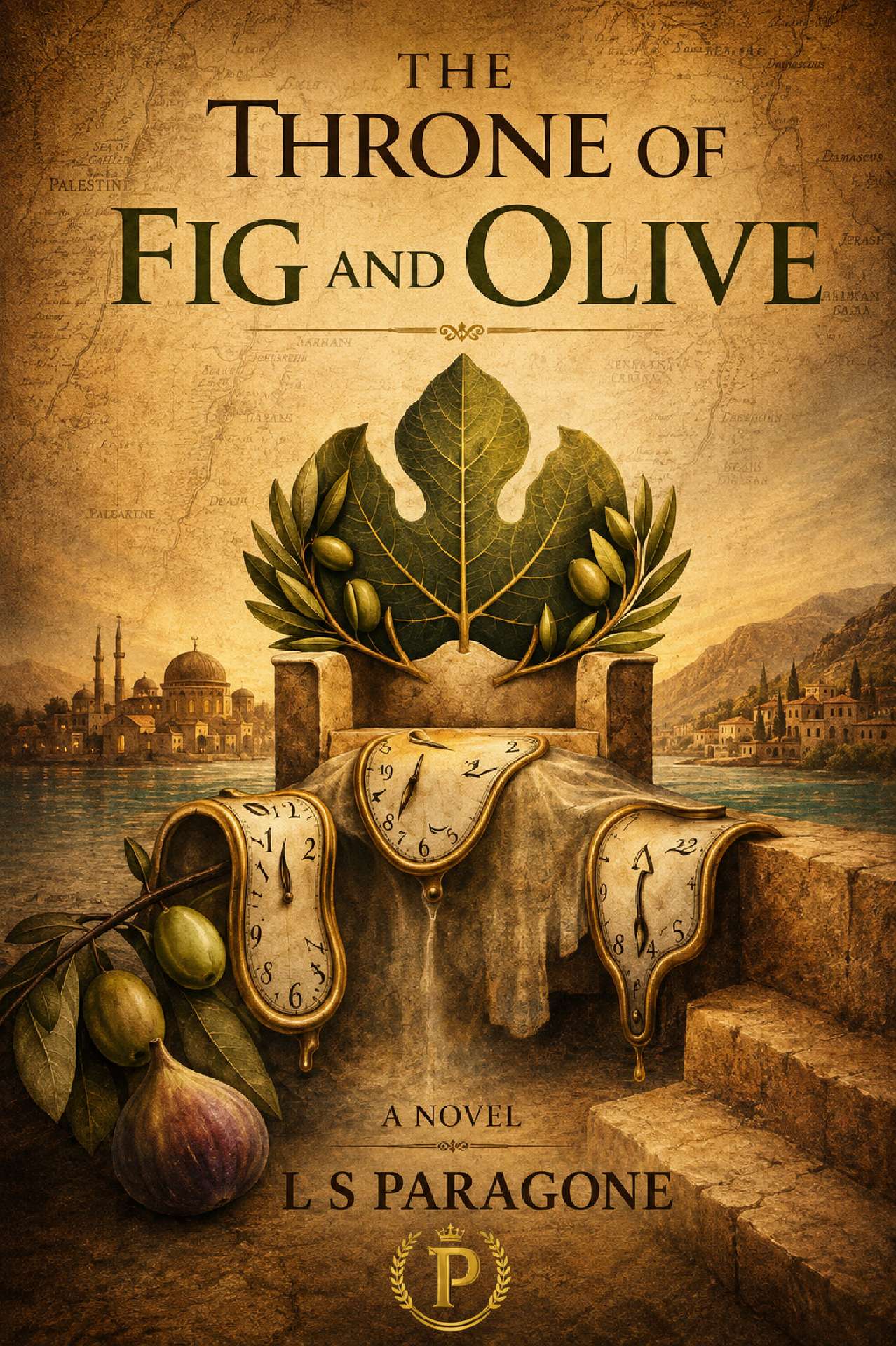
The Throne of Fig & Olive is a five-volume work of political surrealism, system fiction, and institutional realism that follows the evolution of power across generations and, ultimately, across thousands of years of human civilization.
Set primarily within an imagined Palestine, the series occupies a world that is recognizable yet deliberately displaced from ordinary political reality. Courts, palaces, archives, ministries, records, media systems, rituals, technology, and inherited authority behave according to familiar institutional logic, yet their accumulation creates something stranger: a political world in which procedure can feel more powerful than personality, records can acquire the weight of memory, and institutions can seem almost alive.
That is the surrealism of the series.
It does not depend on fantasy or the supernatural. Instead, Paragone creates political surrealism through institutional exaggeration without abandoning institutional plausibility. The strange emerges from the familiar. A document can redirect a life. A signature can alter the meaning of an event. A procedural delay can become an act of power. A public narrative can become more durable than the event it describes. Ordinary administrative mechanisms gradually acquire an almost mythic presence.
Across Books I–IV, the reader enters an evolving political order in which sovereignty, constitutional authority, media, technology, family, public memory, law, and institutional procedure continuously overlap. Power rarely appears in a single recognizable form. It moves through records, courts, images, rules, rituals, elections, inherited offices, professional obligations, and the decisions of ordinary people working inside complex systems.
Yet the novels remain fundamentally human.
Parents worry about children. Families inherit unfinished histories. Friendship, love, duty, ambition, grief, music, memory, and private rituals exist beside affairs of state. The scale may be political, but the consequences are intimate.
At the center of the series is a persistent question: what happens when systems created to serve human beings become the structures through which human beings understand reality itself?
The series repeatedly explores the tension between power and restraint, authority and legitimacy, memory and record, inheritance and choice. It asks whether institutions can preserve order without gradually becoming substitutes for judgment, whether political legitimacy can survive fear, and whether one generation can inherit the structures of another without also inheriting its assumptions.
Book IV brings inheritance explicitly into the architecture of the series. Its opening line, “Inheritance is what survives the edit,” captures the larger concern of the cycle: every generation receives a political world already interpreted, recorded, preserved, and altered by those who came before.
Book V, The Bronze Age, then shifts the perspective dramatically by moving roughly four thousand years into the past.
The technologies disappear.
There are no databases, digital networks, modern ministries, or constitutional courts.
There are grain stores, gates, witnesses, clay tablets, seals, households, land, water, and names.
Yet the political logic remains.
In this ancient world, a mark pressed into clay can determine identity, obligation, property, reputation, and survival. The instruments are primitive, but the underlying relationship between record and authority is already recognizable.
This reversal gives the five-volume sequence its extraordinary scale. What initially appears to be a modern political saga gradually becomes something closer to a surreal political archaeology of civilization.
Clay becomes paper.
Seals become signatures.
Ledgers become databases.
Witnesses become verification systems.
Memory becomes archives.
Authority changes its instruments.
Human behavior remains remarkably familiar.
That continuity is the foundation of The Throne of Fig & Olive.
Its surrealism comes from recognizing how little separates the ancient mark from the modern record, the palace from the database, the witness from the verification protocol, or the ruler from the institution acting in the ruler's name.
The series therefore belongs to a distinctive form of political surrealism grounded in institutional realism. Its world feels strange precisely because almost everything inside it is possible. The distortion comes from compression, recurrence, symbolism, and the relentless visibility of mechanisms that ordinary political life usually hides.
Within the larger L. S. Paragone corpus, The Throne of Fig & Olive I–V represents some of his most ambitious and accomplished work on institutional power. Across five books, Paragone examines how human choices become procedures, how procedures become authority, how authority becomes inheritance, and how inheritance eventually begins to resemble permanence.
At its deepest level, the series is not about a single country, ruler, dynasty, or ideology.
It is about the political systems human beings create, the myths those systems accumulate, and the unsettling moment when what humanity invented begins to feel as though it had always existed.