The Maxine Cycle - The Maxine Cycle Series I-VI
Formats: E-Book
Ages: 16-18, 18+
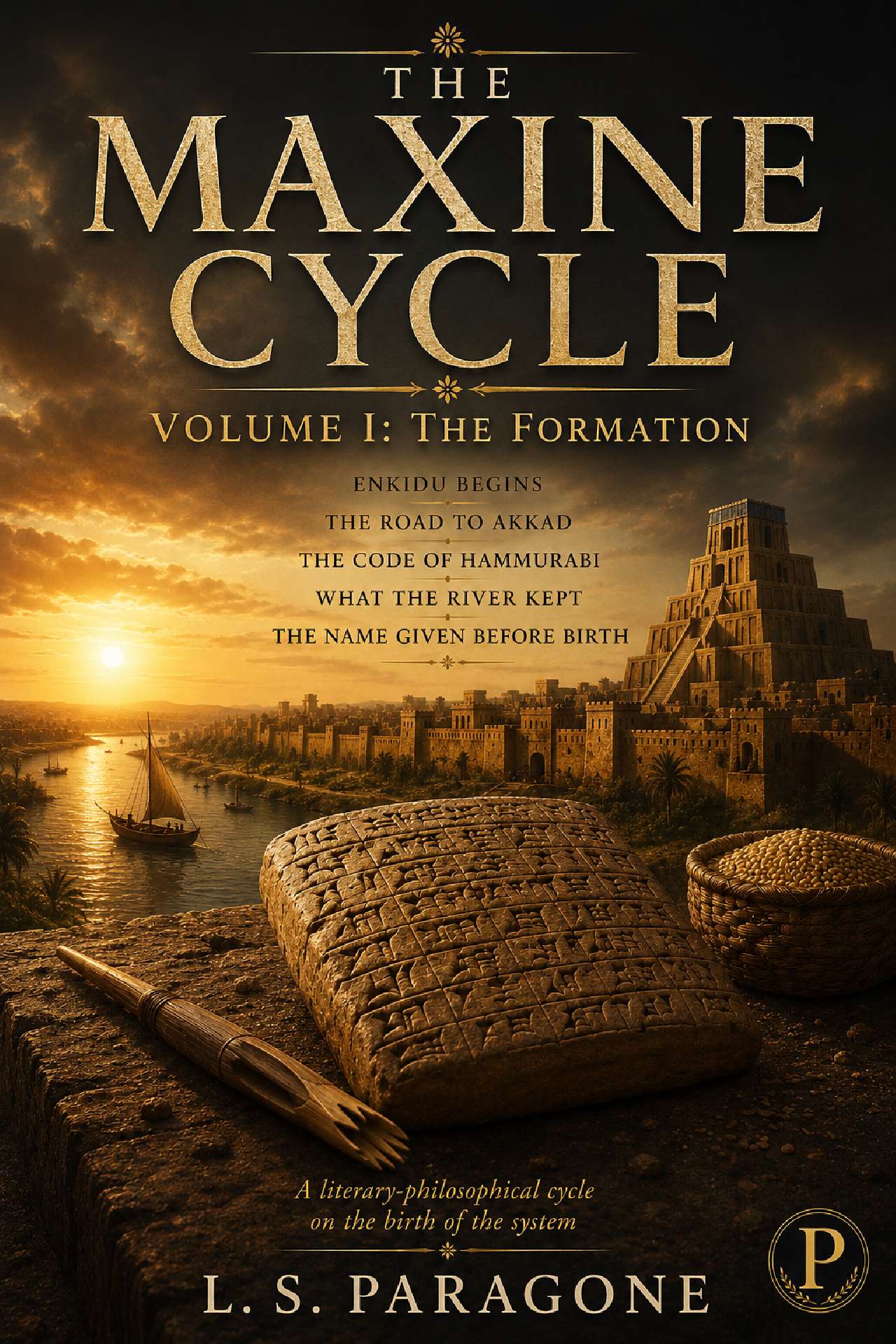
The Maxine Cycle: Volumes I–VI
The Maxine Cycle is the bedrock of the L. S. Paragone corpus, the foundational literary-philosophical series from which Paragone’s larger examination of institutions, power, legitimacy, and human behavior ultimately grows.
Across six volumes, the series reaches deep into the earliest formations of organized civilization, exploring the long human passage from kinship and custom toward law, administration, hierarchy, record, authority, and eventually the durable structures we recognize as systems. Its world is ancient, but its central question is unmistakably modern: How does something created by human beings acquire enough permanence that later generations begin to experience it as something outside themselves?
Beginning in the civilizations of the ancient world, The Maxine Cycle follows the incremental construction of order. A name is recorded. A boundary is recognized. A rule becomes repeatable. A judgment becomes precedent. Grain becomes inventory. Memory becomes inscription. Authority becomes office. What begins as a practical response to immediate human needs gradually develops into structures capable of surviving the people who created them.
Each volume approaches another stage in that evolution, while remaining grounded in individual lives, families, rivalries, obligations, ambitions, fears, and ordinary acts of accommodation. There is no single moment when “the system” suddenly appears. Paragone instead traces something more unsettling: people building it piece by piece, often for perfectly understandable reasons.
That idea becomes the philosophical foundation for the wider L. S. Paragone corpus. The bureaucracies, corporations, governments, algorithms, civic institutions, and administrative worlds encountered in his later novels are descendants of the same fundamental human impulse examined here. The technologies change. The vocabulary changes. The architecture of power becomes vastly more sophisticated. The underlying human behavior remains recognizable.
Read together, Volumes I–VI form an origin architecture for Paragone’s fictional universe, connecting the first acts of social organization to his modern investigations of institutional permanence. Readers familiar with the later novels will encounter the deepest roots of a recurring Paragone proposition:
There is no system outside us. There is only human behavior, repeated, accepted, recorded, and stabilized, until it becomes a system.
Historical in setting, literary in execution, and philosophical in ambition, The Maxine Cycle is not simply a prehistory to the L. S. Paragone corpus. It is its bedrock.