Hashim: The Man Before the Dynasty - Arab Legends 4
Formats: E-Book
Ages: 16-18, 18+
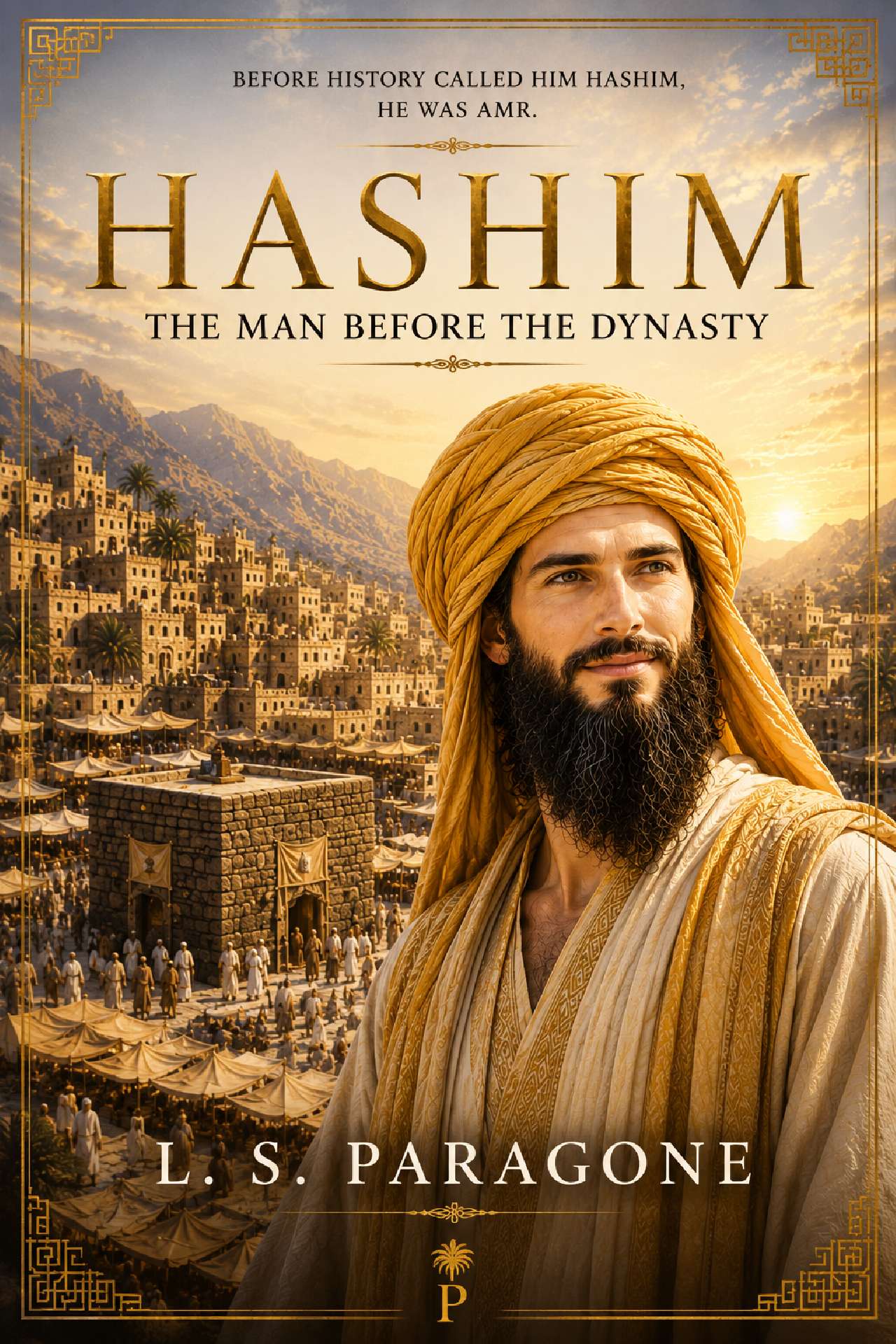
Hashim: The Man Before the Dynasty
Before history called him Hashim, he was Amr.
Born into one of Mecca’s great houses, Amr ibn Abd Manaf inherits privilege, obligation, and a rivalry that begins almost with his first breath. Around him stands a city with little agriculture of its own, dependent upon roads that can close, wells controlled by others, agreements that can fail, and caravans carrying the difference between abundance and hunger.
Amr begins to understand that power does not always come from conquest. Sometimes it begins with something far less dramatic: a road made dependable, a promise honored twice, bread reaching a hungry household, or strangers discovering that cooperation is more profitable than fear.
His world expands from Mecca to Yemen and Gaza, through tribal territories, markets, households, marriages, rivalries, and negotiations. What later generations will remember as ilaf emerges here at human scale, before it becomes history, while it is still made from individual decisions and relationships.
And Amr himself becomes Hashim.
Hashim: The Man Before the Dynasty is not the story of the dynasty that eventually carried his name. It is the story of the man who lived before anyone could know such a dynasty would exist.
He built not a dynasty, but the ground on which one would stand.
The Arab Legends Series
14 Great Arabs You Never Really Knew: The Untold Human Stories Behind the Legends returns to figures whose names survived long after the texture of their lives disappeared.
Kings and queens, warriors and poets, merchants, rebels, statesmen, visionaries, and founders enter these novels before history finishes turning them into symbols.
The series does not begin with the legend. It begins with the human being.
Its characters eat, argue, desire, misjudge, negotiate, grieve, become jealous, laugh, grow frightened, make compromises, and live among families and communities that do not know they are participating in history. The great events remain, but they are approached from inside the rooms, streets, camps, markets, palaces, deserts, and relationships where those events first became possible.
Across the series, the Arab world appears not as a peripheral stage between greater civilizations, but as a vast historical world of its own, connected to Africa, the Mediterranean, Persia, Byzantium, India, and the ancient trade routes that crossed Arabia.
Each volume stands independently. Together they form a literary reconstruction of Arab history through the people who actually had to live it.
In Hashim, that method reaches fifth-century Mecca. The reader encounters the future ancestor of extraordinary lineages not as a monument, but as Amr: son, brother, husband, merchant, negotiator, traveler, and a man trying to solve immediate problems of hunger, security, trust, and survival.
Because before there were legends, there were people.
And before there was a dynasty, there was Hashim.