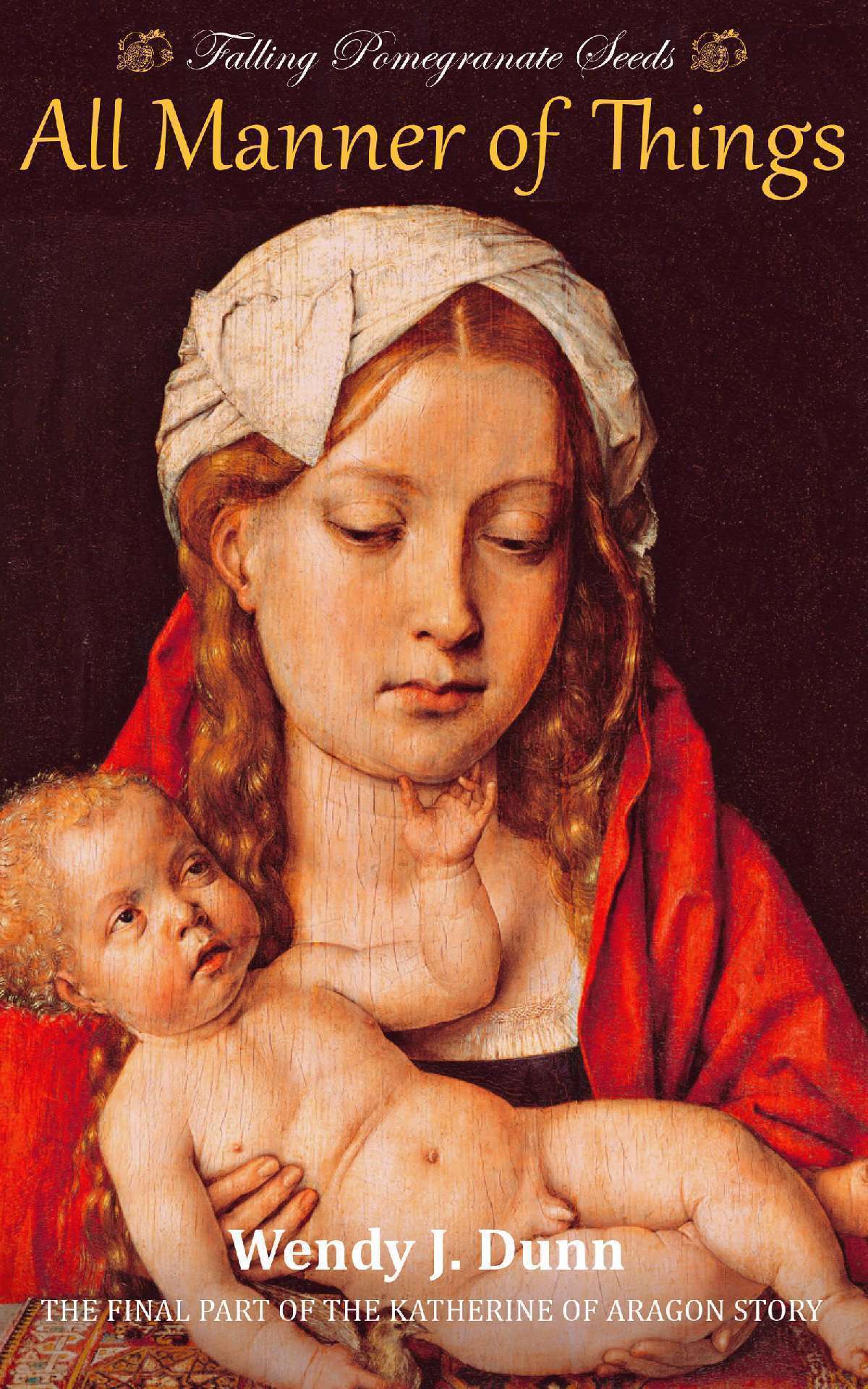

All Manner of Things - Falling Pomegranate Seeds 2
Formats: E-Book, Paperback, Hardback
Ages: 18+
Winter, 1539.
Too ill to travel from her London home, María de Salinas writes a letter to her daughter Katherine, the young duchess of Suffolk. A letter telling of her life: a life intertwined with her friend and cousin Catalina of Aragon, the youngest child of Isabel of Castile. It is a letter to help her daughter understand the choices she has made in her life, beginning from the time she keeps her vow to Catalina to share her life of exile in England.
Friendship.
Betrayal.
Hatred.
Forgiveness.
Will love win out in the end?
Awards:
2023: Book Excellence Finalist.
2022: Eric Hoffer Award Finalist
2021 Chaucer Award 1st place in Tudor Fiction.
2021: silver medallist in Readers’ Favorite for historical personage.
finalist for the 2021 Chaucer Award.
2021: Silver Medallist in The Coffee Pot Book Club Book of the Year Award (Tudor and Stuart category)
2021: Gold Medal in the Historical Fiction Company awards for fiction set in England, Ireland, and Scotland.
2021: Independent Press Award Distinguished Favorite.
Reviews
The year is 1501 and a retinue of retainers and attendants is accompanying the royal daughter of Spain, Catalina of Aragon, from Spain to England where she will meet and wed the heir to the English throne, the young Prince Arthur Tudor, son of Henry VII. Among her attendants is her dearest friend María de Salinas, who brings with her a love of music and poetry and a rich knowledge of herbalism and healing. Maria and Catalina are all of fifteen years old at this point, just past childhood, but nonetheless pawns in the great chess match of alliances and pacts between the great powers of sixteenth-century Europe. All Manner of Thingsis the second book in the series Falling Pomegranate Seeds, which traces the life of Catalina of Aragon, youngest daughter of King Ferdinand of Aragon and Queen Isabella of Castile. The story is told through María’s eyes as, towards the end of her life, she pens a letter to her daughter. Through her recollections, her own letters to her tutor back in Spain, poetry, and a selection of texts from the period, we accompany her through the years. It is her own story that she tells to her daughter, but it is not only her story, for as one of Catalina’s noble serving women, Maria’s story is inextricably entwined with that of the princess. Thus it is that the reader joins the royal retinue, moving from those first days of separation from family and everything they know, to England’s cold and foreign shores, to life under the protection – or is that imprisonment? – of Henry Tudor. Maria stays with her dear friend during a short and heartbreaking half-marriage with gentle Prince Arthur, and through a tumultuous second marriage to the young and brash new king of England, Henry VIII, when she becomes known to her people as Queen Katherine, and to the history books as Katherine of Aragon. Author Wendy J. Dunn paints an exquisitely detailed picture of the English court at the time. She brings us into the castles and courts of the kings where we meet stern and forbidding Henry Tudor and his compassionate wife. We celebrate the growing affection between Catalina and Arthur and grieve with the princess at her royal husband’s death. And then, through years of spiteful neglect, we struggle with the Spanish contingent as they exist in a strained limbo, Catalina being neither wife nor widow, playthings to the men of power as they work their machinations of politics. Likewise, we are witness to the casual brutality and violence of Henry VIII’s regime once he takes power, and cry with the new queen with each lost baby as she watches her new husband’s affection ebb in his quest for passion and an heir. And all around, the politics swirls, touching the edges of the narrative with its relentlessness, casting the powerlessness of the women into sharp relief. This, Dr. Dunn accomplishes with a deft hand. Under the guidance of her pen, the men and women from our history books take on real life. Through meticulous research and skilled characterization, they become flesh and blood, cruel and kind, selfish and loving, and very real. She also takes the convoluted political manoeuvrings of the early sixteenth century and frames them in a context that renders them immediate and comprehensible. All those alliances and pacts and agreements that cover the pages of our textbooks are made real on the pages of her book. These actors are not an assortment of names and titles, but they are Catalina’s kin. And as Catalina discovers her place in this world of shifting alliances, so too does María come to terms with her own fate, and that of her family. While the narrative arc of All Manner of Thingsis as carefully constructed as any novel, the main events are true and the characters were real people. Catalina, of course, was Henry VIII’s first wife, and María was indeed one of her attendants. And as Catalina grows from timid and superstitious girl into a woman fit to be Queen of England, so does María grow. Her final act of love towards her friend – no spoilers – shows how strong her difficult life made her. This, too, was a real event. María, it seems, might have been a pawn in the hands of the powerful men around her, but she was not one to just give up, and we love her more for it. My quibbles about this book are few and far between. It was, perhaps, a bit slow at the beginning, and I would have liked to know more about María’s life after her marriage, although that was not the focus of the story. There were also one or two small threads of narrative that were left unresolved, tensions raised and then abandoned. But these were very minor issues, more of a wish-list than a litany of complaints. In sum, I can think of almost nothing I would change about this book. It is beautifully written with realistic and sympathetic characters, and shot through with the golden threads of music and poetry that bring the era to full life. If Tudor history is your passion – or even if it’s not – this is a book to enjoy again and again.