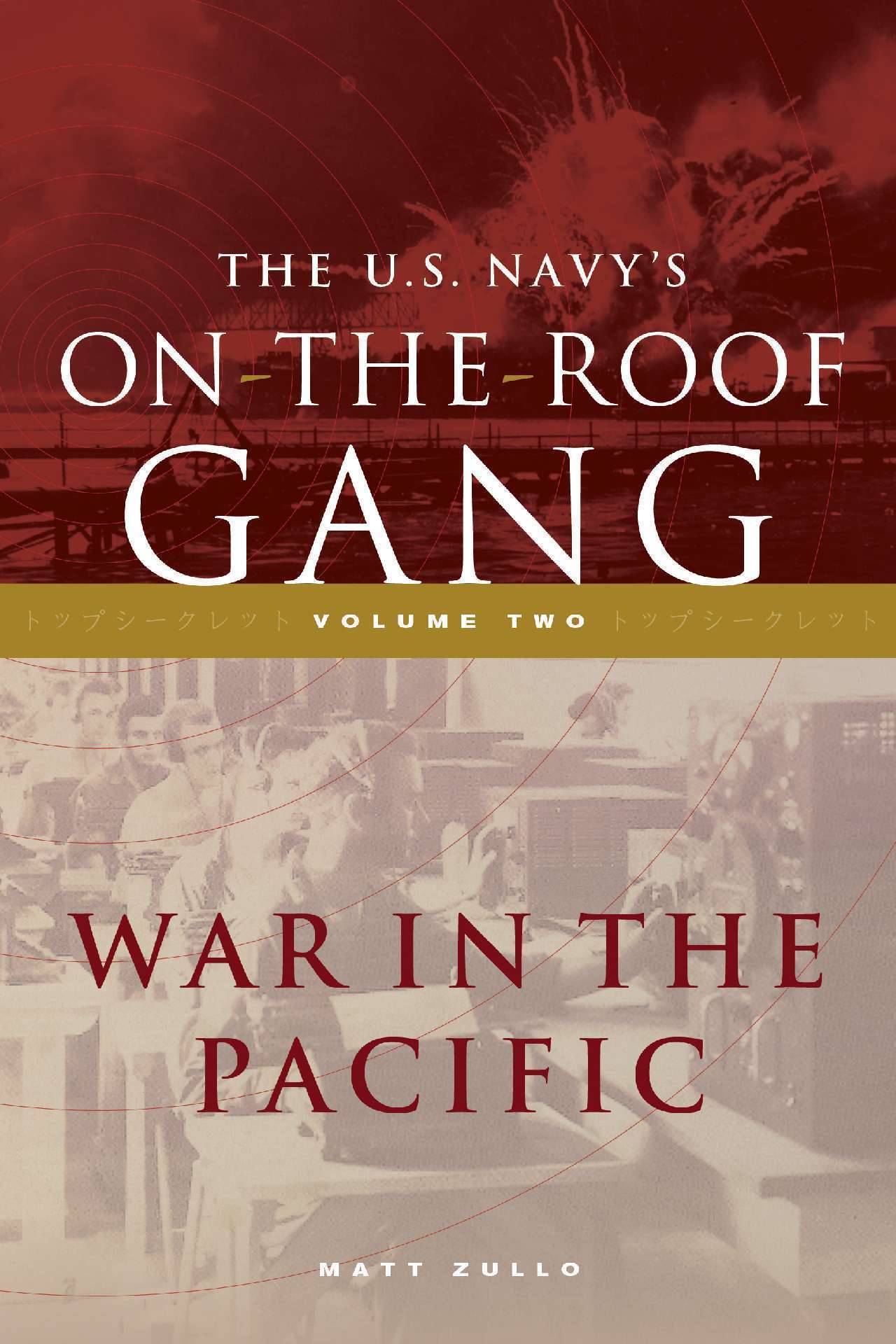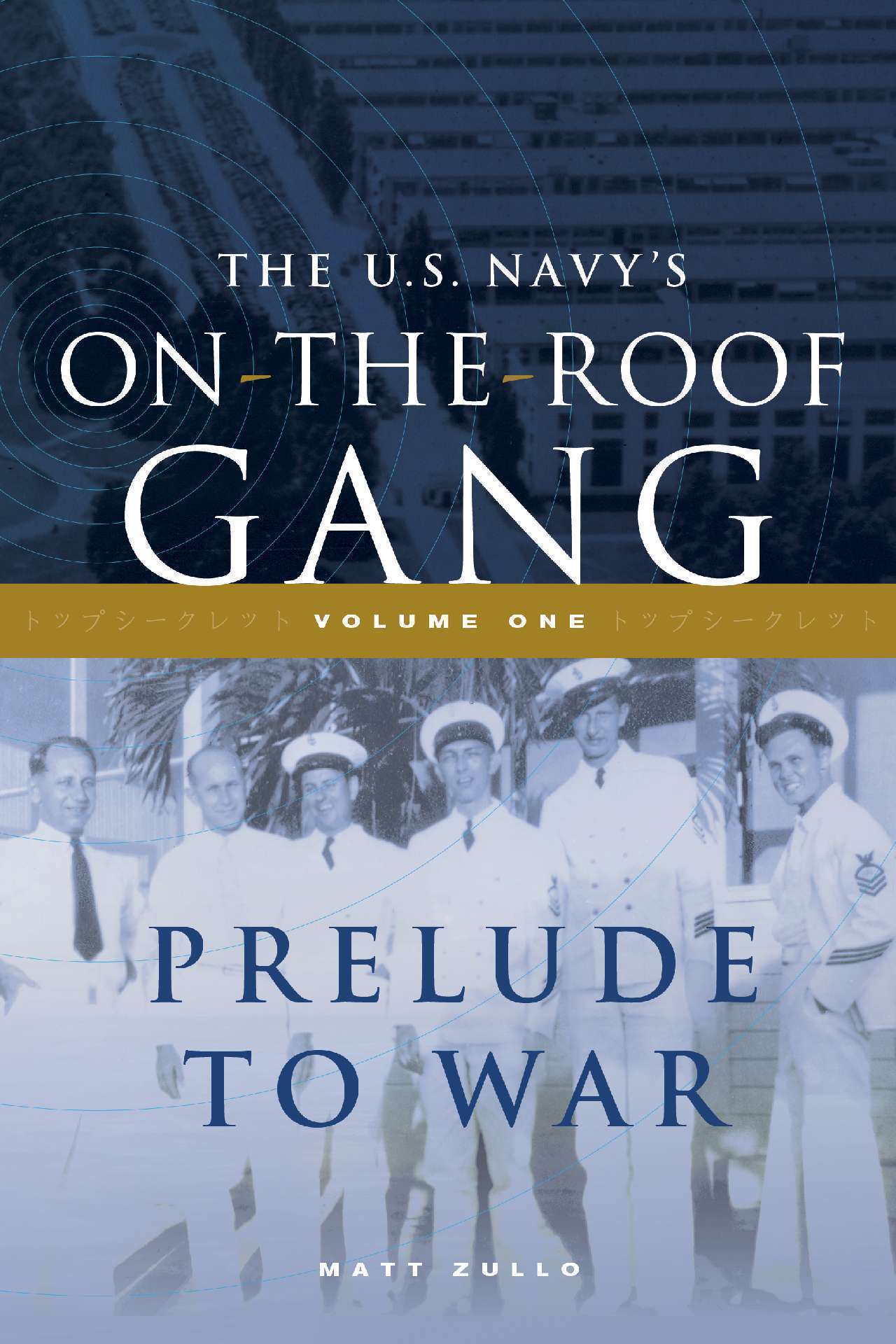


The US Navy’s On-the-Roof Gang, Volume 1 - Prelude to War - The On-the-Roof Gang 1
Formats: E-Book, Audio, Paperback, Hardback
Ages: 18+
THE US NAVY'S ON-THE-ROOF GANG: VOLUME I - PRELUDE TO WAR is a narrative nonfiction book based on the true-life story of the "On-The-Roof Gang," the U.S. Navy's fledgling radio intelligence organization in the years leading up to World War II. It is based on the real life of Harry Kidder, a U.S. Navy radioman who first discovered and deciphered Japanese katakana telegraphic code while stationed in the Philippines in the 1920s, discovering that he was listening to Imperial Japanese Navy (IJN) radio communications. Kidder strongly believed in the future of radio intelligence and a chance meeting with Lieutenant Laurance Safford led to the birth of the Navy's Radio Intelligence community. Kidder taught others the nascent art of intercepting IJN communications on the roof of the Main Navy Building in Washington, DC. From 1928 to 1941, 176 Sailors and Marines attended this training and were then stationed as radio intercept operators around the Pacific. These men would become known as the On-The-Roof Gang and were charged with keeping track of the IJN as they prepared for war with the United States. The circumstances of America's entry into World War II hinged on success or failure of the On-The-Roof Gang, and Harry Kidder knew this. On-the-Roof Gang: Prelude to War concludes with the "date which will live in infamy," December 7, 1941.
Reviews
It is the 1920s. Only a few years have elapsed since World War I when we're introduced to Petty Officer Harry Kidder, an experienced US Navy radioman stationed at one of the Navy's communication stations situated in the Philippines. Harry is an ingenious, self-driven radioman, and he likes radio so much that, besides being a career to him, he has also made it a hobby. Within the station, the radiomen's work was to communicate between ships and shore stations around the world using the international Morse Code, something he always did diligently. But, on that fateful day, during the course of performing his usual duties, Harry happened upon an unusually loud military radio signal that considering its uniqueness, instinctively heightened his curiosity. The combinations of “dits” and “dahs” he was hearing on that particular signal completely made no sense to him, as they were not part of the international Morse Code they were used to. Consequently, in the subsequent days, Harry spent several sleepless nights trying to figure out what that signal could be and how to decrypt it. He, therefore, gave himself a homework. Little did he know that the activities he were to later engage in would, in the process, lead to the birth of radio intelligence discipline within the US Navy. The US Navy's On-the-Roof Gang: Prelude to War by Matt Zullo takes us through how Harry, together with other self-driven, ingenious US Navy radio personnel, developed the fledgling field of radio intelligence, a contribution that later leveraged US forces against future external attacks. It is a gripping account of the US Navy and Marine Corps radiomen, “On-the-Roof Gang”, who, from scratch, trained themselves in intercepting Imperial Japanese Navy telegraphic communications as part of new radio intelligence prior to and during World War II. Among other things, we get to attend over-twenty-five classes with the “On-the-Roof Gang”, go with them to various intercept stations they established after their graduation, witness the hurdles they had to surmount during the course of serving their nation, and most importantly, celebrate with them the various achievements they made for the discipline. All this was done in an engrossing and entertaining way, and I greatly enjoyed this story, thanks to the author's outstanding storytelling ability. I loved every ounce of this book; it is excellent in all facets. I couldn't help but realize how gifted Matt Zullo is in storytelling. It didn't take me long to predict I would enjoy reading this novel, and enjoy it I did. The narration is vivid and descriptive, a feature that created for me long-lasting mental images of the scenes. The main characters’ background information is adequately given, the dialogues are natural and unstrained, the flow is fluid and consistent, the plot is suspenseful and engrossing, and most importantly, the characters’ emotions are exquisitely captured. Moreover, the amount of research the author devoted to this novel was evident, and that, together with the fact that the author ensured a historical accuracy in writing On-the-Roof Gang, make it an invaluable read for researchers and history enthusiasts. Additionally, I appreciated the author's inclusion of maps at various instances within the text as they not only acted as an excellent guide but also ensured an uninterrupted flow of the story. All this enhanced my enjoyment of this poignant novel. As a result, I really learned a lot about the “On-the-Roof Gang” and radio intelligence, in general, and so, will readers who like well-written, informative historical fiction. My favorite aspect of this book was the characters. They are interesting and well-developed, and therefore, I couldn't help but be attached to some of them. In particular, I liked the main characters Harry Kidder, Agnes Meyer, and Laurance Safford. They have extraordinary abilities, and most importantly, they all possess that persistent, innate drive. Their sheer commitment to the budding discipline of radio intelligence within the US Navy is something readers will openly see. As a matter of fact, these characters enhanced my concentration in the entire text, since I would patiently wait for the scenes they featured in. In turn, this not only facilitated my enjoyment of this novel but also kept me glued throughout my entire reading sessions. All in all, I didn't find anything to dislike about this book. I believe it was professionally edited since I found no single error. Therefore, I'm glad to award The US Navy's On-the-Roof Gang: Prelude to War by Matt Zullo 4 out of 4 stars, considering all those exceptional attributes. This novel is dedicated to both past and current US Navy radio personnel, and so, I highly recommend it for them. Moreover, fans of character-driven historical fiction, together with professionals in the fields of cryptology and radio intelligence, will also love this. This book has just a few profanities. That, coupled with the fact that there was no erotic content but just some instances of on-page kissing, make it suitable for a wide range of audiences. On the other hand, with the exception of those who are not into historical fiction, I can't find any person to caution against picking this.
Must read 🏆 A fascinating look at the beginnings of the U.S. Navy’s radio intercept and cryptanalytic program and the men that made it happen. SYNOPSIS THE US NAVY'S ON-THE-ROOF GANG: VOLUME I - PRELUDE TO WAR is an historical novel based on the unknown true-life story of the "On-The-Roof Gang," the U.S. Navy's fledgling radio intelligence organization in the years leading up to World War II. It is based on the real life of Harry Kidder, a U.S. Navy radioman who first discovered and deciphered Japanese katakana telegraphic code while stationed in the Philippines in the 1920s, discovering the he was listening to Imperial Japanese Navy (IJN) radio communications. Kidder taught others the nascent art of intercepting IJN communications on the roof of the Main Navy Building in Washington, DC. From 1928 to 1941, 176 Sailors and Marines attended this training and were then stationed as radio intercept operators around the Pacific. These men would become known as the On-The-Roof Gang and were charged with keeping track of the IJN as they prepared for war with the United States. The circumstances of America's entry into World War II hinged on success or failure of the On-The-Roof Gang, and Harry Kidder knew this. On-the-Roof Gang: Prelude to War concludes with the "date which will live in infamy," December 7, 1941. Matt Zullo’s new book, The U.S. Navy’s On-the-Roof Gang: Volume One – Prelude to War, was a fascinating and well-told story. The characters and events absolutely came alive – no dry-as-dust history lesson here. In fact, I was immediately ready to jump into the rest of the story in Volume Two! The book truly made for exciting reading seeing the creation of this secret, new unit with the mission of intercepting and analyzing the contents of the Japanese messages. I was amazed at the feat these guys accomplished just in being able to copy, report, and then convert to usable information the code they heard over great distances and under pretty rough conditions (both physically and atmospherically.) They were taking the ‘dits and dahs’ of encrypted Japanese and eventually translating it into English. I felt the frustration of these men as they struggled to gain support from those in Washington, DC and, sometimes, even at the various places they had established listening stations. I was shocked when the Secretary of State under Hoover, Henry Stimson, shut down the joint code-breaking organization of the U.S. Army and the State Department (leaving the only the Navy’s group in operation) saying “Gentlemen do not read each other’s mail.” One thing that made the events and history so much more interesting to me were the details that kept anchoring this story to what the world was like during this time. For example, at this time (the 1920s and 30s), telephones were not in every home or office. Households were still using gaslights as not everyone had been able to afford the transition to electric lights as yet. Aircraft carriers were relatively new ships in the fleet. I appreciated the look inside day-to-day naval operations as well. The author provides a nice and useful key to abbreviations at the end of the book, but there were also little tidbits of information regarding rank, duties, and duty stations worked into the story, too. I learned that there is a universal compartment-marking scheme, a letter-number designation which will tell you where a particular location is on board ship. I highly recommend this book to readers of non-fiction, historical fiction, World War II buffs, and ham radio enthusiasts. It was engaging, easy-to-read, and totally engrossing. I loved it! REVIEWED BY Karen Siddall
Retired radio intelligence officer Zullo combines years of technical expertise with a passion for his subject to craft the first of two volumes about a group of 20th-century Navy cryptologists. Called the On-the-Roof Gang because classes were held on the roof of a Navy building, the effort involved 176 men trained between 1928 and 1941. The radio operators learned techniques of transmission analysis involving Japanese katakana telegraphic code in order to intercept Imperial Japanese navy communications. The key figure in the narrative is Petty Officer Harry Kidder, who in June 1924 is a Morse code expert and Navy radioman in the Philippines. An eager and enthusiastic ham radio amateur, Harry discovers puzzling extra letters in transmissions while pursuing his hobby. Determined to decipher what he has noticed, Harry finds out from a Navy memo that the letters are part of the Japanese katakana alphabet. He then asks a friend’s Japanese wife for assistance. She helps Harry develop a “symbol, sound, and letter chart.” Several months later, Harry, now back in the U.S., meets Lt. Laurance Safford, a radio communications officer in Washington, D.C., assigned to look into Harry’s claims. Alongside the two men is the brilliant Agnes Meyer, working as a civilian in Navy communications, who comes up with the idea to establish a training program, and the On-the-Roof Gang is born. The tale proceeds chronologically, discussing developments in code-breaking techniques during the 1930s as well as military history. Other chapters delve into Harry’s personal life and problems, including an incident in Hawaii that leads to his forced retirement before Safford works to fully reinstate him to the “Research Desk” in 1940. The intriguing story picks up speed and tension toward the end, as Safford and Navy radio operators search for elusive “Winds Execute” messages that will provide evidence that shows what by then seems inevitable: “War with Japan was imminent and that the Japanese were likely to attack without warning.” While technically historical fiction due to the invented dialogue and scenes, Zullo’s book leans heavily toward nonfiction and will primarily appeal to readers interested in military history, code-breaking, and the war in the Pacific. The narrative sparkles with authenticity and is well organized and clear, enhanced by the judicious use of historical photographs and maps. But the inclusion of each of the 25 training classes tends to slow the dramatic pace. And while the fictional scenes are well crafted, Harry, Safford, and others remain primarily historical figures. Still, history buffs will appreciate the illuminating chronicle, which has been informed by archival sources, first-person accounts, and interviews with veterans. While some details could have been omitted to achieve a tighter story, the author’s firm grasp of events makes for a compelling read. Volume 2 promises to bring readers into the war. Kidder, affectionately known as Pappy, died in 1963 and was inducted into the National Security Agency’s Cryptologic Hall of Honor in 2019. An engaging tale of some little-known Navy cryptology efforts before World War II. (author’s note, list of abbreviations and acronyms)