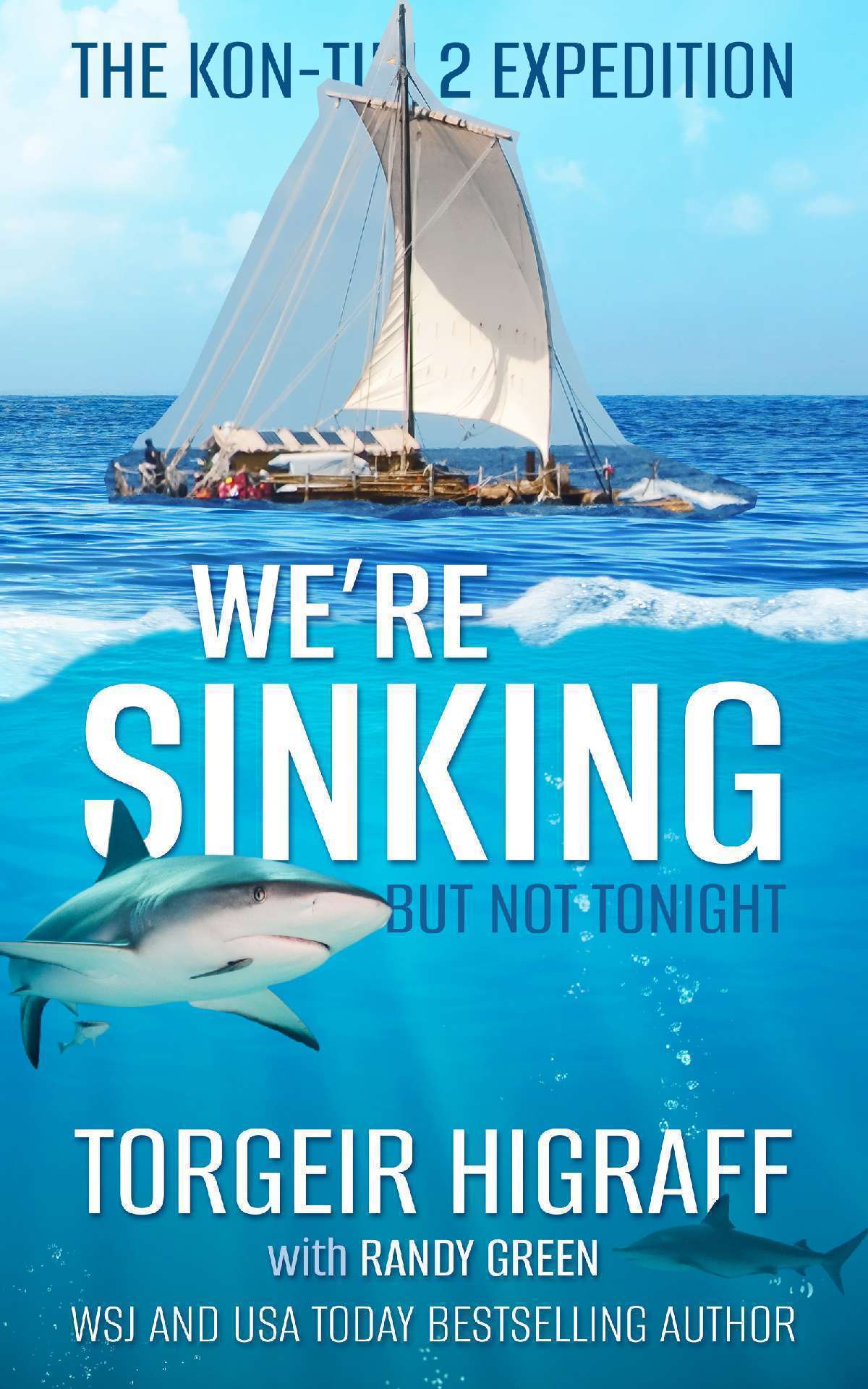
We're Sinking but Not Tonight
Formats: E-Book, Paperback, Hardback
Ages: 12-15, 18+
Narrative non-fiction account of Torgeir Higraff's 2016 Kon-Tiki 2 Expedition to sail twin balsawood rafts from South America to Easter Island... and back. Mission Impossible, they said.
UBL - https://books2read.com/Kon-Tiki2
Reviews
Excellent narration. An accurate description of the navigation and other facts surrounding this extraordinary life experience.
I write this review as a member of Rosie’s Book Review Team and thank her and the author for this opportunity. This book is a non-fiction account of a fascinating expedition that took place between 2015 and 2016, the brainchild of Torgeir Higraff, a Norwegian explorer who had long been fascinated by the original Kon-Tiki expedition, organised by Thor Heyerdahl, another Norwegian, in 1947: Heyerdahl was trying to prove his own theories about people’s migration between South America and Polynesia, and he managed to sail, on a raft, from Peru to Easter Island. Although many of his theories have been disproved since (and are very much of their time, and somewhat problematic when looked at from a modern perspective), the feat of sailing across the ocean in a raft, using primitive methods, was impressive, and resulted in a book, a film, and the raft became an exhibit in a museum. Higraff wanted to go further and do a round trip. Due to the weather, currents, and seafaring conditions, the second part of the journey was expected to be much more complicated than the first leg, and that is the part of the adventure the book focuses mostly on, although not exclusively. The book starts at a dangerous moment on the way back to Peru, and the description of the conditions these seven men are living in grabs the reader’s attention from the beginning. We also learn straight away where the title of the book comes from. As we read on, we hear about the process of planning, the search for sponsors and materials, the actual building of the two rafts (as it was decided that two rafts would be more likely to succeed, as they could support each other, undertake more experiments and collect more data), the Tupac Yupanki (the one we learn more about, as Higraff was travelling on it), and the Rahiti, with a female captain and several women in the crew. We also get to hear some stories about the first part of the journey, and we discover that much of the crew changed from one leg of the voyage to the other. The story is not told linearly, although we get an overall chronological account of the second part of the voyage. I was fascinated by the description of how different the societies and the regimes that developed in the two rafts were, with the Tupac being much more relaxed, with few rules and fairly spontaneous, and the Rahiti adhering to an almost military routine. We don’t hear directly from the Rahiti, but there are some temporary exchanges of crew members, so we get some indications of how things worked in the other raft as well. I am no expert in sailing, and I can’t say I understood all the terminology or the nautical details in the book, although it is evident that sailing on a raft is quite different from sailing aboard a ship. Higraff, who had experience of travelling by raft from previous expeditions, explains they had learned more about the techniques used by the traditional seafaring people from Peru, and they were also carrying different equipment from that the original Kon-Tiki had access to (GPS, Wi-Fi, access to internet and social media…). Not all had changed for the better, though. They were measuring plastics in the sea, which wasn’t a feature in times of Heyerdahl, and they soon realised that finding fish was no longer as easy as it had been in the late 1940s. There are great descriptions of life at sea, of the hardships they had to endure, of the foods they cooked, of how they slept (or not), and it did feel as if one was there, although I will try and find pictures and footage of the expedition, to see if my imagination matches what it must have been like. (I only had access to an e-book ARC copy, so I am not sure if there might be some extra material in the paperback copy.) Some of the information and anecdotes appear more than once because of the way it is told. Although it might feel slightly repetitive at times, it also gives readers a sense of how differently time passes in a raft, and how much time crew members dedicate to ruminate about how they got there and what will happen next, more so for the person who is ultimately responsible for the expedition and for deciding if the whole operation can carry on or should be called off. The ending is very far from Hollywood, as the author says, but it is fitting, and it leaves things quite open to those who might feel as inspired by this expedition as Higraff was by the original Kon-tiki. I recommend reading the section of acknowledgments, particularly those of Higraff, which I found particularly moving. This is especially true when he explains why it took him so long to write the book and mentions how he coped with what he was told was a traumatic experience. It must have taken a lot of courage to relive the experience and his feelings about it, and that enhances the importance of this book. An incredible adventure that teaches us as much about the people on the expedition and the human spirit as it does about the ancient civilizations that crossed the seas long ago. Fascinating.
This is a terrific book, taking you along with an international crew on a perilous journey from South America across the Pacific to Easter Island (recreating the first Kon-Tiki voyage), and then attempting a return journey. You get to know the crew and their teamwork as well as conflicts, in an unforgettable story. Recommended.