So You Want To Be A Scientist - So You Want To Be A... 21
Formats: E-Book, Paperback
Ages: 8-11, 12-15
A scientist is not the person with all the answers — a scientist is the person who cannot stop asking the questions.
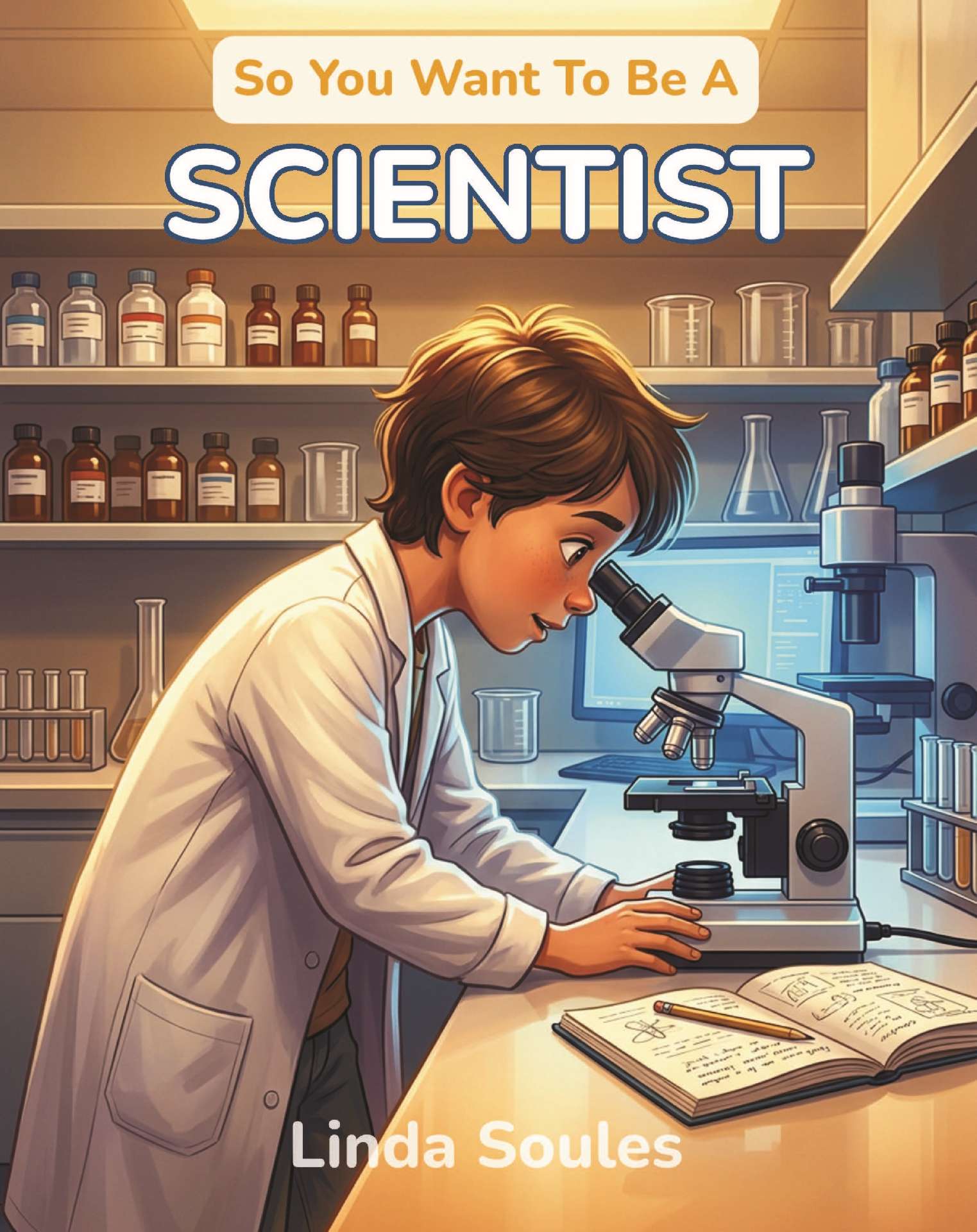
So You Want To Be A Scientist is an illustrated guide for curious kids ages 10–14 who want to know what it really means to pursue a life in science. Not the simplified version. The real one — with all its rigor, its wonder, and its hard-earned rewards.
Young readers will learn how scientists think, work, and discover. They'll follow the full journey from forming a hypothesis to designing experiments, analyzing data, and sharing findings with the world. They'll see how a single well-formed question can open doors that no one knew existed — and how a poorly formed one, no matter how brilliantly pursued, leads nowhere. That distinction matters, and this book takes the time to explain why.
The science careers explored here span biology, chemistry, physics, neuroscience, climate science, and more. Each field demands its own blend of creative imagination and intellectual discipline. Readers will meet the remarkable scientists throughout history whose questions — and whose courage to follow the evidence wherever it led — reshaped our understanding of everything from cells to stars.
This book also tells the truth about what the work requires. The experiments that fail before one succeeds. The peer review process that holds every claim to a standard before it earns the name of knowledge. The teamwork among researchers, statisticians, and fellow scientists that turns one person's discovery into something the whole world can build on. It's demanding, sometimes frustrating, and deeply rewarding in a way that nothing else quite matches.
Written with honesty and warmth, this illustrated nonfiction book treats its young audience as the thinkers they are. It doesn't gloss over the difficult parts or dress up the science in costumes. It brings children all the way inside the work and lets them decide for themselves whether this might be their calling.
For every kid who needs to know why things work the way they do. For the one whose curiosity runs deeper than any textbook can satisfy. The next great discovery starts with a question — and someone brave enough to chase it.
Reviews
For parents of curious 10-12 year-olds, So You Want To Be a Scientist is the rare science book that feels inspiring and rigorously grounded. It doesn't talk down to kids; it trains their 'why?' into a habit of noticing, testing, and thinking clearly. Soules begins where kids actually live: questions about the sky, seeds, and dreams. From there, she eases them into the real work—make a guess, test it, write it down, and try again—without turning it into a lecture. The real-world examples (penicillin, the microwave, Kevlar, the 'Wood Wide Web') are the kind that stick and make kids want to tell you about them later. What I liked most is that it pushes the curiosity off the page: start a notebook, try small experiments at home, and treat 'that didn't work' as part of the process. Soules has a friendly, confident voice and she explains big ideas without making them feel 'school-ish.' The pages move quickly, and it's easy to stop after a section and talk—exactly what you want with this age group. I also appreciated how she normalizes mistakes and keeps circling back to honesty and responsibility ('can we?' vs 'should we?'). The only quibble is that a couple of list-heavy stretches may slow down kids who prefer more narrative flow. In our house, I'd hand this to a kid who loves asking 'why?' and doesn't want the conversation to end. Dip in a few pages at a time, and expect it to spill into real life—kitchen experiments, notebook scribbles, and better questions. That's the point.
Did you know that anyone can be a scientist? All you need is to be curious about the world around you. In So You Want To Be A Scientist, author Linda Soules shows what it entails to be a scientist. Many scientists stumbled upon some of the most important discoveries in history by trying to figure out what went wrong. Scientists work in various environments, including the laboratory and the field. They gather data, conduct experiments, analyze the results, check for errors, consult with colleagues, and write down their findings so others can evaluate them and build upon their research. This picture book highlights the tools of their trade and takes you through a day in their life. You will also learn about some of the famous scientists in history. So You Want To Be A Scientist doesn't just cover the fundamentals of being a scientist; it also delves into the different types of challenges scientists face throughout their careers. Author Linda Soules has done a fantastic job with the 'So You Want To Be A...' series of picture books so far. And this book continues to be as informative, engaging, and fun as the previous installments. Children will find it both educational and entertaining. Soules sets a similar narrative pattern as the rest of the books, highlighting the career, the tools of the job, its unique challenges, and a day in the life of the professionals. I have enjoyed every book in this series, and this one follows the trend. It's a must-have on the bookshelf for anyone with children.