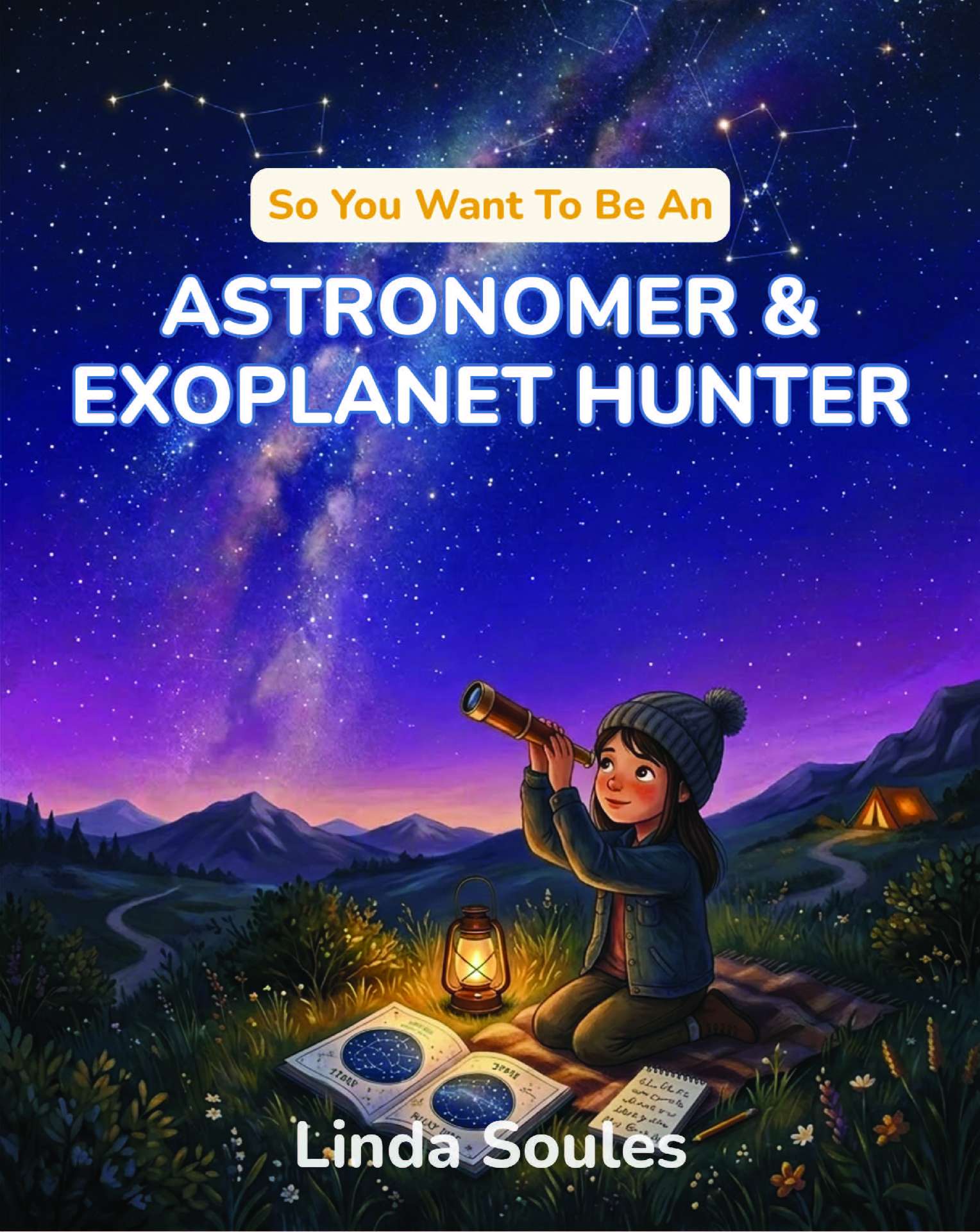
So You Want To Be An Astronomer & Exoplanet Hunter - So You Want To Be A... 34
Formats: E-Book, Paperback
Ages: 5-8, 8-11, 12-15
The telescope clicks into position. The data starts flowing in — a star's brightness, recorded thousands of times over thousands of nights. Most of the readings are flat. But every so often, the light dips by a fraction of a percent for a few hours and then returns to normal. To anyone else, it would look like noise. To the astronomer watching the screen, it's the shadow of a planet — a world no human has ever seen — passing in front of its star, hundreds of light-years away.
So You Want To Be An Astronomer / Exoplanet Hunter takes young readers ages 10–14 inside one of the most patient and most genuinely revolutionary professions in all of science — not the dramatic-discovery version, but the real one. The years of physics and mathematics that happen before an astronomer ever points a telescope at the sky. The specific discipline of finding new worlds by measuring changes in starlight so small the eye could never detect them, and trusting the math to show what the eye cannot. The team of observers, instrument scientists, and theorists working in coordination so that a signal lasting a few hours and crossing hundreds of light-years arrives in a dataset clean enough to interpret. The detection that confirms a new planet — and the one that, after months of analysis, turns out to be a flicker in the instrument and sends everyone back to the data.
This is a book about what astronomers actually do: the long observation runs they plan years in advance to gather light from objects so distant the photons left before humans existed, the spectroscopy they use to read the chemical fingerprints of stars and atmospheres and learn what worlds are made of without ever visiting them, the data analysis they perform on tens of thousands of stars at once to find the rare few showing the dimming of a transiting planet, and the careful follow-up across multiple instruments to make sure a discovery is real before announcing it. It's also a book about what the work demands, what it offers, and why the people who do it say that the most thrilling moment in science is not certainty but the quiet instant when the data first suggests something is out there.
Inside, young readers will discover:
What a real astronomer's research and observing life actually looks like — from telescope time proposals to night-sky data collection to the long process that turns raw light into discovery
The science of how we find exoplanets — transits, radial velocity, direct imaging, gravitational microlensing — and the physics that makes detecting worlds light-years away possible
The intellectual demands the profession requires — and how astronomers build the mathematical fluency, the patience, and the scientific imagination to meet them
The history of astronomy and the legendary scientists whose curiosity and persistence opened the universe to human understanding
What young people can do right now to discover if this might be their calling
Honest, specific, and genuinely illuminating, So You Want To Be An Astronomer / Exoplanet Hunter doesn't talk down to young readers — it brings them all the way in. Because the child who wants to know what this work is really like deserves a real answer.
For readers who feel the pull toward something that demands total mathematical rigor and total imaginative reach in the same breath. For the kid who looks up at the night sky and doesn't just feel the wonder — they immediately wonder what's out there, and how we could possibly know.
Every confirmed exoplanet, every mapped galaxy, every new understanding of the universe began with someone who turned curiosity into a discipline. Who learned the math, mastered the instruments, and waited for the light. Maybe that someone will be you.
Ages 10–14 · Nonfiction · Science & Nature · Illustrated