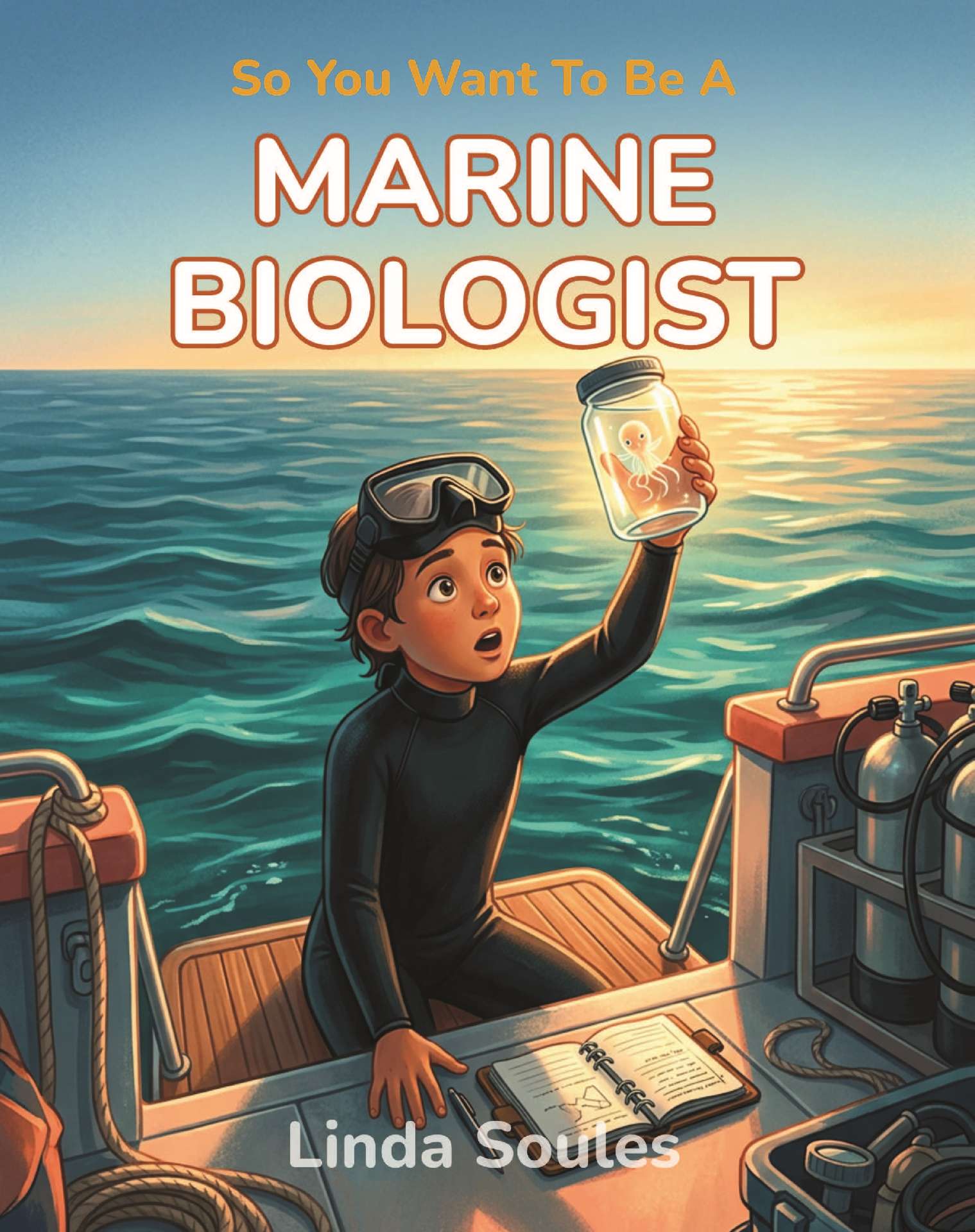
So You Want To Be A Marine Biologist - So You Want To Be A… 7
Formats: E-Book, Paperback
Ages: 8-11, 12-15
Seventy-one percent of this planet is ocean, and most of it has never been seen by human eyes. If your kid has ever stood at the water's edge and wondered what lives beneath the surface — and whether they could be the scientist who finds out — this book was written for them.
So You Want To Be A Marine Biologist is an illustrated nonfiction guide for young readers ages 10 to 14 who are ready to learn what this career actually looks like — not the glossy documentary version, but the real thing. The years of science classes before the first research dive. The patience required to observe animals in an environment that was never built for human bodies. The teamwork between marine biologists, data analysts, divers, and conservationists working to understand a world that covers more of this planet than all its land combined.
Each chapter brings kids deeper into the daily reality of marine biology — from mapping coral reefs and monitoring ocean ecosystems to cataloging sea creatures and studying the connections between species that scientists are still working to understand. Young readers will discover how marine biologists conduct laboratory research and open-water fieldwork, what it means to live and work aboard a research vessel for weeks at a time, and why precise, patient observation matters more than any piece of equipment.
But this book goes beyond the adventure of exploration. It tackles the urgent science of ocean conservation — why coral reefs are disappearing, how pollution threatens sea life, and what marine scientists are doing right now to protect the ecosystems our planet depends on. It also addresses the physical demands and intellectual rigor the profession requires, honestly and without talking down to its audience. Kids who are curious about biology and drawn to the ocean deserve real answers about what this path takes, and this guide gives them exactly that.
Along the way, young readers will learn what they can do right now to explore marine science — the habits, the curiosity, the action steps that help a kid who loves the ocean figure out if this calling is truly theirs. Because the best time to start thinking like a marine biologist is long before you ever set foot in a lab or pull on a wetsuit.
The ocean still holds more questions than answers. And somewhere out there is a young scientist who will spend a lifetime chasing what we don't yet know. This book is where that journey begins.
Ages 10-14. Illustrated nonfiction. Careers, science, and the sea.
Reviews
Did you know that almost every living thing on Earth traces its roots to life in the ocean? In Linda Soules's So You Want To Be A Marine Biologist, many interesting facts will astound you and make you want to look deeper beneath the water's surface. There's a lot to be seen underwater. There are sea creatures that live and breathe deep beneath the water's surface. And many wonderful and inspiring plants grow on the ocean floor. But that's not all. The ocean covers seventy percent of Earth's surface, provides us with oxygen to breathe, controls the weather, and feeds us. What more could you ask for? Considering the ocean's importance, it is essential to take care of it, which we're not doing very well. Pollution is threatening life in the ocean. But there is hope. Marine biologists study the ocean and find ways to rejuvenate what might otherwise become extinct before it's too late. Would you like to be a marine biologist and make a difference to ocean life? In Linda Soules's So You Want To Be A Marine Biologist, young readers will learn about the ocean as well as those dedicated, highly trained scientists, marine biologists, who study and work to preserve a precious part of our lives and well-being. This is a thoroughly detailed book that will inspire young readers to consider this career path, or at least, to interest and educate them on the importance of the ocean and what lives within. The illustrations are superb and add another dimension to the research material. The book is well organized and presented in a manner that will interest young readers. The book concludes with interesting tidbits, like important qualities of a marine biologist, information on some famous marine biologists, some fun facts, and a list of things you can do now to prepare yourself for this potential career path. A fascinating and informative read.
So You Want to Be A Marine Biologist is the kind of children's nonfiction book that immediately pulls young readers in and makes them want to know more. It's officially written for ages 10-14, but honestly, I can see it working for curious younger kids, older teens thinking seriously about careers, and even adults who just love learning cool things about the ocean. What makes this book stand out is that it doesn't just say, 'Marine biologists study the ocean.' It actually shows what the job feels like. Readers get a real look at the work behind the wonder: early dive briefings, research vessels, lab work, data analysis, coral bleaching, ocean conservation, and the patience it takes to study animals and ecosystems that don't operate on human schedules. The book does a great job balancing excitement with honesty. Yes, marine biology sounds adventurous and fascinating, but the book also talks about the harder parts, like cold water, seasickness, failed hypotheses, grant rejections, long waits for funding, and the physical and mental demands of the job. I appreciated that because it gives kids a fuller picture of the career instead of just presenting the fun, shiny version. The illustrations are another huge strength. They are colorful, vivid, and engaging, with images of ocean life, divers, reefs, deep-sea creatures, and research vessels that make the subject feel big and alive. The visuals make the book especially appealing for younger readers who may not read the whole thing independently yet but will absolutely linger over the pictures and absorb a lot along the way. My favorite scenes were the ones where divers were under the water. Those scenes looked magical. I also liked how well the book is organized. The short sections, glossary terms, fun facts, 'day in the life' style details, equipment explanations, and next-step suggestions make the information easy to follow. It gives kids practical ways to explore whether marine biology might be something they want to pursue, which is such a smart addition. I keep leaning on the word 'practical' when writing this review, but I think, overall, that's what this book really is: it's practical. Most career books for kids simply explain what a job is. This one goes further. So You Want To Be A Marine Biologist is a beautifully illustrated, thoughtful, and genuinely inspiring book for any child who loves the ocean, animals, science, or big questions about the world. It's informative without being boring, honest without being discouraging, and exciting without oversimplifying the work. This is definitely a book kids can return to again and again as they grow. Highly recommended for ocean-loving kids, future scientists, and any young reader who has ever stood at the edge of the water and wondered what is out there.
Linda Soules's 'So You Want to Be a Marine Biologist' serves as an essential, practical primer for middle-grade readers. The book's primary strength is its ability to balance the inherent wonder of the ocean with the rigorous reality of scientific labor. Soules begins by establishing the high stakes of oceanography: the ocean produces the majority of our oxygen and regulates our climate, yet it remains largely unmapped. She effectively redefines the marine biologist, moving beyond the trope of a simple 'ocean lover' to frame them as a vital scientist tasked with managing Earth's most critical life-support system. Soules categorizes the field into distinct specialties, ensuring readers understand that 'Marine Biology' is an umbrella term for a network of roles: monitoring biodiversity and bleaching; exploring high-pressure zones using Remotely Operated Vehicles (ROVs); and managing the intersection of human activity and mangroves/seagrass. A significant portion of the book is dedicated to the instructional 'how-to' of the job. Soules meticulously lists the tools of the trade, categorizing them by their function in data collection. The text excels in its 'Day in the Life' instructional segment. This section serves as a procedural guide, breaking down the workday into: Briefing: Defining objectives and safety protocols; Observation: Executing transect surveys and fish counts; Documentation: The transition from underwater observation to lab data entry; and Analysis: Understanding how bleaching at a deep-water site dictates future conservation policy. Soules provides a clear-eyed look at the constraints of the profession. She delineates between the public perception (discovery and adventure) and the professional reality (seasickness, equipment failure, and the constant hunt for grant funding). Key instructional features including scientific terms (e.g., transect, hydrophone, bleaching) are introduced in context with clear definitions. Standard operating procedures outline the importance of safe diving, careful note-taking, and mechanical problem-solving. Lastly, the concluding chapters shift from the 'what' to the 'how.' Soules provides a roadmap for the aspiring scientist, emphasizing that the path begins long before university. She provides actionable pathways, a checklist for the reader, turning abstract interest into a series of 'First Steps,' such as keeping a field notebook and practicing snorkeling. By highlighting icons like Sylvia Earle, Jacques Cousteau and Eugenie Clark, Soules connects the reader to a lineage of explorers who combined scientific discipline with a deep, emotional commitment to the sea. 'So You Want to Be a Marine Biologist' is an empowering STEM resource. It successfully demystifies a complex field, replacing a 'distant dream' with a concrete, actionable career path. It is ideally suited for classroom units on ecosystems or career-focused nonfiction collections, successfully transitioning the reader from a curious observer to an informed aspirant.