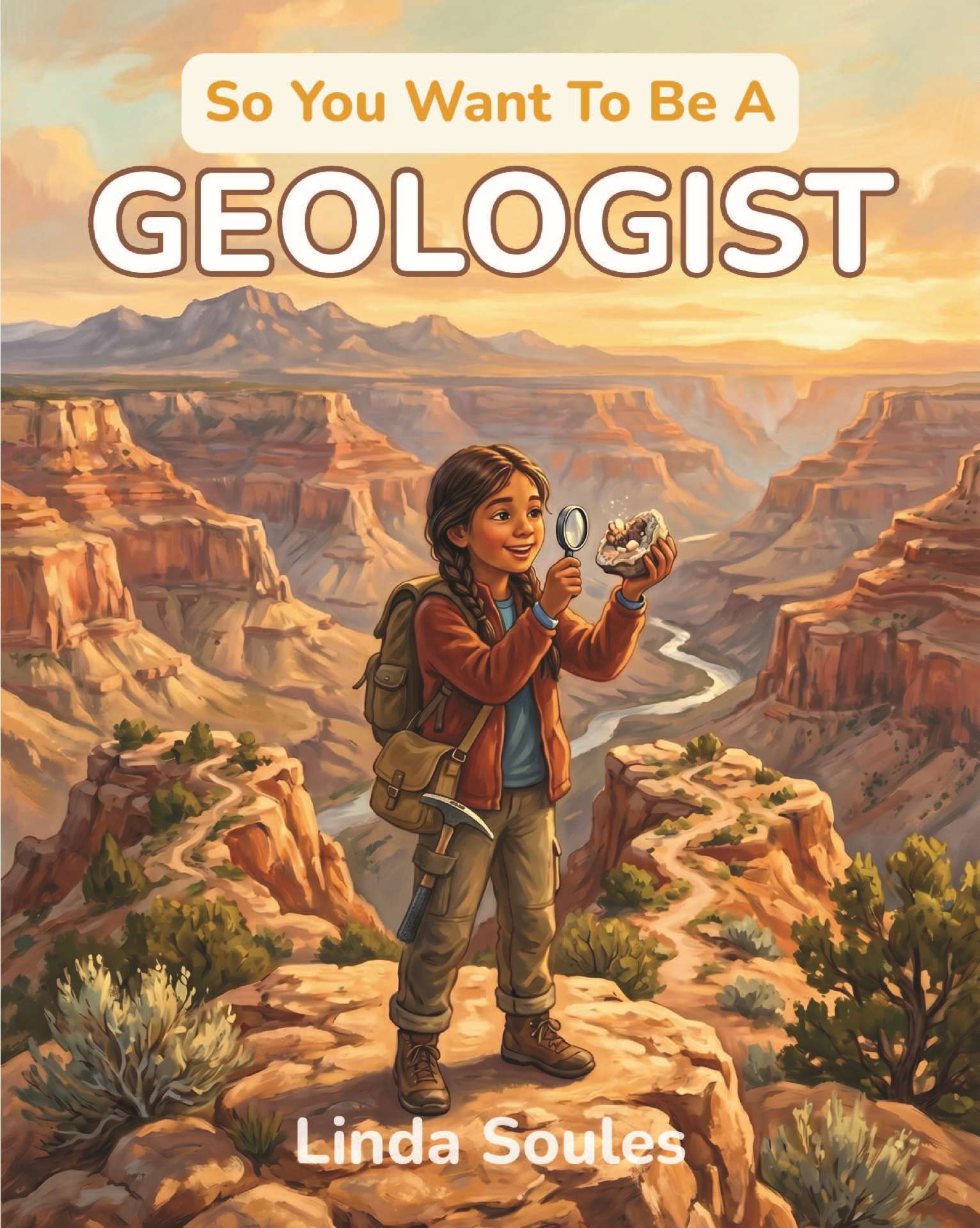
So You Want To Be A Geologist - So You Want To Be A... 50
Formats: E-Book, Paperback, Hardback
Ages: 5-8, 8-11, 12-15
From the So You Want To Be A… Series — 2026 Purple Dragonfly Book Awards, Grand Prize Winner
The ground beneath your feet is moving right now. A geologist is the person who can read what it's doing.
Some kids can't walk past an interesting rock without picking it up. Some look at a cliff or a canyon and wonder how it got there and how long it took. This book is for them.
So You Want To Be A Geologist is a beautifully illustrated Earth science and career exploration book for kids ages 10–14 (and a favorite of curious 8- and 9-year-olds who love to read alongside a parent). Part of the acclaimed So You Want To Be A… series of STEM books for young readers, it treats kids seriously and hands them the real texture of a geologist's life: the wonder, the spectacular field days, and the honest hard parts, too.
Inside, young readers learn to see a cliff as a clock and to grasp the astonishing scale of deep time. They explore the three kinds of rock—igneous, sedimentary, and metamorphic—travel to the molten core of the Earth, and pick up the simple tools of the trade: the rock hammer, the hand lens, and the geologic map. They shadow a working geologist through a real day in the field, from pre-dawn coffee to a puzzling rock that changes everything.
Kids discover the many careers hidden in one word—volcanologist, paleontologist, seismologist, hydrogeologist, and planetary geologist—and learn how geologists keep people safe from earthquakes and eruptions, find the clean water and minerals a civilization depends on, and read the planet's climate record. They meet three real scientists whose stories capture the heart of the science: James Hutton, Mary Anning, and Inge Lehmann.
Packed with jaw-dropping facts about volcanoes, fossils, dinosaurs, plate tectonics, crystals, and minerals—floating rocks, petrified lightning, crystals the length of a school bus—the book closes with a kid-friendly glossary, honest guidance on what the job takes, and resources for where the adventure goes next.
A meaningful gift for rockhounds, future scientists, and curious minds, and a wonderful addition to any homeschool or classroom Earth science shelf. Meeting readers eye to eye, this is an invitation to look closely, stay curious, and never let anyone tell them a pocket full of rocks is a childish thing.
Reviews
So You Want To Be a Geologist by Linda Soules is a clear, inviting career guide that treats young curiosity about rocks and the Earth with real respect. Families, teachers, and librarians looking for a thoughtful way to open science careers with kids ages eight to fourteen will find this title worth sharing. Reading this with a young rock collector in mind, I found a full guide to the geologist's world. The book takes on deep time, field mapping, the three rock families, plate tectonics, and the everyday tools of the hammer and hand lens. It does not skip the hard parts either: missing pages in the rock record, slow lab work, and long days outdoors. It also explains how geologists help find water, watch volcanoes, and judge where it is safe to build. For parents, those sections make easy entry points when a child comes home with another pocket of stones or asks how a canyon got there. Soules writes in a calm, conversational voice that never talks down to young readers. She keeps big ideas clear without sounding stiff, and she stays honest about both the wonder and the difficulty of the work. The book also includes illustrations that help children see the tools, rock types, and fieldwork up close. As part of the So You Want To Be... series, Geologist has the steady, respectful tone that works well for shared reading. This guide turns early curiosity into a serious invitation. It is a strong pick for shared reading and for independent readers ready to think about what it means to study the Earth with care.
ave you ever picked up a rock and wondered where it came from? So You Want to Be a Geologist by Linda Soules is a non-fiction children's book that introduces readers to a career that goes far beyond collecting stones. Soules explains that a geologist is a scientist who studies the Earth. This professional gets to uncover its long history by reading the clues hidden in rocks, mountains, rivers, and more. Not only do kids learn what a geologist is, but they also discover where the word geology comes from. Young readers get a behind-the-scenes look at where they work, the tools they use, and a typical day on the job. The many specialties within the field, like studying earthquakes, searching for minerals, and protecting water supplies, are also detailed. Plus, Soules breaks down the three main types of rocks and what's below the Earth's surface. The guide even highlights both the rewards and the challenges of the profession. At the end, there are sections on notable geologists from history, surprising facts, and a helpful glossary of terms. So, do you think you have what it takes to become a geologist? I've now read several books in Linda Soules' So You Want to Be... series, and So You Want to Be a Geologist may be my favorite yet. I learned so much, especially about where the word geology comes from and how much thought, observation, and problem-solving this job involves. Before reading it, I didn't realize how important these scientists are in keeping people safe, protecting resources, and helping us understand our planet. I also loved that Soules chose to highlight women in geology. Finding out about pioneers like Mary Anning and Inge Lehmann made the occupation feel even more welcoming to young girls who may dream of working in science one day. I'd happily use this title during a careers or Earth science unit. Students could bring in rocks to identify, compare the different rock types, discuss why geology matters in everyday life, or keep their own 'geologist's journal' while making observations outside. The bright illustrations complement the text perfectly. My favorites are the ones showing the women geologists working in the field because they quietly reinforce that this role is open to everyone. Those who enjoy books about science, nature, exploration, and careers they may not have considered before will want to pick this one up. Geologist Florence Bascom said, 'The fascination of any search after truth lies not in attainment, but in the pursuit.' That quote captures the sense of wonder running through this guide, and it's one I'd gladly recommend for homes, schools, and libraries.
So You Want To Be A Geologist is an engaging and informative introduction to geology for young readers. A Grand Prize winner in the 2026 Purple Dragonfly Book Awards, the series is especially well suited for children ages 10-14, although younger rock lovers may also enjoy reading it with an adult. It invites readers to look more closely at the ground beneath their feet and discover how rocks, cliffs, fossils, and minerals reveal the history of our planet. The book clearly explains important geological concepts without overwhelming its audience. Readers learn about igneous, sedimentary, and metamorphic rocks, the layers of the Earth, plate tectonics, volcanoes, fossils, crystals, and deep time. It also introduces the tools geologists use, including rock hammers, hand lenses, and geologic maps. One of the book's strongest sections follows a geologist through a typical day in the field, giving children an honest and exciting picture of what the work actually involves. Another strength is the book's exploration of geological careers. Young readers are introduced to volcanologists, paleontologists, seismologists, hydrogeologists, and planetary geologists, along with famous scientists such as James Hutton, Mary Anning, and Inge Lehmann. The book shows that geologists do much more than study rocks: they help locate clean water and valuable minerals, understand climate history, and protect communities from earthquakes, eruptions, and other natural hazards. Its beautiful illustrations complement the text and make the scientific information easier and more enjoyable to understand. I recommend this book to children who love rocks, fossils, dinosaurs, volcanoes, or science in general. It is thorough and educational, yet it never feels like a dull collection of facts because it speaks directly to readers and shares the passion and curiosity of real geologists. The fun facts, career guidance, glossary, and additional resources may inspire children to continue learning, and perhaps even ask for their own geology tools. Whether or not a reader plans to become a geologist, this book offers a fascinating new appreciation for the Earth and the stories written in stone beneath our feet.