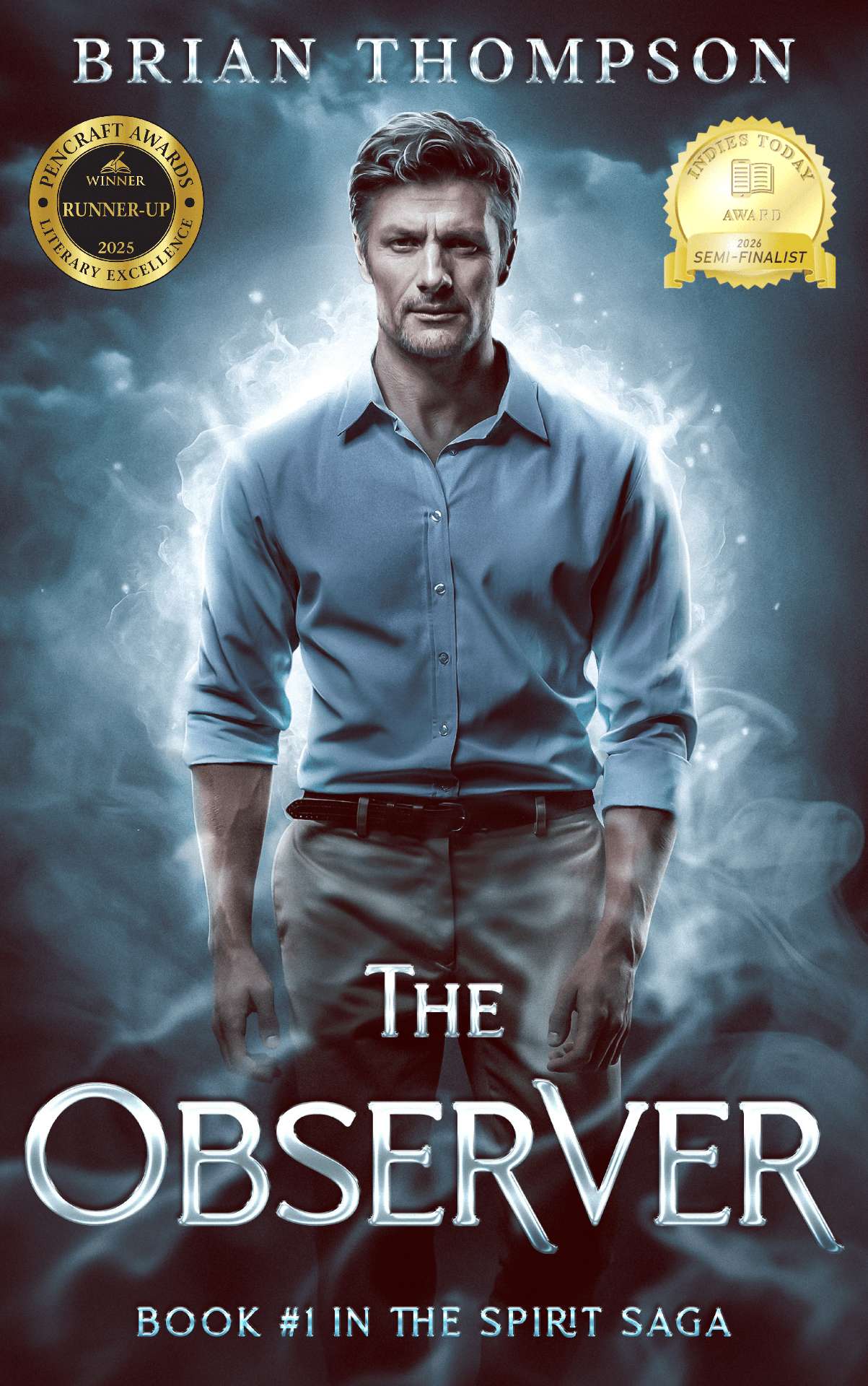
The Observer - The Spirit Saga 1
Formats: E-Book, Paperback, Hardback
Ages: 18+
Most cultures tell stories about what happens after you die, but what if they're all wrong? What if there's no Heaven, no Hell, no reincarnation? What if consciousness continues in a way no one expected?
Frank awakens in darkness. No memories of where he is, how he got here, or even who he is. As his vision returns he finds himself in a hospital room that is frozen in time. As he examines the room, he finds out that the man laying dead in the hospital bed, is him.
Follow Frank on a journey through a fantastical afterlife filled with time travel, gladiator flights, a murder mystery, and a spiritual cold war where both sides are trying to recruit Frank, but all he wants to do is watch over and protect the family he left behind.
Indies Today Recommended, Runner-Up Best Paranormal Fiction of 2025 by the PenCraft Book Awards.
Reviews
The Observer: Book 1 in the Spirit Saga is a gripping supernatural fantasy and the first book in the "Spirit Saga" series by Brian Thompson. Told through a surreal, out-of-body experience, it tells the story of Frank, a 42-year-old middle school teacher who wakes up in a dark, empty space with no memory of who he is or how he got there. As the story unfolds, Frank comes to the startling realization that he has died and become a spirit. We see him caught up in a frozen moment in time in a room where a doctor is using defibrillators on his body, a nurse is crying, and his wife Angela and son Franklin Jr. are grieving, as he lies motionless in a hospital bed. But just as Frank begins to accept his fate, a mysterious figure bathed in orange light appears suddenly appears, interrupting Frank’s spiral of confusion and grief. Though he looks like a teenager, the figure, named Michael, claims to be over 4,000 years old and what he reveals shatters everything Frank thought he knew about death, purpose, and the afterlife in a twist that changes everything. Michael identifies himself as a Guide whose job is to help new spirits, like Frank, figure out what the afterlife is all about. He profoundly and patiently explains that death isn’t really the end, but more like the start of something much bigger, which, as you can imagine, completely throws Frank for a loop. Michael furthermore informs Frank that he is now an Observer, a spirit whose role is to watch the world quietly and sometimes help the living not directly, but through tiny nudges, gut feelings, or flashes of intuition that will gently push people in the right direction. He also teaches Frank how time doesn’t behave the way it used to, how energy fuels everything in this new realm, and that there are other spirits out there, some kind and others terrifying, including Demons who thrive on pain and suffering. These revelations are like nothing Frank ever gave thought to when he was alive. Soon, we see him begin to understand that the world he’s entered is not only more complex than he ever imagined, but it’s also filled with danger, mystery, and a purpose he never expected to have. As Frank trains under Michael’s watchful eye, he begins to unlock abilities he never imagined such as glimpsing the future, slipping through time, even influencing the thoughts and emotions of the living. But every act of intervention and great power comes a painful cost. Every time Frank taps into his spiritual abilities, whether it's offering a subtle nudge to the living, sharing his energy to protect someone, or confronting a dark force, he draws from the very essence that keeps him anchored in the afterlife. Too much, too fast, and he risks fading away entirely, a second and final death that not even Michael can stop. Frank learns this the hard way when he hears the story of James, Michael’s first student, who burned out after giving too much of himself to save a soul from a Demon. It's a turning point for Frank, forcing him to weigh his compassion against survival, even as a desperation to help grows. The deeper he dives into his role as an Observer, the more he begins to question the system he has now become part of. We see him question why some spirits are chosen to guide, while others are twisted into demons as well as who are the Gods that built these rules in the first place. When whispers of rebellion stir among the spirits and a forbidden truth about his own past threatens to unravel everything, Frank is forced to choose either to stay within the lines of cosmic order, or risk everything to rewrite the fate of the afterlife itself. This is a unique story that creates a different version of the afterlife, one where spirits are portrayed as emotional beings with jobs to do and roles to undertake. It’s a fresh take that moves away from traditional beliefs about the spirit world as floating around or haunting people and builds something both imaginative and meaningful. One of the strongest elements in the story is its use of time travel—not just as a gimmick, but as a smart, well-explained tool that helps the reader explore the limits of spiritual power and the value of patience. Even though the story is full of supernatural elements, its heart is very human, captured through flashbacks that are touching, and which give the story a strong emotional base. Brian Thompson’s writing style makes this book a really smooth read, the language is clear and never tries too hard, the pacing moves along quickly, and the dialogue feels like real conversations you might overhear even in the middle of all the supernatural stuff. The protagonist's thoughts are a major highlight: he’s funny in a dry, sarcastic way that brings some lightness to even the heaviest moments, and that humor makes him incredibly easy to relate to. What really stands out is how detailed the world-building is, and how it never overwhelms you with information. You get to learn about the spirit world slowly, naturally, as the protagonist learns it himself through his conversations with Michael. And even when the book takes time to explain the spirit rules or the cost of powers, it always breaks that up with either some strong emotion or action, so you never feel bogged down by it. Various scenes are unforgettable such as where a young slave is forced to fight a massive, demon-controlled warrior in a brutal arena match, and another Observer is trying to help but things don’t go as planned. But beyond the action and the spiritual battles, the book is filled with emotional truths that stick with you such as how grief and guilt follow you even after death, how power needs to be used with wisdom and patience, and how even though you can’t fix the past, you can still change what comes next. Quill says: Whether you're into time travel, fantasy worlds with rules that actually make sense, or stories about second chances and quiet redemption, The Observer delivers all that with heart, clarity, and a surprising amount of emotional depth. This is a story for anyone who loves supernatural tales that aren’t just about magic or monsters, but about people trying to figure out who they are, what they’re meant to do, and how to make peace with the lives they’ve lived. For more information about The Observer, please visit the author's website at: brianthompsonwrites.com
Reviewed by Warren Maxwell An action-packed journey into a spiritual realm parallel to our world “I say history of the universe and you think it’s a ‘little story’ I’d hate to see what you’d consider a big story.” Religions incarnate, fate-defining battles, a man uncovering who he is—setting an epic saga in motion, The Observer by Brian Thompson introduces Frank, a man who, having died, finds himself in a spiritual realm with no memory of who he was in his life or how he died. Michael, a 4000-year-old spirit in a teenager’s body, greets Frank and begins the long process of introducing him to a world that exists and impacts our own. Leading Frank through the origin stories behind modern history and religion, introducing him to incarnate spirits from the Judeo-Christian tradition—including Adam, Eve, and Jesus—and teaching him his powers as an “Observer” spirit, one who is constitutionally bent on helping humans and feeling their guilt and pain in response to their suffering, Michael guides Frank into his new role and life while uncovering the secrets of his past identity. Yet it soon becomes clear that not all is as it seems. Millenia-old tensions come to the surface between old gods, vengeful, dark gods, and the Elders, the oldest surviving human spirits. Frank finds himself caught in the midst of this simmering conflict not least because his preternatural ability to harness power as a spirit has led some to believe that he may be the long-awaited Chosen One, a human spirit powerful enough to confront the gods. “What an absurd thought. I can’t be dead. If I were dead, well… I wouldn’t be having this conversation with myself. I’d be… dead. I look at the man in the bed. That is definitely me.” The Observer is many things. It’s a story of finding one’s place in the world—even if that world is an afterlife. It’s a tale of good, evil, and the fine line between them. It’s also a book about the dangers of lying, the suffering of living, and the capacity for humans to join together with compassion and support one another, even after death. Incisive scenes show the pain of loss driving people into addiction and alcoholism, the rage that boils over when we are hurt, and the chain reaction it causes. In imagining a realm of different kinds of spirits—beyond the benevolent Observers, there are Tricksters, who live up to their name without definitely erring on the side of good or evil, Guides like Michael, and then Demons, the malevolent forces behind so much pain and anxiety in the human world. Among the book’s many fascinating innovations is the way it shows Demons and Observers directly battling each other through human surrogates by influencing those people for the good or the bad. Particularly in descriptions of tragedy, addiction, and intrusive thinking, the manifestation of a Demon whispering in the human’s ear offers a striking, visual way of understanding how bad events unfold. “‘That is the Jesus? But he looks nothing like Jesus.’ ‘He looks exactly like Jesus. Surely you didn’t think Jesus, a man born in the middle-east to a poor carpenter, would look like he does in the paintings. When was the last time you saw a white Hebrew with long flowing, shiny brown hair? While Jesus was human, he was a poor, homeless wanderer.’” The worldbuilding and depth of imagination that goes into this book are simply marvelous. It single-handedly creates a new human origin story—braiding many myths and religions into a compelling understanding of both human history and the human soul. Often, the book’s shortcoming is that it gives too much time and attention to these expansive sections of universe and history building. There is a density and preponderance of detail that is not always necessary—some origin myths spill out across multiple consecutive chapters and slow the plot’s movement. While there is intrigue and a deep level of thought throughout, these digressions weigh on the pacing and force the book to take too much time to establish its central narrative and conflict. “I am pain. Franklin Joseph Hess no longer exists. Pain has manifested itself in my place.” Beyond questions of narrative development, the prose is lucid and captivating. While occasion lines of dialogue feel stilted, The Observer is excellent at establishing large stakes and then allowing action and narration to carry the momentum forward. Scenes of extreme violence, though sparse, have an almost palpable, stomach-churning effect that mirrors Frank’s own response to human suffering as an Observer. Simply witnessing injury or death causes blinding pain to shoot through him and renews his urgency to help people. This ability to draw us into the world, both through Frank’s perspective and the literal composition of detail on the page makes for a gripping read. An epic adventure about spirit realms, hidden truths, world religions, and the basic realities of being human in a hostile world, The Observer is the strong first installment of what appears to be a fascinating new series.
Fans of paranormal fantasy and psychological thrillers will be drawn into the gripping suspense of spiritual warfare in Brian Thompson’s debut novel, The Observer. It is the first installment of the Spirit Saga, this riveting story invites readers to reconsider the very nature of consciousness, both in life and beyond. Set against the backdrop of a vivid and haunting afterlife, the novel follows Frank Hess, whose journey begins with his untimely death. Stripped of his memories, Frank embarks on a complex and unforgettable exploration of the spiritual realm in a tale that lingers long after the final page. Frank is understandably disoriented when he suddenly finds himself in the “reality” of the dead, his spiritual body adjusting to this unfamiliar plane of existence. Almost immediately, he is met by a spirit guide, a wise and enigmatic presence assigned to train him in the ways of the spiritual world. This guide introduces Frank to the complex routines, rituals, and rules that govern the afterlife, as well as the art of spiritual martial arts—a discipline that combines energy, focus, and inner balance. As Frank trains, he is also immersed in vivid memories of his past life, reliving moments that shaped him in profound ways. These memories serve as lessons, revealing how his actions, choices, and even unresolved secrets have left an imprint on his spiritual personality. He begins to understand that the events of his life didn’t just define who he was as a person but have also played a significant role in shaping his spirit and determining his destiny after death. Through this journey of self-discovery and training, Frank starts to uncover the deeper meaning of his existence, both in life and beyond. Frank discovers that there are three distinct categories of spirits, each with unique roles and abilities. Observers, like himself, are tasked with helping and guiding the living, acting as unseen protectors and advisors. Demons, on the other hand, thrive on destruction and chaos, drawing their power from harming humans and spreading negativity across the mortal plane. Tricksters, the most unpredictable of the three, walk a fine line between good and evil, influencing humans in both positive and negative ways depending on their whims or motives. All physical powers, whether used for attack or defense, are governed by the spirit’s mental strength and focus, making the mind the ultimate weapon or shield. As Frank undergoes his cosmic training to fully understand and control his abilities, he finds himself caught in the looming danger of celestial wars—conflicts between powerful spiritual forces that threaten to tip the balance of good and evil. To make matters more complicated, Frank’s interactions with other spiritual beings are anything but straightforward. His relationships are fraught with tension, confusion, and moral dilemmas, as he navigates a world where the lines between good and evil are often blurred, and allies and enemies are not always what they seem. The plot and character development in "The Observer" are narrative-driven, encouraging readers to engage their imagination to fill in the visual details and bring the story to life in their minds. This unique approach allows for a deeply personal reading experience, where each individual can interpret the world and its characters in their own way. Readers of "The Observer" will find themselves questioning long-held beliefs about the afterlife and spiritual realms, while also being prompted to reflect on the greater fate of humanity and its place in the universe. The story is thought-provoking and layered, offering plenty to ponder long after the final page is turned. Fans of the book will be excited to know that the second installment in the "Spirit Saga," titled "The Demon," is on its way and will soon be published, promising to continue this captivating exploration of the unseen world. Stay tuned for more! Reviewed by: Carol W.