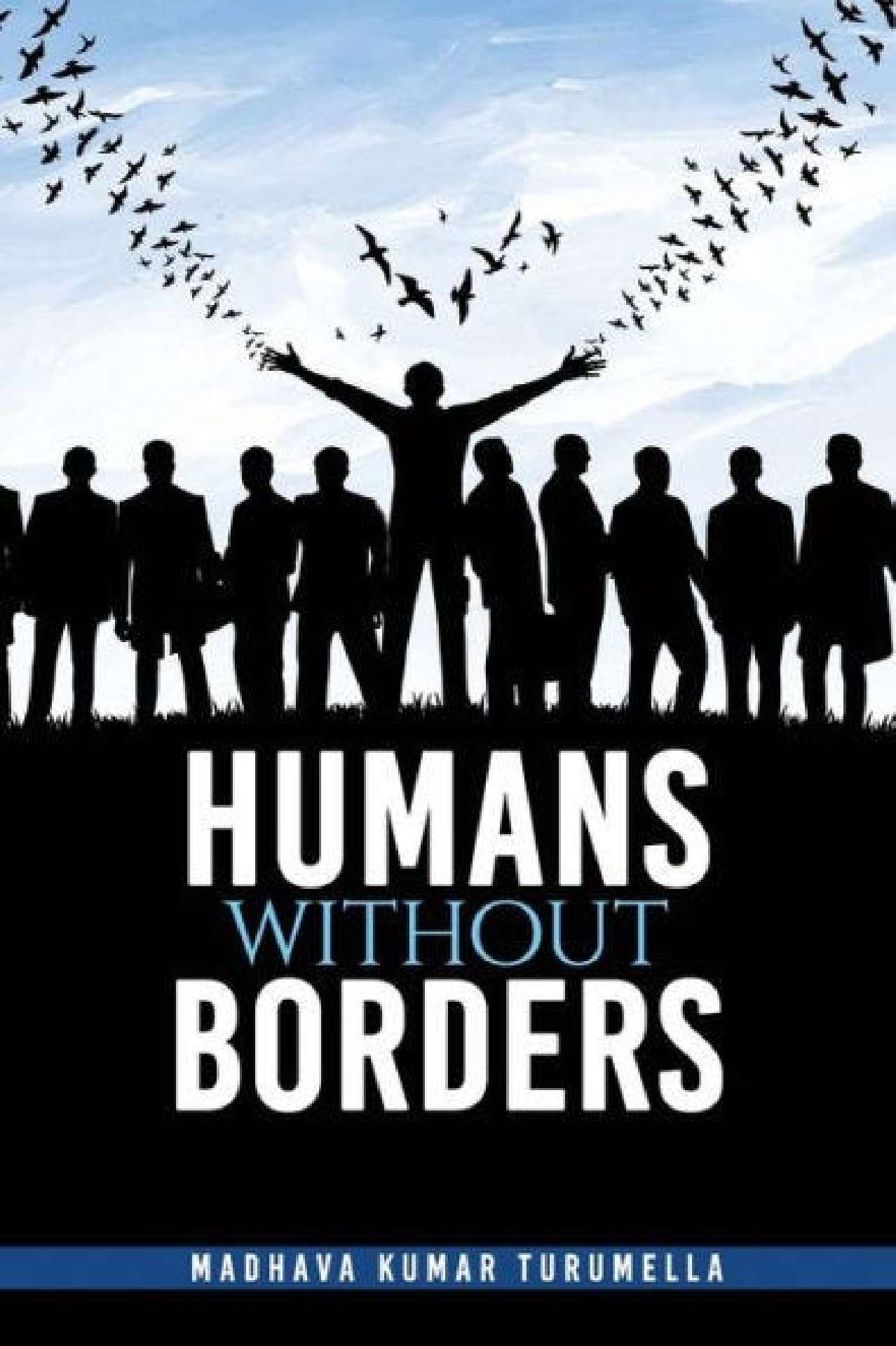
HUMANS WITHOUT BORDERS
Formats: E-Book, Paperback
Ages: 16-18, 18+
In 2015 the author was invited by The United Nations to give a lecture at a global climate conference in Turkey. There at the airport, he witnessed scores of child refugees begging. Inspired by an event that took place during the visit, the author presents a passionate argument in support of freedom for everyone. He offers a human-centric analysis of who or what is causing Humans to become refugees. In his book 'Humans without Borders', he argues that worldwide, humans face problems because of exploitative individuals' actions. He provides a four-quadrant model based on teachings from Bhagavad Gita to help us understand human activities. He says peace will not be possible if humans do not come into self-alignment with their unique inner nature. He argues that we must give love a chance to heal humanity. Prominent themes we can pick up from this book are freedom for everyone, Humanity 2.0, a new architecture to help the natural evolution of humanity, global wealth imbalance, weaponisation of human needs and the global refugee crisis. He uses the knowledge he gained from Transpersonal psychology, Systems Architecture and other books on Hindu philosophy to present his points in this book. He presents a compelling truth which makes this book a refreshing read.
Reviews
This was a fairly short read, but there was a lot of content. Human behaviour can be a very complex thing, and I think there are times when we don't think carefully enough about the potential consequences of our actions - this book highlights that. Perhaps, as humans, we can't always offer an explanation for why we do the things we do, but it's interesting to think about. I also appreciated the exercise that the author asked the reader to undertake, at the start of the book. It was an interesting read thought-provoking read. Kelly Marie Purdy's review
In Humans Without Borders (2023), poet, author, commentator and scholar of Hinduism Madhava Kumar Turumella makes an argument for recreating our world as the one unit it actually is, a world without the borders that humans have artificially created and which exploitative individuals use to their advantage while bringing hardship and miseries to countless others. Starting his analysis with a look at broad human behaviour (which he classifies using a quadrant model into ‘normal’, ‘exploitative’, ‘stupid’ and ‘altruistic’), basic human needs, and awareness, he considers how aspects like ego, greed, delusion, arrogance and cognitive dissonance as also the absence of love or experiences of trauma can feed into individual experience and exploitative behaviour. Exploitative individuals (as also ones falling within the ‘stupid’ quadrant who not only destroy others but also themselves) or behaviours inevitably interweave into the state and its machineries breeding corruption and greed. The weaponisation by these of even basic human needs from food (and pet food) to healthcare and regulation of basic human relationships takes away from people the right to live free lives in accord with their true nature and the satisfaction of their wants. Colonial structures which have in essence simply merged into present day ones (rather than being done away with) have had a significant part to play in this process. In the author’s view, it is a society sans borders, based on love and compassion that can bring true freedom, with a place for not only human beings but also the other life we share this planet with. I found interesting the author’s analysis of how basic human traits and behaviours are at the root of various exploitative behaviours and systems that society broadly lives under or with today, both in terms of the people who indulge in such conduct as well as human needs/traits themselves being controlled or ‘weaponised’ to the benefit of those few. While some of the aspects of this weaponisation, be it food habits or healthcare were ones I was aware of, other aspects like a connection he draws between the spread of unscented flowers and the perfume industry or value determination were interesting to contemplate as well as how all of these aspects essentially form part of a large system of sorts (even if not organised/intended as such). These ideas certainly give one plenty to reflect on. I also liked that his ideas take into account the need to acknowledge and indeed respect the worth of other life forms who are as much entitled to this planet as we are, rather than our arrogant assumptions of ‘superiority’. The larger goal that the author aims at of a borderless society as the answer to many of these problems though seems perhaps too utopian and not very practical given the points he himself raises, of the nature of human beings. While he does acknowledge the need for regulation (even though in his view, the ideal is an order-free society, the only truly free form), even this larger free society attaches too much to individual human conduct which even on surface level would need capability, intent and values, not perhaps to be expected on the same level from all. On some other aspects like freedom as to relationships also, I wasn’t entirely in agreement because there again, as we’ve seen in the world thus far, they can very easily assume an exploitative form with certain segments simply being at the receiving end. A book I think that’s well-intentioned and gives one plenty to reflect on, though its vision of the kind of society we need to create feels at least given the current state of things, not very feasible. Humans probably would have to evolve far more for it to be thought of. (Blue Rose One, 2023; pp. 172, Kindle ed)