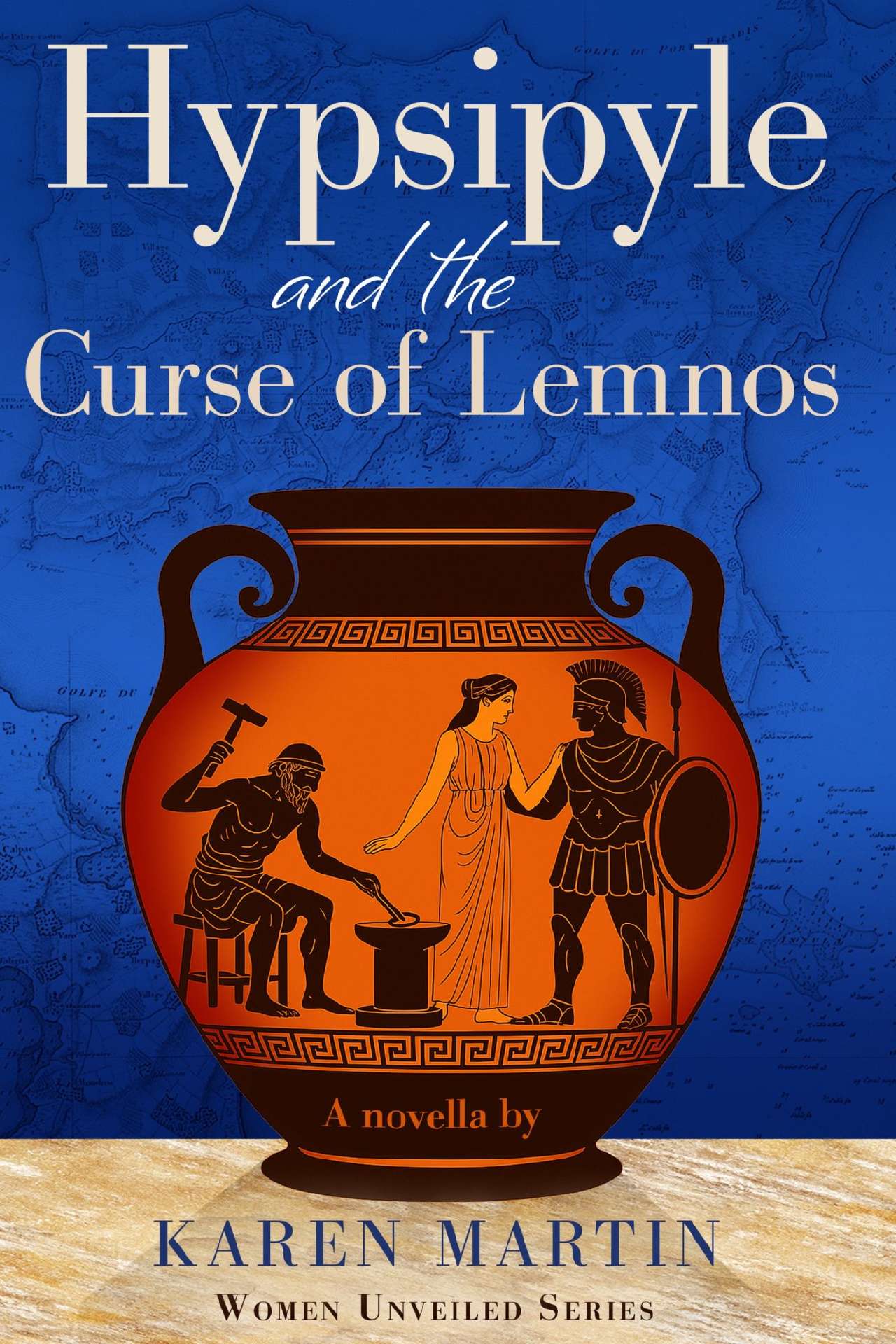
Hypsipyle and the Curse of Lemnos - Women Unveiled
Formats: E-Book, Paperback
Ages: 18+
When Aphrodite is humiliated by Hephaestus, she plots revenge. As divine payback, she curses his beloved island Lemnos, turning love into loathing and unleashing a reckoning of betrayal, bloodshed, and for Hypsipyle, an impossible choice between opposing loyalties.
For readers drawn to retellings of Greek mythology through a feminist lens like those of Pat Barker, Natalie Haynes, or Madeline Miller, Hypsipyle and the Curse of Lemnos is a fierce, lyrical reclamation of one woman’s struggle to shape her destiny following the repercussions of a divine retribution.
Reviews
I don't recall having heard about the Lemnos myth before. What Karen Martin does in this novella is retell this story from a feminist stand point, that of the woman who betrays the other women, her sisters. I feel that, unlike the other books in this series, this is a book of big feelings of maturity, a book of grief, of questioned values and what it means to live a life suffocated by guilt. This is a book defined by a sort of sobriety that these kind of big feelings create. Despite this, I loved the many layers of feminine perspective: the beauty and justice the women provide for their leader, her Queen's soft approach and space created for the wrongdoings to be met, the relationship Hypsipyle has with he body, the way she views the newly created games, so many layers of what it means to bring forth a woman's perspective. I am grateful to have received this in order to share my view. In the end, this book is an act of justice in itself, of giving voice to the women history has condemned in its tale of the Lemnos myth. And it's a lesson for this times of transition where women still struggle to choose between the patriarchal days toward a more balanced world. Ioana (Goodreads/ Amazon)
This is the first of Karen Martin’s books I’ve read and I truly enjoyed it. At some point, I’ll circle back to her previous works. Told through a feminist lens, Hypsipyle and the Curse of Lemnos is the story of women working together in sisterhood, to reclaim their lives, no matter the cost, and about the impossible choices we often are forced to make. Karen Martin has shined a light on this not-so-well-known myth, fashioning it into a defiant tale of betrayal and revenge, but also one of moral introspection. We are only human and we make mistakes. The story is thought-provoking: we all face moral dilemmas. What would you do in this situation? Additionally, it unmasks the effects of trauma which can breed the unthinkable. And that when fate or divine intervention thwarts our plans, we must proceed with caution, as there are always consequences. It’s a quick read. Pick up your copy.
It is no secret that loyalty, when divided, can present a punishing tightrope that is impossible to walk. To which side then, do we lean, and ultimately fall, when faced with insurmountable, ill-fated choices? What would it cost? In this case, what would it cost a woman? Award-winning Australian playwright and author, Karen Martin guides readers through the “corridors of the underworld” in her latest novella as she retells the “infamous” history of Lemnos from a feminine perspective – the perspective of Lemnian Queen, Hypsipyle. Martin untangles Arachne’s “exquisite web” to reveal just how royal roots bloom into “weighted” routes as the blessing of power also curses with consequence. Imprisoned in a labyrinth of torment, Hypsipyle’s moral dilemmas and “patterns of misfortune” appear to ensnare all who enter her sphere of influence, as her journey seeks to “rebirth” the feminine resolve while silently striving to repair the resulting ripples in her own reflection. Down a revolutionary road paved with survival and reclamation, each sentence navigates the seemingly predestined build of “intimate burden”, anticipatory grief, the blueprint of repercussion, and the” waged wars” between “heart, soul, and mind”. True to the conventions of Greek myth, with a twist, the author’s style is emblazoned with vivid imagery and artistic prose from the onset. Aphrodite’s “sadistic spite” towards her husband, Hephaestus leads to a retribution-stained alliance with the chthonic goddesses, “Erinyes” who ignite the “vengeful ruin” and curse of Lemnos left for all “pitiful mortals” to bear – “Let the hearts of Lemnos’ men turn cold to their wives.” The author focuses on how in retaliation to their abandonment, all women of Lemnos—except for one—emerge from the “silent slaughter” of men as “killers, survivors, sisters” … “not redeemed, but rebirthed” … unified, yet isolated. At this very moment, audiences will be thrust into suspense and the depths of patriarchal duty as Hypsipyle is reborn in her own right while knowingly exiling herself from the women she governs by saving her father, King Thoas. Alongside recurring acts of justice and sacrifice, Hypsipyle’s epochal decision and truthful admission steers the novella and shapes the view of the “Lemnian Crimes”. Haunting and explorative, Martin reveals how the notion of lasting freedom is not merely seized by expectation, but rather, integrates itself as an unattainable right in Hypsipyle’s life while being presented as the price women must pay for their honesty and defiance. Despite the personal cost, Martin skilfully underscores truth as a cathartic ritual, necessary for renewal, reinvention, and rebirth. In addition, vulnerability can be interpreted as inherent to the feminine resolve, emerging as a crucial force that reflects inner fortitude, integrity, and resilience. Layered lessons, metaphors, and a sense of duality also help to awaken and establish this unique interpretation of Lemnian history. From the very soil in which Hypsipyle “plants the seed of her undoing”, she is shepherded by her “garden turned oracle” imbued with memories of her late mother, Myrina. Nostalgia aids in reflecting Hypsipyle’s compassion and fealty struggles on a broader, deeply human level, as her devotion to both parents touches the “vulnerable child” in all of us. Martin ingeniously calls on the inescapable laws of nature and time as themes to illustrate the protagonist’s spiritual strength, accentuating the evolution of her resolve. As Hypsipyle ventures out of the roles imposed on her, inherited societal norms for women further peel away, revealing a deeper, more complex and introspective understanding of femininity and its purpose across the ages. Through sublime symbolism and irony, it is evident that Hypsipyle’s destiny – as a daughter; a woman, and a queen – would always be met with perplexing expectations: “Rule with fire and restraint” … “If you kill the drones before the queen lays again, there will be no next generation” … “which roots will still feed the soil?” Jason, his argonauts, and the peace of anonymity for Hypsipyle following exile provides healing intervals to the story and grants glimpses of hope for both characters and readers alike amid enduring shame and crestfallen circumstances. Upon reflection, reshaping the fabric of identity is not only highlighted as pivotal to the novella, and Hypsipyle, but to the agency of all Lemnian women. Extracted from “the shadows”, this essential retelling of Lemnian history offers a room between worlds where conscience can converse beyond voice. A woman’s conscience. This version bestows Hypsipyle and her “emotional toll” the spotlight as Martin uses her “creative liberty” to successfully push past the less visceral boundaries of previous iterations, and in doing so, orchestrates a space where “women become seen and heard”, even in their silence. As Martin notes, “we owe this to our daughters”.