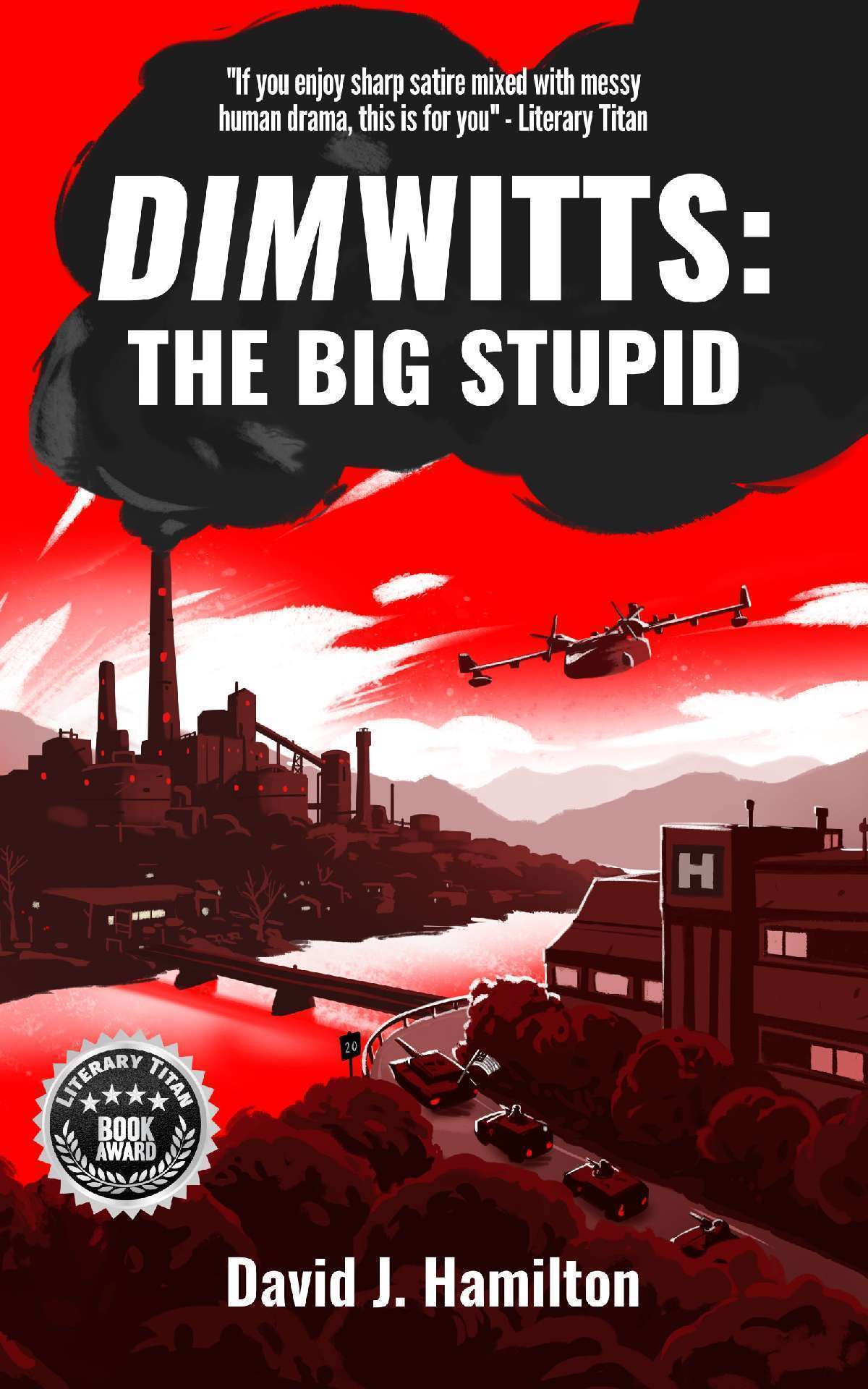
DimWitts: The Big Stupid - The DimWitts Trilogy, 1
Formats: E-Book, Paperback
Ages: 18+
Charlie Witt knows his brother is a superhero, but Michael is too dim to realize it. Stuck in a grimy old smelter town in southern B.C., he dreams of escaping.
The newly elected American president annexes the small Canadian city as part of his scheme to “Make America First Again.” The Canadian parliament, prorogued by a rogue prime minister, struggles to mount a defence.
King George VII, meanwhile, persuades the British parliament to take control of the former colony and its military. With the help of his lucky green bunnyhug, he vows to stop the American invasion cold.
The story spans the globe and the realms of imagination as the insidious dim reveals its true nature. Will Charlie master the overwhelming power, or will it push all life—and death—into a crisis that can only be called: The Big Stupid?
Reviews
I’ve never given much thought to the question, sometimes asked at job interviews or on speed dates, “if you could have any superpower, what would it be?” However, in the future, should anybody ask, I shall promptly reply that I’d choose the power wielded by Michael Witt, in David Hamilton’s burlesque novel “Dimwitts: the Big Stupid.” Specifically: “The superpower Michael possessed was not something truly physical or mental, either. It was an unconscious aura, and people who got too close to it were adversely affected. They got stupider. Like, a lot stupider.” Michael’s brother, Charlie, calls this phenomenon “the dim.” Charlie is no Einstein, himself. A loser in love, stuck in a job and a town he hates, he’s bitter and looking for revenge on everybody, especially Michael. The narrative begins as an over-the-top lampoon, with sharp resonances with current events. Lancaster Dirk, the renegade, newly-elected U.S. president dispatches massive troops to the Witts’ hometown—Valley, British Columbia— to annex it and seize control of its valuable smelter. Canada must respond, but the prime minister is missing, so in desperation the government turns to England’s King George VII to lead the defense of his former colony. Meanwhile, Charlie discovers that he can channel his rage to focus and amplify Michael’s dim, so he aims it at the American invaders. Unexpectedly, a resulting global meltdown called the “Big Stupid” sweeps the planet. While the first half of this novel unfolds like a farcical political spoof, from this point it launches warp-driven into galaxies of comedic fantasy. Readers meet, among myriad other oddballs, a shadowy billionaire international arms dealer, a mysterious doctor with a machine “to devour everything that ever was,” and a supernatural feline named Squinkles, who is the “protector of all things forbidden.” Apart from this book’s many colorful characters, to me the funniest role belongs to the god-awful town of Valley, itself: “…There was grime on everything, a grit to the air, a sheen on the water. The city suffered some painfully obvious side effects of living under the ancient smelter…” which evoked stench akin to a “lingering robot-fart of death dipped in vinegar and lit on fire.” Credit the author with superior comedic chops. Still, some readers, myself included, will prefer the character-driven satire of the book’s first half to the unfettered absurdity in its second. Before committing to “Dim Witts,” be advised it ends with, “to be continued.”
David J. Hamilton’s DimWitts is a biting, wild ride through a world that feels both satirical and uncomfortably real. It jumps between the collapsing life of David Enders, a leftist late-night comedian silenced by a newly authoritarian president, and the twisted family drama of Charlie Witt, a bitter man stuck in his brother’s strange, almost supernatural shadow. The novel paints a grim but oddly playful picture of politics, power, and small-town despair, blending sharp political commentary with intimate stories of resentment, failure, and strange gifts that alter the people around them. From the halls of the White House to a grocery store in rural British Columbia, the narrative builds a chaotic tapestry of media, corruption, and human frailty. This book was both exhilarating and frustrating, in the best way. The writing has a manic energy to it, full of sharp edges and vivid scenes. Sometimes the prose cracked me up, other times it made me wince, and there were moments where I had to put the book down because it hit too close to home. The dialogue is alive with personality, though it occasionally veers into caricature. That said, the caricature works because the world it describes already feels absurd. I admired Hamilton’s ability to juggle satire and genuine tragedy without losing the thread. Though at times I felt almost overwhelmed by how much was packed into a single chapter, but it mirrors the mess of the world it’s trying to capture. What really stayed with me was the mix of rage and humor that runs under everything. I found myself genuinely angry at the injustices described, but then laughing a page later at the ridiculousness of a character’s remark. I don’t think the book wants you to feel comfortable. It wants you off balance, amused, unsettled, and maybe even a little guilty about how much you enjoy the spectacle of disaster. I’d recommend DimWitts to readers who like their fiction bold, political, and unafraid of being abrasive. If you enjoy sharp satire mixed with messy human drama, this is for you. Reading DimWitts felt a bit like if Kurt Vonnegut wrote a season of Succession after binge-watching The Daily Show. It's darkly funny, biting, and just absurd enough to sting with truth.