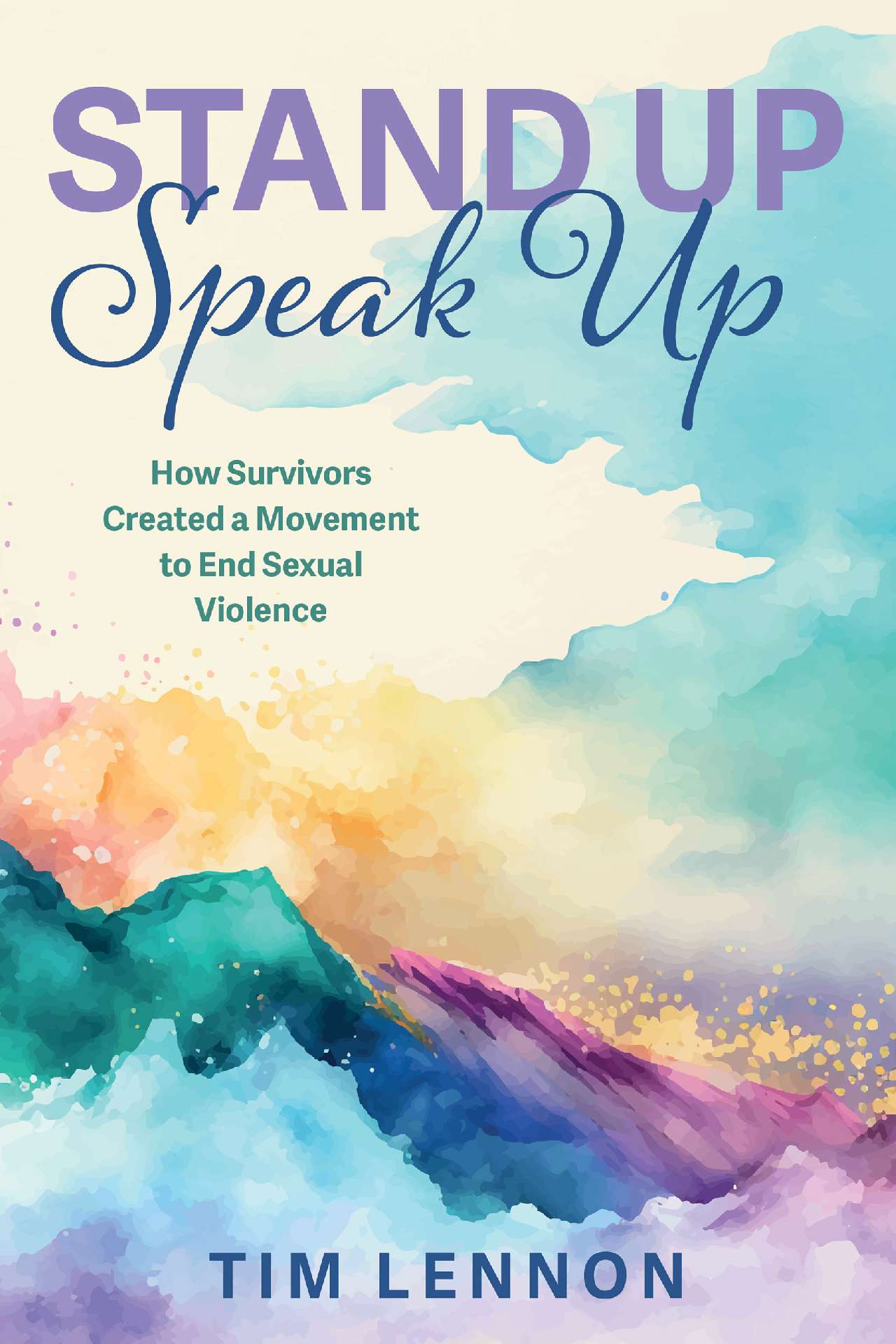
Stand Up Speak Up --How Survivors Created a Movement to End Sexual Violence
Formats: E-Book, Paperback, Hardback
Ages: 18+
For generations, survivors of sexual abuse stood alone. Now they step forward as a powerful social movement, the Survivors Movement.
Stand Up, Speak Up celebrates survivors who emerged from the shadows of imposed shame to challenge cultures of oppression and institutions of power. Since the year 2000, millions have mobilized a powerful social-justice movement that has flourished as a social and political force. Rising from the ashes, it created hundreds of organizations and compelled reforms in law, social relations, and culture.
Author Tim Lennon shares the obstacles, victories, and courage of the survivors who stepped forward and shattered the silence. Drawing on history, analysis, and exclusive interviews, Lennon demonstrates how survivors have challenged institutions of power, including Hollywood producers, church ministers, athletic coaches, doctors, and many others. They are igniting a movement to end the violence that has plagued society for generations.
Stand Up Speak Up celebrates the activism of survivor-leaders who stepped up and changed the world.
Reviews
This book is both a painful personal account and an inspiring call to action. Author Tim Lennon begins by recounting his own childhood trauma as a survivor of clergy abuse, a story that unfolds with heartbreaking honesty. From that foundation, he traces the rise of a global movement of survivors who have turned silence into strength and pain into activism. Through detailed chapters, Lennon chronicles the efforts of individuals and organizations that have worked tirelessly to expose abuse, support victims, challenge institutional cover-ups, and push for justice around the world. What struck me most was the rawness of Lennon’s writing. His emotions come through in every line. Rage, grief, confusion, and ultimately, a fierce determination. He walks us through his journey from a silent, broken child to a relentless advocate and leader. The writing has a rough-edged clarity. It’s not polished like a memoir written for mass market appeal, but that’s exactly why it hits so hard. You feel like he’s speaking directly to you, almost like you’re sitting in a church basement at a support meeting, hearing someone finally say out loud the things no one else will. The book is packed with stories, statistics, names of organizations, and powerful examples of systemic failure across nearly every major institution like churches, sports teams, the military, Hollywood, schools, and government. It’s an ambitious, wide-reaching work that paints a clear picture of just how deeply rooted the problem is. Lennon doesn’t shy away from the scale or complexity of it all. Instead, he leans in, showing us the full scope so we understand that this isn’t about one bad actor or one broken system. It’s everywhere. And that’s what makes the book so powerful. It’s not meant to make you feel comfortable, it’s meant to wake you up. I’d recommend Stand Up Speak Up to anyone who cares about social justice, survivor advocacy, or institutional reform. It’s especially powerful for survivors who might be looking for a sense of connection or hope. It’s not always an easy read, but it’s an important one. Lennon’s voice is not only personal, it’s political, unflinching, and urgently needed. This book is a torch passed from one survivor to another. If you’re ready for it, it will light something in you. Literary Titan
Tim Lennon’s STAND UP SPEAK UP bears the subtitle “How Survivors Created a Movement to End Sexual Violence.” Lennon holds that sexual abuse is at epidemic proportions across the globe, and he advances ways in which it can be combated in America. As such, his book is a powerful read, mixing horror with hope for the future and dismay with determination to secure justice. One of the book’s strengths is its rootedness in facts and figures while remaining accessible to the general reader. Because it so often appears in private or semi-public contexts, sexual abuse is frequently unseen and unreported; ascertaining its prevalence, when it occurs, and who perpetrates it is central to addressing it. Lennon draws on a wide range of sources to support his claims, including peer-reviewed academic material and government reports. Lennon notes the incidence of sexual abuse in the Catholic Church (he was repeatedly abused by a priest during childhood), as well as in the Southern Baptist Convention. He also notes the high rates of abuse in and among various constituencies and spheres of activity: the entertainment industry, the military, higher education, and so on. A particularly valuable part of the work is Lennon’s identification of “the playbook,” the five-step method by which institutions seek to abscond from justice and preserve their reputations when members perpetrate sexual abuse—a strategy that includes maintaining secrecy, gaslighting the victim, aggressive legal remedies, and leveraging power differentials. Such has been the historical approach of the Catholic Church with regards to the problem of child sexual abuse by priests, the scale of which is sickening to contemplate. Lennon gives no quarter, detailing the church’s multiple cover-ups in exhaustive detail. The book is well-written, though slightly repetitive in places. Lennon’s calls for action are simple: the calling of a “convention of equals” of survivor groups; statute of limitations reform; and the banning of child marriage, which unbelievably remains legal in 34 states (37 at the time of the book’s publication). Plainly, there is no simple, one-size-fits-all way to deal with Lennon’s “epidemic;” sexual abuse, because it is ordinarily about exerting power, will continue for as long as human beings lack the ability to properly control the will to gain power. The answers Lennon advances sound humdrum and managerial; but then again, like the need to protect freedom through constant vigilance, such work can never be completed or skimped. The sooner we as a society roll up our sleeves and get on with it, the better. Tim Lennon’s STAND UP SPEAK UP: How Survivors Created a Movement to End Sexual Violence is a chilling exposé of the widespread nature of sexual abuse, as well as a valuable work that details the many survivors’ groups and activism that help bring perpetrators to justice.