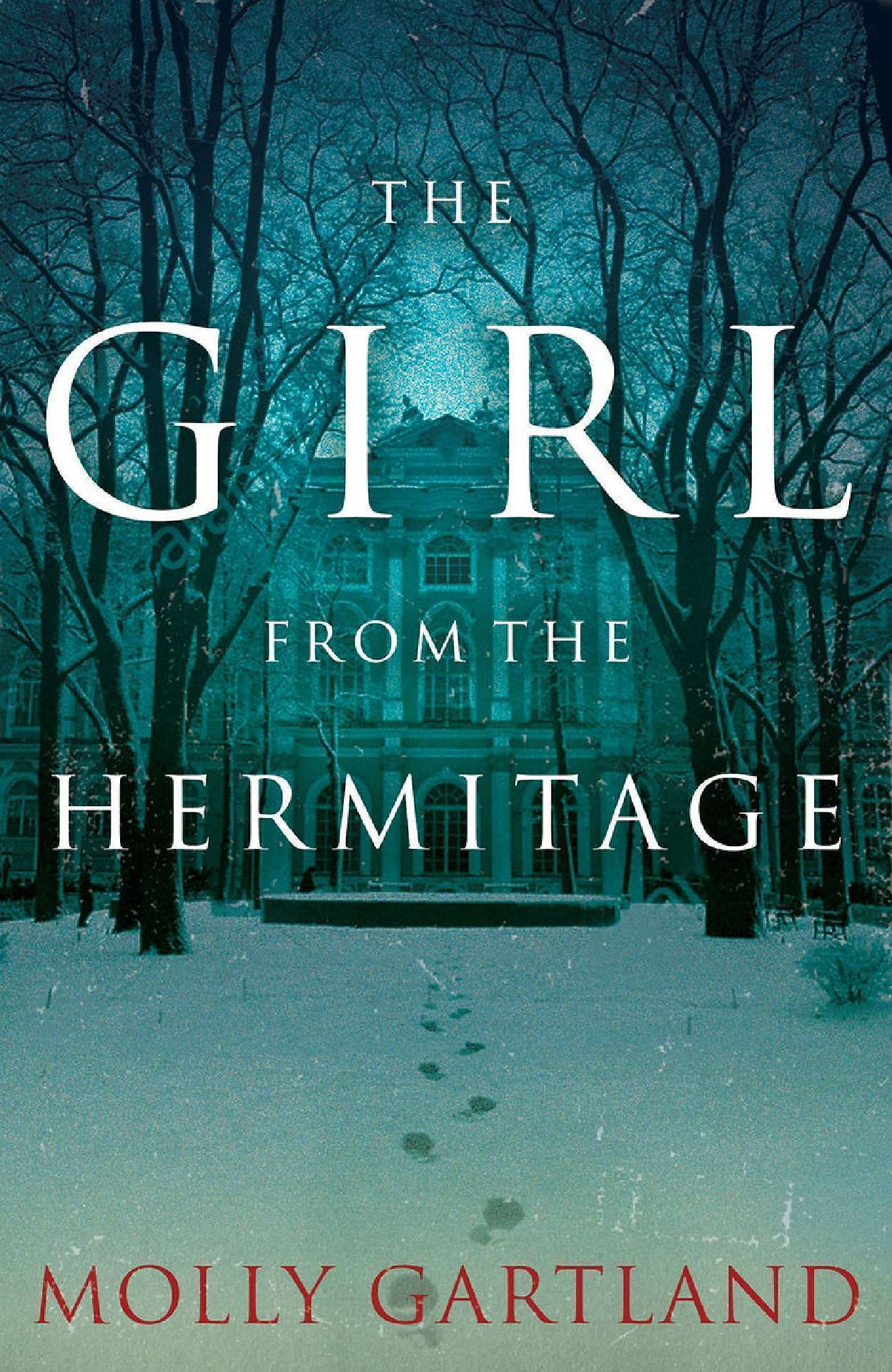
The Girl from the Hermitage
Formats: E-Book, Paperback
Ages: 18+
It is December 1941, and eight-year-old Galina and her friend Vera are caught in the siege of Leningrad, eating soup made of wallpaper, with the occasional luxury of a dead rat. Galina’s artist father Mikhail has been kept away from the front to help save the treasures of the Hermitage. Its cellars could now provide a safe haven, provided Mikhail can navigate the perils of a portrait commission from one of Stalin’s colonels.
Nearly forty years later, Galina herself is a teacher at the Leningrad Art Academy. What ought to be a celebratory weekend at her forest dacha turns sour when she makes an unwelcome discovery. The painting she embarks upon that day will hold a grim significance for the rest of her life, as the old Soviet Union makes way for the new Russia and Galina’s familiar world changes out of all recognition.
Warm, wise and utterly enthralling, Molly Gartland’s debut novel guides us from the old communist world, with its obvious terrors and its more surprising comforts, into the glitz and bling of 21st-century St Petersburg. Galina’s story is at once a compelling page-turner and an insightful meditation on ageing and nostalgia.
Reviews
The Girl from the Hermitage WRITTEN BY MOLLY GARTLAND REVIEW BY JEFFREY MANTON Gartland’s novel, an ambitious family saga spanning two generations, is set in Leningrad, later St. Petersburg, from 1941 to the first glimmers of transformation in the 1990s and then into the glitz of the 21st century. Starting in 1941, young Galina’s father, Mikhail, fights for his child in desperate conditions. Then a chance opportunity leads to his painting a portrait of the sons of one of Stalin’s sinister and all-powerful colonels, with life and death decisions at every step. But the commission means he can shelter his daughter in the Hermitage and steal food for her and his best friend, Boris, from the colonel’s table. Forty years later, grown-up Galina is an art teacher in Leningrad with a family of her own. But Boris has his own tale to tell, and when Galina puts her own artistic skills to the test, she impacts her future in the shining new St. Petersburg. Part One, set in 1941, would make a dramatic novel in its own right; the stunning depiction of Russian suffering engages us as if we were there with Mikhail. The leap from the jeopardy of pleasing a Soviet colonel to the mature Galina in post-war Leningrad feels blunt and sudden, a missed opportunity. We get so few novels about the horror of civilian life in the siege that occurred when Nazi forces surrounded Leningrad, and yet it was every bit as chilling as the end of the war in Berlin or the Blitz in London, if not more so. Here is human survival in every form. This is an extraordinarily well-written book for a debut.
Tens of thousands of nameless older women inhabit St. Petersburg, picking their way amongst the pockmarked sidewalks and treacherous cobblestones, dressed in clean but shabby clothes, their shoulders stooped with decades of carrying heavy burdens. They are as integral to the city as the elaborate facades and the noonday gun from Peter and Paul Fortress, but these women attract less attention with the city’s many visitors, and rarely — if ever — do they find themselves the heroines of novels set in St. Petersburg. Not so in Molly Gartland’s debut novel, “The Girl from the Hermitage,” which gives a name to one such woman and places her at the heart of a multi-generational family saga, set in the waning years of the Soviet Union and the messy transition to Vladimir Putin’s Russia. We meet Gartland’s protagonist, Galina, as a child during one of St. Petersburg’s darkest hours, the 900-day siege of Leningrad by the Nazi army which lasted from 1941 to 1945. Galina and her artist father, Mikhail, join their neighbors Anna and Vera in seeking shelter in the Hermitage during the relentless Nazi bombardment. Mikhail’s commission to paint a family portrait for a senior military officer saves this beleaguered foursome from the slow starvation that was the fate of millions of the besieged city’s inhabitants. Gartland has marshalled details of life in that period into vibrant and moving scenes of the macabre pathos of frozen corpses, the gnawing hunger pangs that wallpaper glue soup cannot assuage, and the ghostly half-existence without light or heat during those harrowing years. We then follow Galina and her family and friends into Brezhnev’s stagnation period, through the messy 1990s, and into the present. Gartland’s time as an expatriate in Russia during this period serves her well, and she is as comfortable with her post-war social history as she is with the siege, creating scenes, which artfully evoke Stagnation era privations, the pared-down, bucolic life of a Russian dacha, and the garish nascent capitalism of the 1990s. The scene detailing the contents of an expat’s apartment from the point of view of her cleaning woman may cause foreign veterans of that era to wince, and justifiably so. Galina emerges as a sympathetic heroine, behind whom we easily rally, hoping that the end of her story will be less tumultuous than its beginning and middle. Gartland pits the richly drawn Galina against a constantly changing society and chaotic economy, forcing her to find novel ways to survive and thrive, while pursuing her passion for painting. Other characters are understandably more two-dimensional, though the character of Masha who transitions from mousey Soviet student to a textbook 1990s Russian “dyev” complete with lacquered talons, a Mary Kay sales kit, and the obligatory foreign boyfriend is pitch perfect. I did, however, find myself craving more time with Galina, Vera, and their affable guardian Boris in the girls’ post-war adolescent years and wanting to know what happened to several characters, including Galina’s grandson Igor, who got entangled in an all-too familiar web of Russian corporate intrigue. And I wished that Gartland had done more with the Hermitage itself, which features only episodically. But wanting more is a sign of compelling characters. “The Girl from the Hermitage” is a commendable debut novel by an author who has a clear talent for parlaying careful research into a credible sense of time and place. In choosing to craft a likable and memorable heroine from one of the nameless older women of St. Petersburg and set her at the heart of one of the city’s most turbulent centuries, Molly Gartland has provided a fine addition to the rich genre of historical fiction set in St. Petersburg.