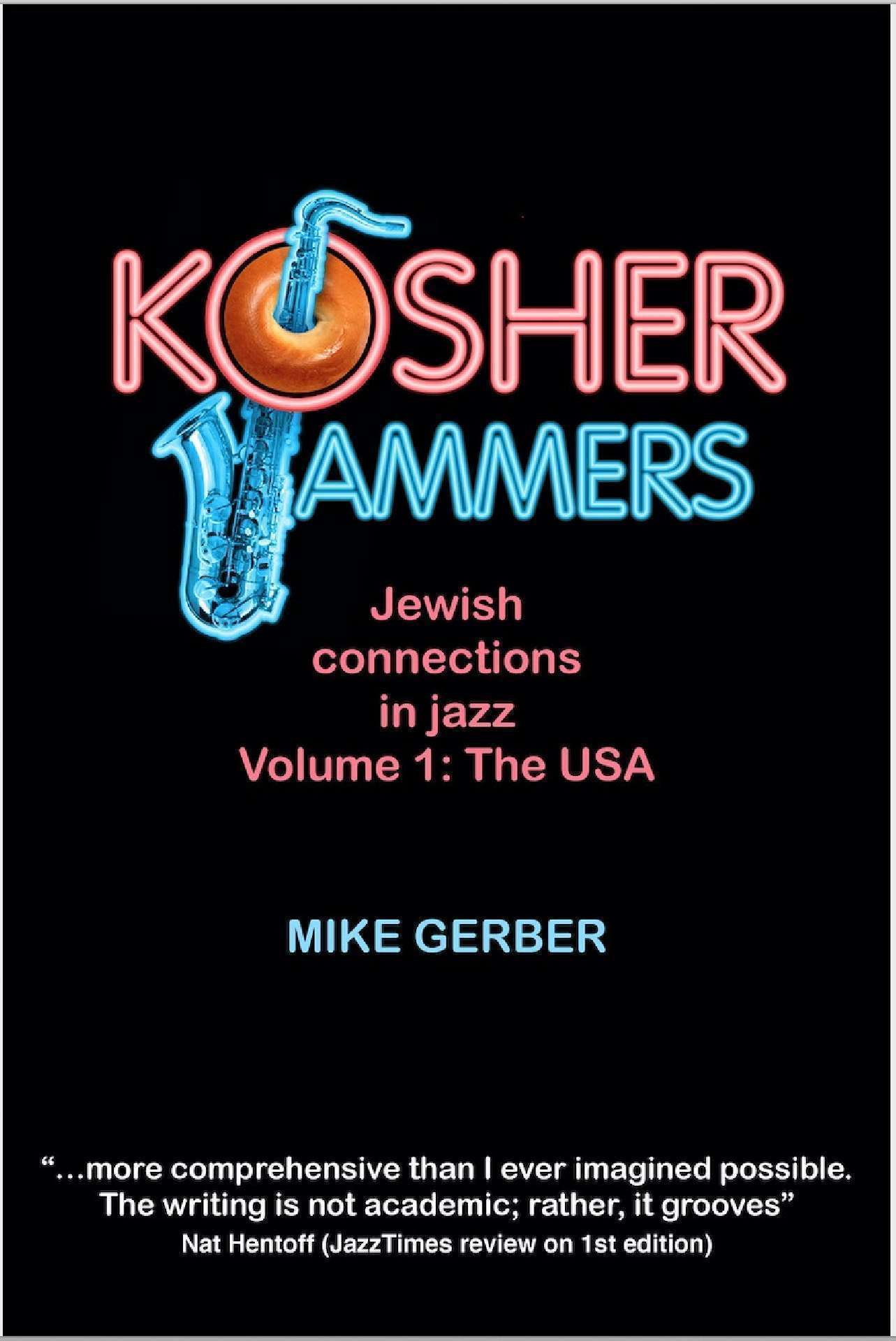
Kosher Jammers: Jewish connections in jazz – Volume 1 The USA
Formats: E-Book, Paperback
Ages: 12-15, 16-18, 18+
Jews have been a major presence in America's jazz, as musicians and as jazz facilitators, and in Kosher Jammers: Jewish Connections in Jazz – The USA, Gerber tells that story with a rigour worthy of academia but with a feature writer's creative flair.
Besides drawing on a plethora of second-hand sources, Kosher Jammers is absolutely packed with first-hand material, from interviews, phone calls and emails with jazz figures, Jewish and otherwise – including possibly the last ever interview with swing era icon Artie Shaw. Among the many other interviewees are black jazz figures such as saxophonist Buddy Collette and the critic Stanley Crouch, as a key theme running through the book is the relationship between Jews and African Americans in jazz.
The impact on jazz of tunes written by Jewish "Great American Songbook" composers such as George Gershwin, Harold Arlen and Johnny Green is also covered, And the book features an extensive study of the Jewish-jazz phenomenon, whereby musicians from Ziggy Ellman in the 1930s to contemporary artists, notably John Zorn, have sought to create jazz that draws on Jewish music influences and themes. Gerber drives home the point that, even had there never been a single Jewish jazz musician, Jews will still have contributed massively to the development of jazz in the United States, as managers, impresarios, venue owners, label founders, writers and such.
Reviews
Kosher jammers: Jewish Connections in Jazz. Vol.1: The USA by Mike Gerber Vinyl Vanguard, £19.99 The soundtrack of freedom and justice CHRIS SEARLE treasures a profoundly original exploration of jazz, the blues and Jewish liturgical cantorial chanting AS I grew into jazz in my teens and twenties, I had many jazz heroes. Some of them were east Londoners, but what I didn’t realise at that time was that their roots were Jewish, and learning the ordeals of their people throughout the first half of the 20th century made me love them even more. Favourite clarinetists like Stepney’s Monty Sunshine or Bow’s Cy Laurie, rampaging saxophonists like Ronnie Scott who had grown up with his uncle who fought at the Battle of Cable Street — it seemed that, in Britain too as well as in the US, jazz and the struggle against racism were synonymous. No writer has done more to make this connection explicit than the London journalist and record store owner, Mike Gerber, whose first pioneering book, Jazz Jews, was published in 2010. Now he has extended his research to delve even more deeply into these links, starting with the US, and Kosher Jammers is the result. Gerber is a profoundly original writer who writes as he speaks. His text is not only serious scholarship, but informal, conversational and full of surprises. This makes his interviews with musicians, record company bosses, musicians' managers, impresarios and jazz festival organisers speak with the exigencies of real life, so that his book is a succession of voices across the US, and if you love jazz or even have little more than a marginal interest in it, you will not want to put his book down. Gerber maintains that “Jews like many others found inspiration in the sounds of black America” from jazz's earliest days in 1900s New Orleans. He traces the relationship between jazz, the blues and Jewish liturgical cantorial chanting, returning to this theme many times throughout his book. He quotes bandleader Artie Shaw, whose popular success as a white jazz big band maestro was only surpassed by Benny Goodman, in a 2002 interview, two years before he died: “Being Jewish has everything to do with everything you are, in a society that is very abhorrent of Jews,” he told him. This statement haunts Gerber’s book. Yet where would jazz have gone without the majority of Jewish composers who created the American Songbook? Gershwin? Jerome Kern? Richard Rodgers? Johnny Green? The melodies and starting points of I Got Rhythm, Body and Soul, My Funny Valentine or All The Things You Are became the food of jazz, played and recorded thousands of times by the music’s greatest virtuosi of the mid-20th century, from Armstrong to Coleman Hawkins, from Miles Davis to John Coltrane, who played and recorded Rodgers’ My Favourite Things time and time again. But the real power of Gerber’s book is in its conversations. He knows just the right questions to ask. His interview with the great bop drummer and ex-heavyweight boxer, Stan Levey, for example, remembers his 1940s days with Charlie Parker, Dizzy Gillespie and drums genius Max Roach with tremendous wit and vibrancy, and the same is true of dozens of exchanges he has throughout his book. His writing travels through all the jazz genres, from New Orleans, to swing, to bop, post-bop, free improvisation and the Radical Jewish Culture movement led by New Yorker John Zorn. As a reader you marvel at the sheer number of interviewees he managed to trace and sit down with across the US — and this is but the first volume, with a second tome exploring the British and European connections yet to come. In the meantime, if you want to be a continuing part of his interlocutions, visit Vinyl Vanguard, his small but throbbing record store in Walthamstow, east London. You’ll probably come away not only with his book but a few marvellous sounds too, and plenty of encouragement to support and add your weight to the Palestinian struggle. For Gerber knows well that jazz is the soundtrack of undiminished freedom and justice for all of us.
Kosher Jammers: Jewish Connections In Jazz By Chris May September 17, 2024 Kosher Jammers: Jewish Connections In Jazz Volume 1: The USA Mike Gerber 406 pages ISBN: 979-8-224-74480-0 Vinyl Vanguard 2024 Jews have been so intimately, influentially and copiously involved in the story of jazz that every person's list of ten favourite musicians is almost certain to include one Jewish player, and probably more than one. Yet until 2010, when London-based writer Mike Gerber's Jazz Jews (Five Leaves Publications) was published, there was no book devoted to identifying Jewish connections in the music. Jazz Jews, which had been ten years in the making, ran to 654 pages and there were over 7,000 names in the index, which gives an indication of its scope and depth of detail. Nat Hentoff said of the book that it was "more comprehensive than I ever imagined possible," adding "The writing is not academic; rather, it grooves." Gerber has since expanded Jazz Jews, adding newly researched material, and retitling it Kosher Jammers. To make the new edition's physical bulk more manageable, he has divided it into two volumes. Volume 1: The USA, the subject of this review, and an upcoming Volume 2, which will cover the rest of the world. Volume 1: The USA chronicles Jewish involvement in the development of jazz from its beginnings through to the new millennium, its fifteen chapters taking in the cornerstone styles, the musicians involved, the composers of the Great American Songbook, the enablers and facilitators, producers and club owners, the role of women, and more. Along the way there is a feast of off-piste takeaways. It is not widely known, for instance, that throughout his life Louis Armstrong wore a Star of David on a chain round his neck, as a remembrance of the Jewish family in New Orleans who took care of him during his early teens. And how many people know that stride pianist Willie "The Lion" Smith considered himself Jewish (his business cards were printed in Hebrew) and that "The Lion" part of his name referred to the Lion Of Judah? There are many more fascinating tidbits along these lines. The book also addresses weighty questions. Perhaps the most important of these asks to what extent, if any, does a musician's, or a composer's, Jewishness impact on the way they play jazz, or write songs. Gerber's interviewees come down on the subject variously. Some, like the saxophonist and label owner John Zorn, are certain that klezmer and the cantorial tradition are audible Jewish retentions in some Jewish musicians' jazz. Others are adamant that Jewish ethnicity and cultural traditions are not involved. Some, including Artie Shaw, in what was possibly his final interview, are unable to make up their minds. At times Shaw, in a lengthy interview, denies ethnicity has anything to do with it, at other times he implies that it does. Gerber presents the opinions and proffered evidence of both sides and leaves it to each reader to make up their own mind. The book's many interviews—conducted in person in the USA, on the phone and by email—add considerably to the success of the book, which also draws on a wealth of published sources. It would take more than a book even as chunky as Kosher Jammers to cover every person who has contributed to the totality of Jewish connections in jazz. Inevitably, there are some omissions. These include the late Bernie Brightman, who was a dope smoking regular at New York's Savoy Ballroom in the 1940s and who later founded Stash Records, launching its extensive catalogue with Reefer Songs in 1975. Brightman's accessible interviews throw valuable light on the personal and societal relationships between Jewish and African American jazz enthusiasts in the 1940s and early 1950s. Another omission is the new millennial proliferation of US-based Israeli musicians, such as the great tenor saxophonist Oded Tzur. Gerber says he will be covering this in Volume 2. Bottom line: a scholarly, valuable and accessible addition to our bookshelves.
Discord and harmony Jewish Socialist magazine, Autumn 2024 This book is a treasure trove for jazz lovers – a chronology of Jewish involvement in American jazz, peppered with anecdotes and interviews. The title, Kosher Jammers, is a reference to Mickey Katz’s band of that name (Katz was Joel Gray’s father). The book is not polemical but it confronts the major issue of tension between Black and white musicians. As an aside, in my experience, no African American, especially from the South, would believe that a white person could understand or identify with the life that they experienced – the handed- down memories of slavery, grinding poverty and sheer humiliation of being treated not so much as a second class citizen but almost as a different species. Jews often did identify with that, since we have our own recent memories of persecution, and maybe because we celebrate our own liberation from slavery, but, the tensions are understandable. There are some conclusions which are implicit in the book. Jazz emerged from Black America, most of its great innovators were Black, and it remains predominantly a Black American art form. Nonetheless, there was an important white input and a significant Jewish contribution. Jews were prominent in exposing jazz to a wider public, promoting it, recording it and managing venues where it was played. Jews felt an empathy for Black music because they identified with underdogs, but there are always tensions between promoters and musicians. That is no less the case when the musicians are Black and the promoters are Jews. But there were also many Jewish virtuoso musicians and bandleaders, including, amongst others, Benny Goodman, Artie Shaw, Shelley Manne, Buddy Rich, Stan Getz, Lee Konitz. Jewish bandleaders were the first to break the segregationist barriers by including Black musicians and crediting Black composers. That also caused resentments because Jews, as whites, could reach a wider audience and earn more. Jewish band leaders could also offer Black musicians better rates than Black bandleaders. Jews like George Gershwin, Harold Arlen, Johnny Green, Jerome Kern and Richard Rodgers made a disproportionate contribution to the composition and development of popular American music, and that indirectly fed jazz composition. One example is Gershwin’s “I’ve got Rhythm”, where the chord sequence was so well known as a basis for jazz improvisations that they were known as “Rhythm changes” and were used as exercises for students. There was some evidence of klezmer and cantorial music directly influencing Jewish jazz musicians but most of that influence came indirectly, via popular song composition. But, Jews were also attracted to jazz which, like Jewish music, does not conform to western classical music rules: the notes need bending and “krechts” to sound right. There are some wonderful anecdotes in the book, such as when Eddie South, a blind Black fiddler, was playing at Café Society, and the venue was half empty. Barney Josephson, the Jewish owner, had forgotten it was Yom Kippur but Eddie South hadn’t; he played a moving version of Kol Nidre. Later, Eddie told Barney that he had a Jewish grandfather. One of the most important collaborations was between Billie Holiday and Artie Shaw, whose band she sang with. Her trademark song, “Strange Fruit”, was written by a Jewish man, Abel Meeropol, and she first performed it at Café Society, run by a Jew, then recorded and distributed by another Jew. When Miles Davis left Charlie Parker’s band, he was replaced with Red Rodney – a Jew. When the band toured in the South, Parker avoided segregation laws by claiming that Rodney was a Black albino. The segregationist restrictions in the South and to some extent in the north, too, were draconian. Officially until 1964, but in practice long after that, Black and white people could not stay in the same hotels, eat in the same restaurants or attend the same clubs. Benny Goodman was the first band leader to challenge segregation by hiring Black musicians, including Charlie Christian, the pioneering guitarist. Goodman was known as a difficult man but he was staunch in his defence of his musicians. While the band were setting up for a gig at the Grove in Los Angeles, he saw the doormen telling his Black musicians to use the back door. He told the band to pack up their instruments and they left, turning down a lucrative gig. Interestingly, Benny Goodman was a big admirer of Naftule Brandwein, a famous klezmer clarinetist. According to the British klezmer clarinetist Susi Evans, Naftule Brandwein was known in the Yiddish community as “the Jewish Benny Goodman” in sarcastic reference to Goodman’s lack of Jewish identification. Artie Shaw was less protective of Billie Holiday. She left the band in a fury when she was made to use the back door and the goods lift at a gig in a smart New York hotel. The inequality still existed in the 1970s. At the Village Gate in New York, Miles Davis was on the same bill as Blood Sweat and Tears. He was paid $5,000 a week; they received $25,000. An interesting topic was women in jazz. I had not come across the International Sweethearts of Rhythm before – a Black women’s swing orchestra, which included some Jewish women who passed as Black when they toured in the South. I had come across Emily Remler, a fabulous guitarist, and Barbara Carroll, a pianist, but Jane Ira Bloom, Mimi Fox and Jessica Williams were new to me. Other Jewish artists who were huge talents and influences were Al Cohn, Mel Powell, Ziggy Elman, Stan Levey, Barney Kessel, Shorty Rogers, Steve Lacy, Paul Bley and Randy Brecker. They’re all in the book. Jewish Jazz promoters included Irving Mills (Duke Ellington’s manager), Joe Glaser (Louis Armstrong’s manager) and Norman Granz, who promoted Jazz at the Phiharmonic. There’s an interesting interview with George Wein, who started the Newport Jazz and the Newport Folk Festivals and countless other clubs, festivals and record labels. He summed up the relationship between entrepreneurs and musicians, saying: “Entrepreneurs were looking for ways to make money. Musicians were looking for how to get paid. Nothing difficult to understand about that.” The book took me a long time to read because I kept turning to YouTube to listen to yet another example of a musician I hadn’t heard or heard of. Very enjoyable! Simon Prager