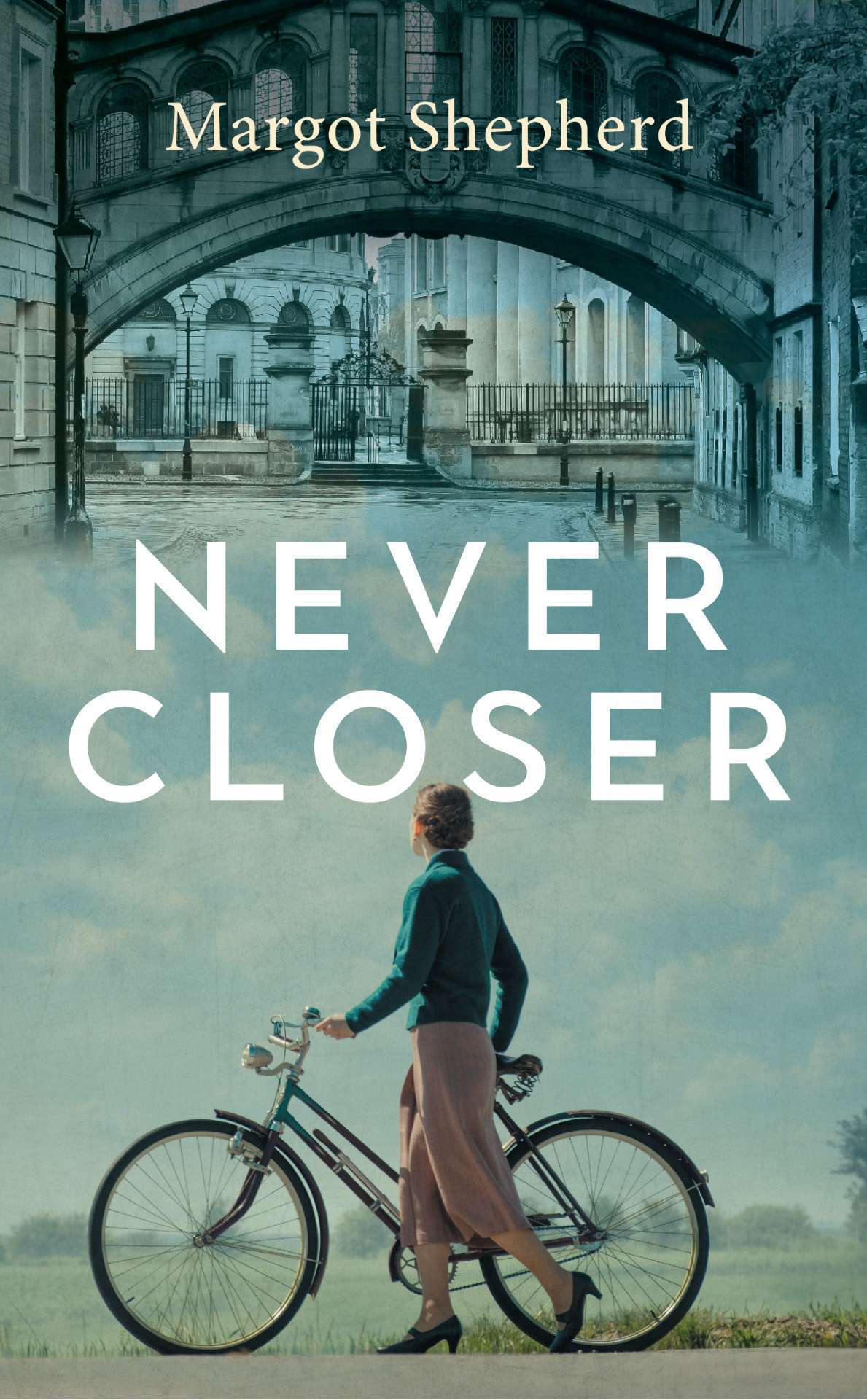
Never Closer
Formats: E-Book, Audio, Paperback
When your life changes in a moment, how do you rewrite your story?
In 1940s Britain, with the Second World War raging, Alice is working in a laboratory developing a new miracle medicine. Made to leave school at sixteen and abandon her aspiration to be a teacher, she learns instead how curing people may be her destiny.
In the present day, Jo, already in a failing marriage, is devastated when she hears her daughter’s life is on a knife edge. At her bedside Jo starts to read Alice’s diary, found the previous day in a vintage handbag.
A door opens onto the past, revealing a young woman’s fierce determination to succeed against all odds. Past and present overlap and merge as life-changing events resonate across the gulf of time.
This is a story of a mother whose life is blown apart. Now she must find a way to put it back together. Can Alice show her the way?
Reviews
Never Closer brings three women together in a poignant way and tugged at my heart strings. I enjoyed this book and would read more by the author.
I love when I learn something when I’m reading a book and I found out a lot from Never Closer. Did you know that although Sir Alexander Fleming is credited with the discovery of penicillin, he actually abandoned his research as he couldn’t work out how to isolate the drug? This book then tells the story of Alice, one of the ‘Penicillin Girls’ who were working on producing and extracting the antibiotic in the 1940s so its efficiency could be tested. This isn’t just a historical novel though as it has a present day storyline too. This part focuses on Jo and her university student daughter Jessie. Jessie contracts bacterial meningitis and is seriously ill. Through her story, we can contrast the difference and advances in medical care from the 1940s to today. The stories are linked by a diary, written by Alice and found by Jo’s friend Zoe in her vintage clothes shop. I loved reading these extracts from the diary and the parts of the book told from the point of view of Alice herself. Alice may begin as a lab assistant but she has aspirations and is inspired by the work of the doctors and nurses to make big changes in her life. Alice’s diary in turn inspires Jo to change her life too. I thought it was very clever the way that the author contrasted the experiences of those in wartime with the traumatic experiences which Jessie went through. There were similarities in the way that people reacted to the traumas they experienced but stark differences in their chances of survival in the early days of antibiotic use. It really makes you think about how lucky we are to live when we do and gives a sobering reminder that with increasing antibiotic resistance, we shouldn’t overuse or take antibiotics for granted. Never Closer is an excellent novel, engaging, informative and well-written. This is a book which will move readers, particularly if you are a parent, showing not just the power of medicine to heal but also the power of love to make a difference.
Oxford, 1940: teenaged Alice’s first job is in a laboratory where mould is deliberately grown in a motley collection of bedpans, pie-dishes, and biscuit tins. This is the realm of the scientists Heatley, Chain and Florey, and the mould is penicillin. Alice’s story is told in parallel with Jo’s, in 2017. Ultimately their two narratives intertwine in this carefully crafted story, starting with Jo finding Alice’s diary in a vintage clothes shop; the discovery offering her a respite from her life with an unreliable, insensitive, and covertly domineering husband. Then she receives an urgent call to the John Radcliffe Hospital (the modern successor to the institution where penicillin was first administered), where her daughter is in a coma with meningitis. In wartime, Alice and her fellow ‘penicillin girls’ scramble frantically to grow more penicillin in an attempt to save the life of a policeman; the leaders of the lab have to cross the Atlantic to find pharma companies prepared to manufacture their discovery. Domestically, Alice worries about her father and a young man met at a dance, both servicemen, while dreaming of a nursing career, and clashing with her cold and unhappy mother. The stories of these two women are told with empathy and perception. Shepherd’s impeccable research shines through: anaemia as a side effect of the amyl acetate used in extraction; Molyneaux’s rayon utility shirtwaisters; a train journey with no stations identified. Reading Alice’s diary to her convalescing daughter, Jo reminds her that ‘the death rate from infectious diseases in this country is the lowest it’s ever been’ but has a premonition of an impending medical calamity. This is a historical novel for our times, a reminder of how much medical science has bettered our lives.