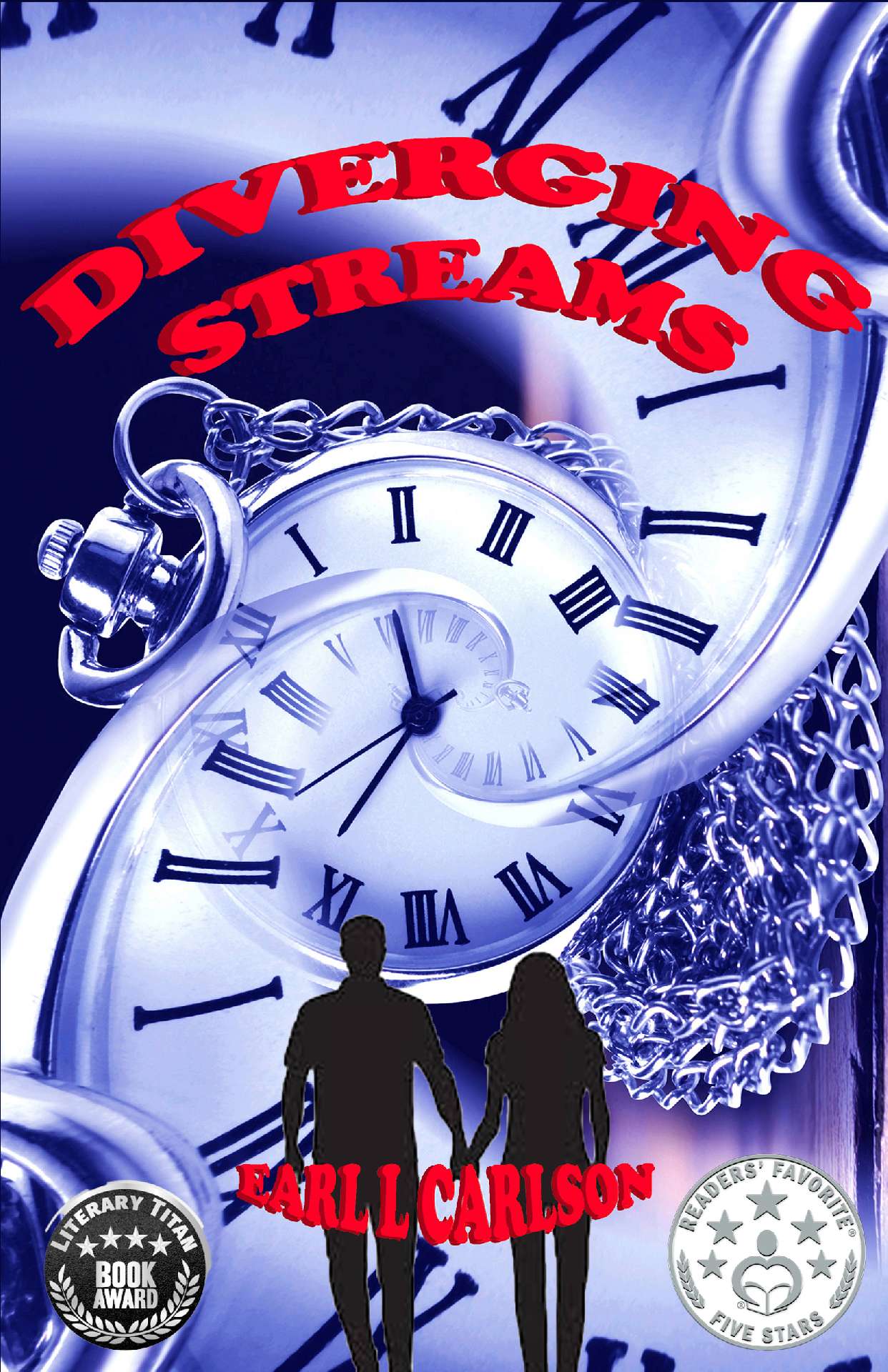
Diverging Streams
Formats: E-Book, Paperback
Ages: 12-15, 18+
Separated following a tragic accident in which the girl's parents are killed, adolescent lovers are reunited twenty years later by a second tragedy, which enables them to travel through time. Unencumbered by corporeal form, they may choose to go forward to the future or back to witness historical events. They may also travel sideways through other dimensions of time to visit alternate (what might have been) realities.
This brief novel is set in a universe in which time is multi-dimensional, with constantly dividing and diverging time streams—each stream containing its own unique reality. In this universe, "anything that can possibly happen cannot possibly not happen" somewhere in multi-dimensional space-time. Though it may sound confusing, the explanation—as provided by one of the characters and further clarlified by the author in the Caudal Appendage—is really quite easy for the layperson to follow.
Actually, the author has long contended that you and I live in just such a universe, which is consistent with the many-worlds interpretation of quantum mechanics. And his belief has recently been reinforced by a paper submitted for peer review by physicist Gunther Kletetschka, associate professor at the University of Alaska.
The book also answers that persistent question: Why can't we remember the future as clearly as we remember the past?
Reviews
I recently came across Diverging Streams while browsing science fiction, and its premise immediately intrigued me. A story of adolescent lovers separated by tragedy, reunited decades later with the ability to travel not only through time but across alternate realities, all grounded in the many-worlds interpretation of quantum physics, sounds like the kind of ambitious, heartfelt, and intellectually rich speculative fiction I’m always searching for. What stands out is the elegant intertwining of human emotion and high-concept science: Haskell and Jennifer’s journey through diverging time streams, witnessing history and exploring “what might have been,” while navigating a love that transcends not just years, but dimensions. It’s a rare blend of quantum theory and quiet intimacy, a story that feels as vast as the multiverse and as personal as a long-held memory. As a writer myself, I’m drawn to science fiction that uses its speculative framework to explore deep human questions. From a reader's perspective, a novel like this, which sits at the crossroads of hard sci-fi and timeless romance, sometimes faces the delightful challenge of reaching both audiences effectively, appealing to those who seek conceptual depth and those who crave character-driven narrative with equal success.
Diverging Streams is a work of literary science fiction that blends time travel, alternate realities, and deeply human moments. The novel follows Haskell Yngren across multiple timelines, weaving together pivotal events from adolescence, adulthood, and parallel versions of his life. What begins as a vivid, often humorous barroom incident expands into a meditation on chance, memory, desire, and the small decisions that quietly fracture a life into many possible paths.Author Earl L Carlson writes with a confident, old-fashioned storyteller’s rhythm, the kind that is unafraid to linger. He pauses to philosophize, to explain, to wander off briefly and then return. The prose is rich but not showy. He trusts long scenes and detailed observation, especially when he is writing about adolescence, embarrassment, longing, and those fragile moments when everything feels charged and irreversible. Some passages are genuinely funny, others almost uncomfortably intimate, and that contrast feels intentional.The story leans into digressions and omniscient commentary, sometimes stepping well outside the action to reflect on culture, sexuality, or human cruelty. Still, those same detours are also where the book’s personality lives. The speculative elements are never flashy. This is not a fast, gadget-driven science fiction novel. Instead, the genre functions as a framework for asking what might have happened if a single moment tilted another way. The alternate timelines feel less like puzzles to solve and more like emotional echoes.I felt that Diverging Streams is best suited for readers who enjoy reflective, character-driven speculative fiction. If you like science fiction that behaves more like literary fiction, are curious about time but deeply invested in memory, desire, and consequence, this book will likely resonate. It rewards patience and a willingness to sit with discomfort, humor, and nostalgia all at once.