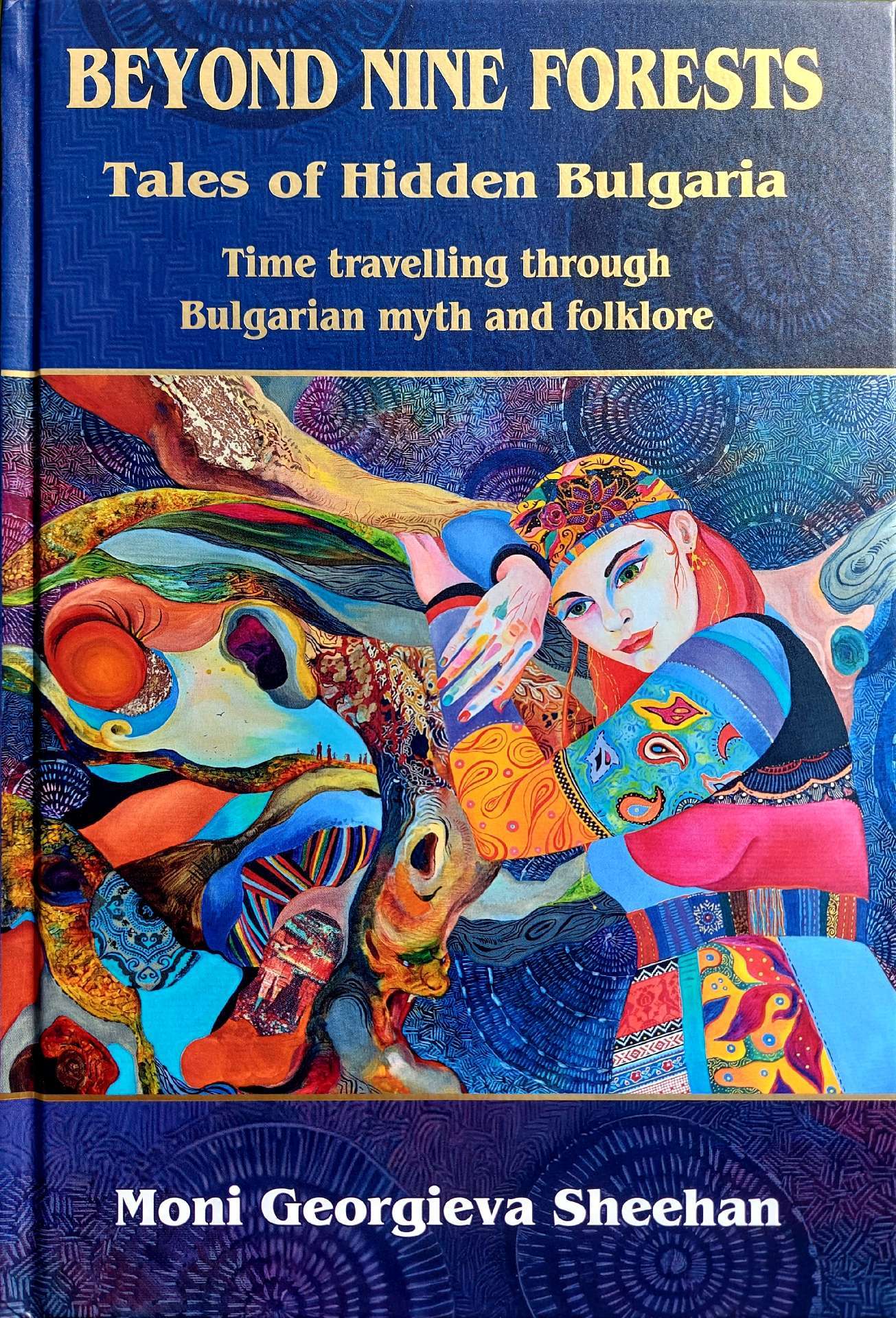
Beyond Nine Forests: Tales of Hidden Bulgaria
Formats: E-Book, Hardback
Ages: 12-15, 16-18, 18+
Time travelling through Bulgarian myth and folklore
Within the fragrant forests and beautiful mountains of Bulgaria lies a land of gold, a hidden world of ancient myth and folklore, of shape-shifting dragons, wild women, giant-hearted heroes, vampires and demons of the night.
'Beyond Nine Forests' is a fabulous collection of Bulgarian traditional tales that range from the magical to the macabre, from fairy tale to heroic epic. In addition, the author delves into Bulgaria’s folklore and ancestral mythologies going back to ancient Thracian times, to explore the roots of these stunning stories and their deeper meanings.
Acclaimed British-Bulgarian oral storyteller Moni Georgieva Sheehan has retold the tales in a way that is true to the heart of the original narratives in this trailblazing work. Translated from authentic sources and little known in the West, they cross the boundaries of time and space to speak to the heart, mind and soul.
With a foreword by Professor Ronald Hutton, the book features artwork from some of Bulgaria’s finest artists.
Reviews
Shapeshifting children, amorous dragons, dangerous nymphs who ride deer and wear rainbows for belts, doomed heroes who can overcome any obstacle but their own death: Bulgarian folktales weave into a rich and mesmerising universe. On the surface they are moving and strange, a combination of hair-raising adventure and sorrow for the lost lives of fair maidens and young men turned into stags. Deep beneath the entertaining and emotional level, however, runs an older current – coded memories of millennia-old traditions and beliefs of the Bulgarians, and of the peoples who lived in these lands before and alongside them. English-speaking readers are largely unaware of this trove of storytelling and ancient myth. Beyond Nine Forests: Tales of Hidden Bulgaria by Moni Georgieva Sheehan is an excellent introduction. It goes beyond retelling some of Bulgaria's most mesmerising and strange tales: the book provides crucial historical and mythological background that helps the reader navigate these stories and find their own way into the labyrinths of myth. Like so many storytellers, and in true continuation of the oral tradition, Moni Georgieva Sheehan discovered the strange world of Bulgarian folklore at home, through her mother. Paraskeva Georgieva Stefanova Armstrong left Bulgaria soon after the Second World War with her British husband. Far from her family and roots, she found a way to keep Bulgaria close. She told stories to her daughters. She recounted strange memories from her youth and spoke of the uncanny creatures of Bulgarian folklore: karakondzho goblins, vampires and wild samodivi. Yet Moni Sheehan discovered the true wealth of Bulgarian folklore only when she went to Plovdiv to study Bulgarian folk dance. In 1995 she began researching it in earnest. "I came across not just one, but many stories that blew me away – dramatic, emotional, magical and cosmic stories that are definitely not for children," she told us. "Little Stag Brother" made a particularly strong impression. It begins with a brother and sister fleeing from their would-be cannibal parents and tells of their many trials, which include shapeshifting and constant transitions between death and life. The story compels not only through its tight plot – Moni Sheehan is eager to point out its rich metaphors and symbols referencing elements from Bulgarian traditional weddings. As Moni Sheehan grew into a storyteller with her British-Bulgarian storytelling company A Spell in Time, she and her mother began working together to find, translate and analyse some of the most fascinating Bulgarian folk tales and epic songs into English. After 30 years of work, the book is now ready: a beautiful, top quality, fully bound hardback. Across more than 300 pages, Beyond Nine Forests: Tales of Hidden Bulgaria is many things at once. It is a fascinating collection of stories entirely new to the English-speaking reader – an eye-opener for anyone seeking to expand their horizons. Its analysis and contextualisation of possible hidden meanings make it a compendium of Bulgarian mythology. Its storytelling craft, which has adapted certain elements for modern readers, makes it a mesmerising read – you will find it hard to put down. Artwork by contemporary Bulgarian artists gives vivid form to the ideas and creatures that populate its pages. It is also the embodiment of an emigrant woman's sorrow for her native land, and of her daughter's love for her, and for that land. Paraskeva Georgieva Stefanova Armstrong did not live to see Beyond Nine Forests published. But it is here now, ready to open an entirely new universe. Find more about the book on www.spellintime.co.uk
The revival and reinvention of storytelling in Britain during the past 45 years has produced a substantial shelf of tangible book product from people whose primary art is based in the intangibility of oral storytelling. The best range from Helen East’s ground-breaking classic, ‘The Singing Sack’ (A& C Black, 1989) to Hugh Lupton’s ‘Unriddling the World’ (Wilton Square, 2025). These are now joined by a fabulous new book focused on the magically vibrant stories and folklore of Bulgaria. It is the result of a passionate life-long collaboration between a mother and her daughter. Throughout her life, Moni’s Bulgarian mother, Paraskeva, tirelessly translated Bulgarian folktales into English so that her daughter being raised in Britain might know them and tell them. As founder of the storytelling company, A Spell in Time, Moni has spent her entire adult life telling these stories – combining them with the ritual, dance and song culture of Bulgaria – in Britain and overseas. This is a book bursting with deeply researched, fully lived and utterly heart felt knowledge. As such it opens with a succinct history of Bulgaria from prehistoric and Thracian times to the present day, giving a clear context for, and background to, the various strands of cultural influence in which these stories have been born. Throughout the book exceptional care has been taken to provide notes and cross references that bring much useful cultural framing to the stories without intruding on the stories themselves. Some oral storytellers, finding themselves cast in the role of ‘cultural ambassador’ (by choice, projection or funding obligation!) can be challenged by the question of how to avoid hindering the flow of the tale with awkward ‘info-dumps’ thus lifting the listener out of the mantic charm of the story... Moni’s approach here is a superb solution facilitated by the print medium. The copious notes clad the stories in an ever more delightfully enriching imaginal whole. There are 51 fully told stories in the book, and many more referenced and summarised. They are followed by a beautiful summation of the festivals and customs that make the calendar of the ritual year. There is growing awareness in the UK of the deep wealth of archaic pagan survival in much of non-protestant Europe (thanks to works such as Charles Fréger’s classic ‘Wllder Mann’, Dewi Lewis 2012) and this book offers a rich doorway through which to approach the mysteries of, for example, the unnerving Kukeri figures and their accompanying mummery. The stories themselves are grouped around themes such as: Wonderous Weddings, Samodevi – The Wild Ones, Shapeshifters and Magical Animals, Tricksters, Demons, Epic Heroes, etc. There are magnificent stories of curses and blessings, of transforming bears and serpents, of honey as bee dung, of drought -bringing dragons and seductive forest nymphs, of God, the Devil and Death and much more, (even Nastraddin Hodja puts in an appearance, courtesy of the Ottoman Empire). The stories are frequently surprising and occasionally harsh and violent – punches are not pulled. Bulgaria was once known as Thrace. It was the home of Dionysus, Orpheus and the Maenads and the wild and heart-aching presence of that court permeates everything. Where possible Moni has added ATU and EB numbers to the stories so that dedicated folklorists can track parallel and variant versions in other cultures and global regions. As to the retellings? They make exemplary texts. The stories are told cleanly and with an economy that makes them very clear. Many attempts by oral storytellers to write down their tales sadly become muddied by affected ideas about literary form – resulting in self-conscious ‘poetic’ language or purple tinged prose. The Orality of Storytelling is an embodied art and the body, through its vocal inflection, bearing, rhythm and gesture, should colour a vocabulary and syntax that is functionally direct, natural and effective. Because every story in this book has already been tried and tested on audiences, there is an assured, organic, strongly rooted rhythm in the use of words. And, in terms of content and plot, the stories – long or short, heavy or light – are all deeply satisfying. Moni’s love for the stories (and her mother’s influence) is absolutely evident, so the mission for her art is to simply transmit them – rather than herself – as best she can. This is why these retellings have integrity and are ‘clean’. They are free of an ego and its desires to impress and self-express, which can add burdensome layers of neurotic psychology to stories that already are 'psychology' (in metaphorical form), by either misguided attempts at ‘novelisation’ or the addition of too much inner monologue, commentary or emotionally-manipulative language. Sometimes Moni uses free verse to convey ballad and epic song. This is an acknowledged and effective deployment of ‘short line form’ to surround words with blank paper, effectively causing microseconds of pause in the rhythm of reading: it brings heightened energy without pretence. The 308-page book is richly produced with many photos of people, objects, places, illustrations and other artworks all in full colour, necessitating the use of a coated paper throughout. Credit must also be given to Moni’s husband, Ivor Davies, whose skilful photography and methodical attention to detail is everywhere present. The photos show just how ‘tribal’ the aesthetic of Bulgarian folk culture remains. The people of Bulgaria are clearly still sounding an ancient note of wonder that was once prevalent throughout Europe. It’s wonderful that it can now also be heard here. Moni has surely fulfilled her mother’s wish beyond her sweetest dreams. Hurry, buy this outstanding book before the edition sells out. I mean it. ;¬)
A truly magical read that I have been waiting for forever. This book has everything that makes a folktale collection excellent: 1. It was written by a storyteller. Which means that the stories are retold in an eloquent, flowing language that makes them come alive off the page; they speak to the readers, the audiences instead of presenting text as it was recoded. 2. The stories are very well selected. A lot of them have not been published in English before, and they are all interesting variants of more well known types. And they are great. I found a lot of new favorites in this book. 3. Each story comes with detailed sources and notes. The notes explain the story's symbolism, context, and the changes the storyteller has made. 4. There is a long introduction about Bulgarian history, culture, and folklore, that helps understand the stories within the larger tradition. 5. The last chapter is a list of traditional festivals and holidays around the year, and each one comes with sources and story recommendations. I loved this idea. All in all, this book is a master class of storytelling, research, and keeping tradition alive. The author's love an enthusiasm for telling and for research shines through the stories. Highly recommended!