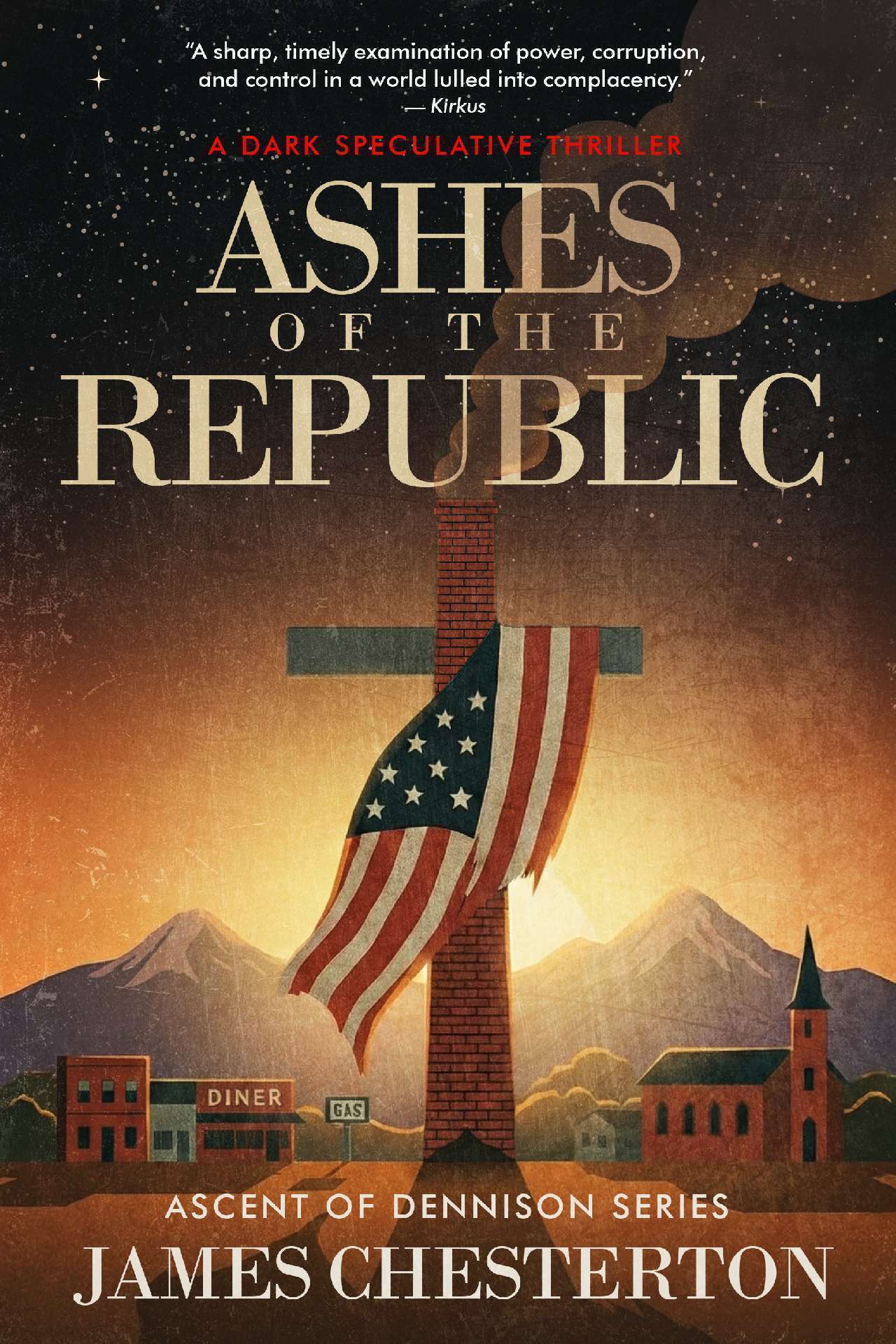
Ashes of the Republic - Ascent of Dennison
Formats: E-Book, Audio, Paperback, Hardback
Ages: 18+
The year is 2046. Freedom is extinct. Faith is law. And one woman’s impossible pregnancy could ignite a revolution.
The United States has devolved from a thriving democracy into a Christian nationalist surveillance state—where elections are theater, dissent is erased, and women’s bodies are monitored by the government.
Lily Osbourne has learned how to keep her head down. Then, while passing through Colorado Springs airport, everything shatters when a TSA agent informs her she is pregnant—and assigns her fetus a Social Security number.
Lily is on a contraception guaranteed to be effective for twenty years, so the only way this is possible is if she took the pill that opens a temporary window of fertility.
But she doesn’t even own one, which means someone chose for her.
As Lily and her partner, Jeff Maslow, search for answers, they are drawn into the orbit of Iwanna Dennison—the president’s ruthless daughter—and a larger conspiracy that could unravel the regime itself. Or make it undefeatable.
As rival forces plot in the shadows, Lily is pulled into the brutal power struggle at the heart of the Dennison regime, where her pursuit of truth threatens to shatter a nation built on lies.
Terrifyingly plausible and razor-sharp, Ashes of the Republic is a gripping series opener that blends the political paranoia of 1984 with the feminist fury of The Handmaid’s Tale.
Reviews
Chesterton’s Ascent of Dennison opener examines the edges of extremism in 2046 America, where Charity Malodor is living in Colorado under the false identity of Lily Osbourne, after a dangerous confrontation 20 years ago with her prior employer, Iwanna Dennison—the business mogul behind Dennison Robotics and daughter of the ultra-conservative sitting president. Life in near-future America is harsh, and jobs are hard to come by, forcing Charity to apply for the first one that’s available—a stewardess. But when a routine TSA scan reveals she’s pregnant, Charity immediately suspects foul play: she’s on the “mag,” a state-of-the-art birth control effective for up to 20 years, prompting her to conclude that someone must have slipped her a “fert”—a birth control counter that lasts for just 24 hours. Chesterton creates an immersive future America that is shocking but not hard to imagine: abortion is illegal, sexual encounters are approved through an app, presidential term limits have been erased, and the Make America Dominate party is in control. Charity exists within that system, along with her fiancé Jeff, but she struggles with intense inner conflict. Initially torn between her mother’s deep-seated religious beliefs and her father’s disdain of spirituality, her ideology evolves as the novel progresses. When she becomes pregnant, and discovers it’s ectopic, she realizes her own vulnerabilities—“a life inside you, with the world outside enforcing its will on your mind and body”—and regrets her earlier “false dogma.” That awakening leads her to a dangerous decision but also sparks her fight to end America’s oppression. Iwanna also offers intriguing contrasts: single-minded in her hunt for power but internally hurting—though she channels that hurt in a damaging way. Chesterton skillfully creates a sense of vivid social horror, with religion weaponized, extremism rewarded, and corruption the norm. The conclusion surprises, but it’s fitting for a world where truth and integrity are traded for power and control. Takeaway: Atmospheric thriller of social horror and extremism in near-future America. Comparable Titles: Christopher Brown’s Tropic of Kansas, Elliot Ackerman and James Stavridis’s 2054. Production grades Cover: A Design and typography: A Editing: A- Marketing copy: A
Chesterton’s novel takes a satirical look at a futuristic, government-controlled society whose rosy outlook hides a dark underbelly. The year is 2046 and the United States has essentially become a monarchy under President Dennison. Having abolished term limits, his administration has overseen the cure for all sexually transmitted diseases and the invention of a 20-year birth control pill (called “mags”) alongside a pill that “opened a twenty-four-hour window of fertility” (called “ferts”). Increasingly realistic AI and cheap outsourcing mean robots and immigrants dominate the job market as aggressive government-backed gentrification drives out the working class. Jeff Maslow is a former teacher, fired when he was found with a contraband copy of Walt Whitman’s Leaves of Grass—evidence of a liberalism that is no longer tolerated in the state-controlled educational system. Jeff’s new girlfriend, Lily Osbourne, became unemployed when her psychologist role was replaced by robo-therapy. She eventually takes a job as a flight attendant for a charter service with the Dennison account, a role that makes her privy to some shocking insider information. When Lily becomes pregnant despite not taking the fert, a larger conspiracy threatens her and Jeff’s very lives. Meanwhile, President Dennison’s psychotically ambitious daughter, Iwanna, will let nothing stop her from ascending to power—not even the disastrous rollout of the newest bot-model, during which the robot embarrasses a little girl named Stephanie and bloodshed ensues: “Stephanie pulled out a .22 caliber handgun from under the belt of her dress with her right hand, a ninth birthday gift from her grandfather, nine being the legal carry age in Colorado. With the other hand, she wiped the melted cream from her eyes, being replaced by her tears as the crowd laughed and hollered. Like Jesus would.” Eventually, Iwanna’s quest for control intertwines with Lily and Jeff’s search for the truth behind the government veil. This densely packed, intricately woven narrative is everything a smart political satire should be; at times bitingly funny, it effortlessly combines some truly over-the-top moments with pointed commentary about everything from American politics and artificial intelligence to religion and women’s reproductive rights. Chesterton delivers smooth, naturalistic dialogue even as he introduces sci-fi inventions like “the digilens,” which allows users (through “focused thought”) to stream and share videos directly through their contact lenses. Iwanna shines as a gleeful, scenery-chomping villain. At certain points, the futuristic descriptions of things like rogue AI and drone bees may remind some readers of their favorite episodes of the television show Black Mirror. Other scenes—as when Lily and her cohorts are strapped to chairs undergoing an intense interrogation about an illegal abortion while being threatened with a box full of tarantulas—are reminiscent of Orwell’s 1984 (1949). Chesterton makes little attempt to hide the absurdity of his antagonists or make them the least bit sympathetic, which may rankle readers who desire a bit more subtlety in their satire—but in this futuristic world, in which the rich can move literal mountains while the educated masses can only find work as roller-skating waitresses, there isn’t much point in sugarcoating things. What the novel may lack in nuance it more than makes up for with a compelling, action-forward plot and genuinely surprising twists. A sharp, timely examination of power, corruption, and control in a world lulled into complacency.