If I Could Remember: Bears & Brains & Caring For My Mother
Formats: E-Book, Paperback, Hardback
Ages: 18+
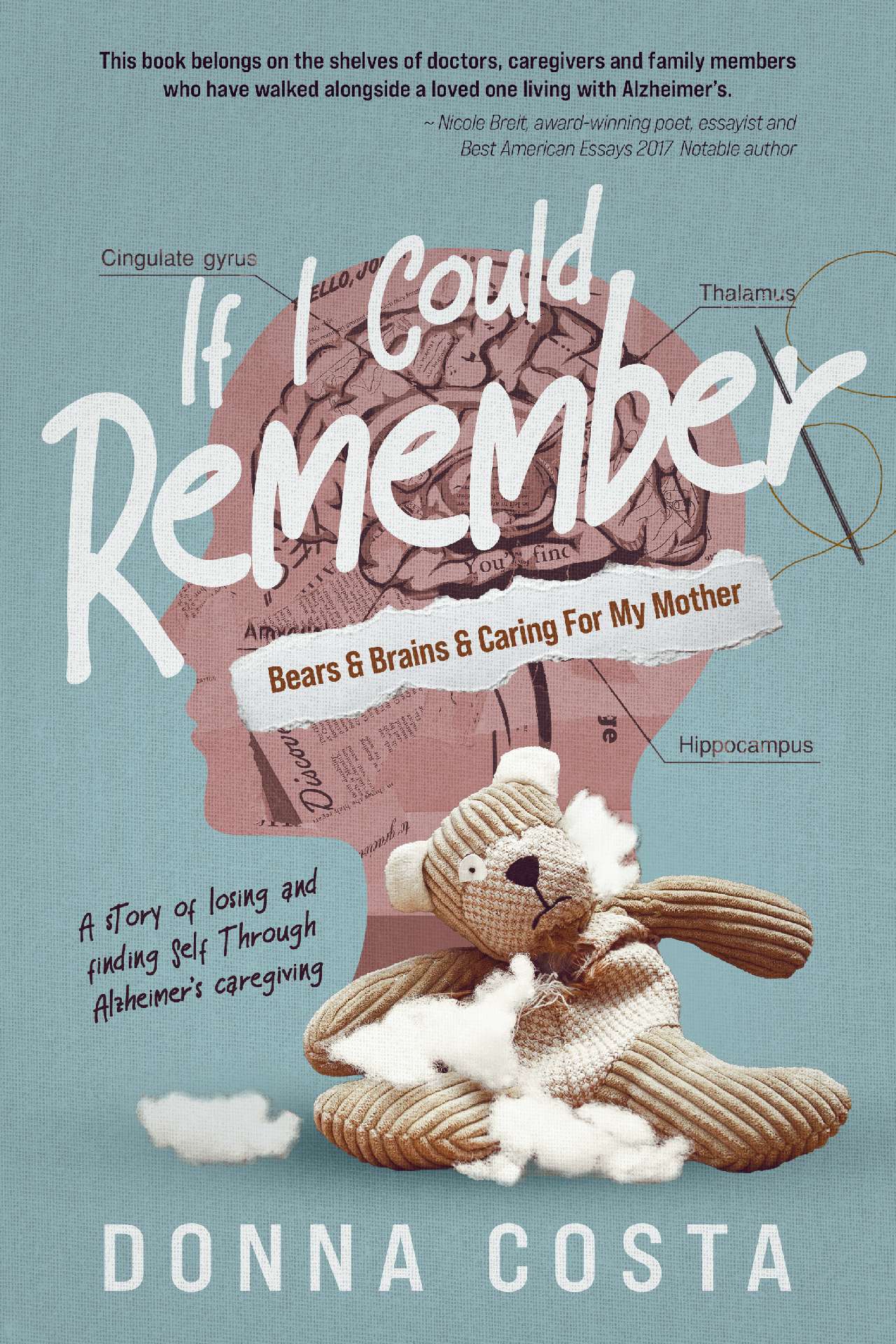
When Alzheimer's begins to rob her mother's cognitive abilities, Donna frantically searches for options to slow the progression of the disease. In the process, she explores the complexities inherent in all mother-daughter relationships. Amidst the stress of caregiving, she loses her sense of self-worth, neglects self-care and struggles with negative self-talk. To cope, she creates a fictional world of teddy bears at various stages of Alzheimer's. She weaves their stories with her own caregiving experiences, and with excerpts from her mother's journals and newspaper columns. T
his heartwarming and honest account reveals the physical and mental changes faced by Alzheimer's patients and caregivers, and how, by losing herself in caregiving, Donna ultimately finds herself.
Reviews
Page 11 of Old East Villager: Teddy Bears, Alzheimer’s and the Power of Story by Barb Botten For author Donna Costa, her latest book began as “a creative outlet” during one of the most challenging chapters of her life. After her father passed away, Donna’s mother—living with her dog in a condo—began showing signs of Alzheimer’s. Donna started spending more time there, often staying overnight in the spare room, surrounded by dozens of handmade teddy bears her mother had sewn over the years. “The teddies spoke to me,” Donna recalls. “They had stories to tell. I came to know each bear by name, learned their personalities, empathized with their cares and concerns and even heard their thoughts about Alzheimer’s and caregiving. I listened. They returned the favour. Hugs were free!” Over five years—two spent caring for her mother in the condo and three more after her mother moved in with Donna and her husband—Donna tracked the physical and mental changes brought on by Alzheimer’s. She wove together her experiences as a caregiver, excerpts from her mother’s journals and newspaper columns, and the imagined stories of the teddy bears. “As a way to talk about different aspects of Alzheimer’s, I gave several of the teddies Alzheimer’s. Somehow, that just makes it easier to discuss difficult topics,” she explains. For Donna, writing became a form of therapy. “It was a place where I could talk about how difficult it was being a caregiver, where I could grieve, or rant when I felt frustrated, incompetent or overwhelmed. It’s a story of losing and finding myself through Alzheimer’s caregiving.” While this work is deeply personal, it’s not Donna’s first foray into publishing. Her debut novel, Breathing With Trees, was young adult fiction. She also edited Transformation: Autobiography of Beverly Vollmer, and her poetry and fiction have appeared in Out of the Woods: Voices from the Forest City, an anthology produced by the London Writers Society. Currently, Donna is finishing a rom-com, When Harry Met Charlie, based on two teddy bear characters from her Alzheimer’s book. She’s also working on a historical fiction novel told from the perspective of a female homeopath in London, Ontario, during WWI and the Spanish flu—a story that weaves in her grandfather, who was conscripted in 1918. Donna can often be found at the Western Fair District—shop-ping at the Saturday market, cheering at her grandson’s hockey games at the Sports Centre or enjoying a night at the races and buffet at Top of the Fair. With September recognized as National Alzheimer’s Month, Donna encourages caregivers and those with loved ones living with Alzheimer’s to consider picking up her book. It is available through major online retailers, locally at Tuckey Home Hardware, or directly through her website at www.donnacosta.ca. Visit the Alzheimer Society of Canada to learn more about Alzheimer’s and Dementia at alzheimer.ca
Headline: "Author details caregiving, mother-daughter relationship and intricacies in new book." by Rachel Hammermueller
Review by Melissa Suggitt A daughter’s grief, a mother’s fading memory, and a chorus of teddy bears that refuse to let the silence win – If I Could Remember is as heartbreaking as it is unexpectedly tender. Donna Costa’s If I Could Remember is the kind of memoir that doesn’t just open a window into one family’s struggle with Alzheimer’s—it rips the curtains down, lets the cold air in, and forces you to sit in it. It is at once brutal and tender, blending memoir, fable, and medical fact into a tapestry that feels both unflinchingly real and strangely magical. The book begins with diagnosis, a moment rendered with the rawness of a battlefield. Costa’s mother sits in a sterile room, subjected to the indignities of the Montreal Cognitive Assessment. When told she can no longer drive, her grief is immediate, visceral: “Please, please, don’t take my license! Not that!” The plea isn’t about a car; it’s about independence, dignity, and the right to exist on one’s own terms. In passages like these, Costa captures how loss arrives in increments, each one as devastating as the last. But this isn’t just a medical memoir. It’s also a book where teddy bears come alive, carrying the weight of metaphor and memory. Her mother, a prolific bear-maker, left behind hundreds of handmade teddies, each stitched with care. In Costa’s hands, they become companions and narrators, voices in the dark when the human ones falter. They bicker, console, and even confront Alzheimer’s themselves. In one whimsical yet piercing exchange, when a bear struggles to recall the past, another responds simply: “If I could remember, I would.” That refrain becomes the book’s heartbeat. Childlike in its phrasing, but devastating in what it suggests about memory’s fragility. Woven among these intimate vignettes are passages of research and cultural reflection. Costa details the science of neurons and tangles, the statistics of diagnosis, and the stigma faced by both patients and caregivers. Yet she balances the clinical with the lyrical, moving seamlessly from “amyloid plaques” to a story of her Polish grandmother bootlegging whiskey with bottles strapped to her legs. The juxtaposition works because Costa understands that identity—personal, familial, cultural—is never just one thing. The writing itself is sharp-edged but warm. Costa does not smooth over the humiliation, the anger, or the expletives that slip from her mother’s lips in moments of fury. She honors those moments not to shock but to show the truth of decline, dignity tangled with rage, lucidity with confusion. Readers are steeped in both heartbreak and resilience. We sit at the kitchen table when her mother forgets to set a place for her daughter. We meet Charlie and Harry, teddy bears whose friendship is tested by memory loss. We feel the cultural dissonance of heritage half-claimed, half-denied. Costa doesn’t give us a linear arc so much as a kaleidoscope of fragments, reflecting the way memory itself splinters. If I Could Remember is ultimately about how we hold onto love when memory fails us. It is about daughters carrying their mothers, bears carrying their makers, and words carrying what can no longer be spoken. To read it is to be both gutted and comforted, to laugh through tears, and to feel deep in your bones the urgency of remembering while we still can.