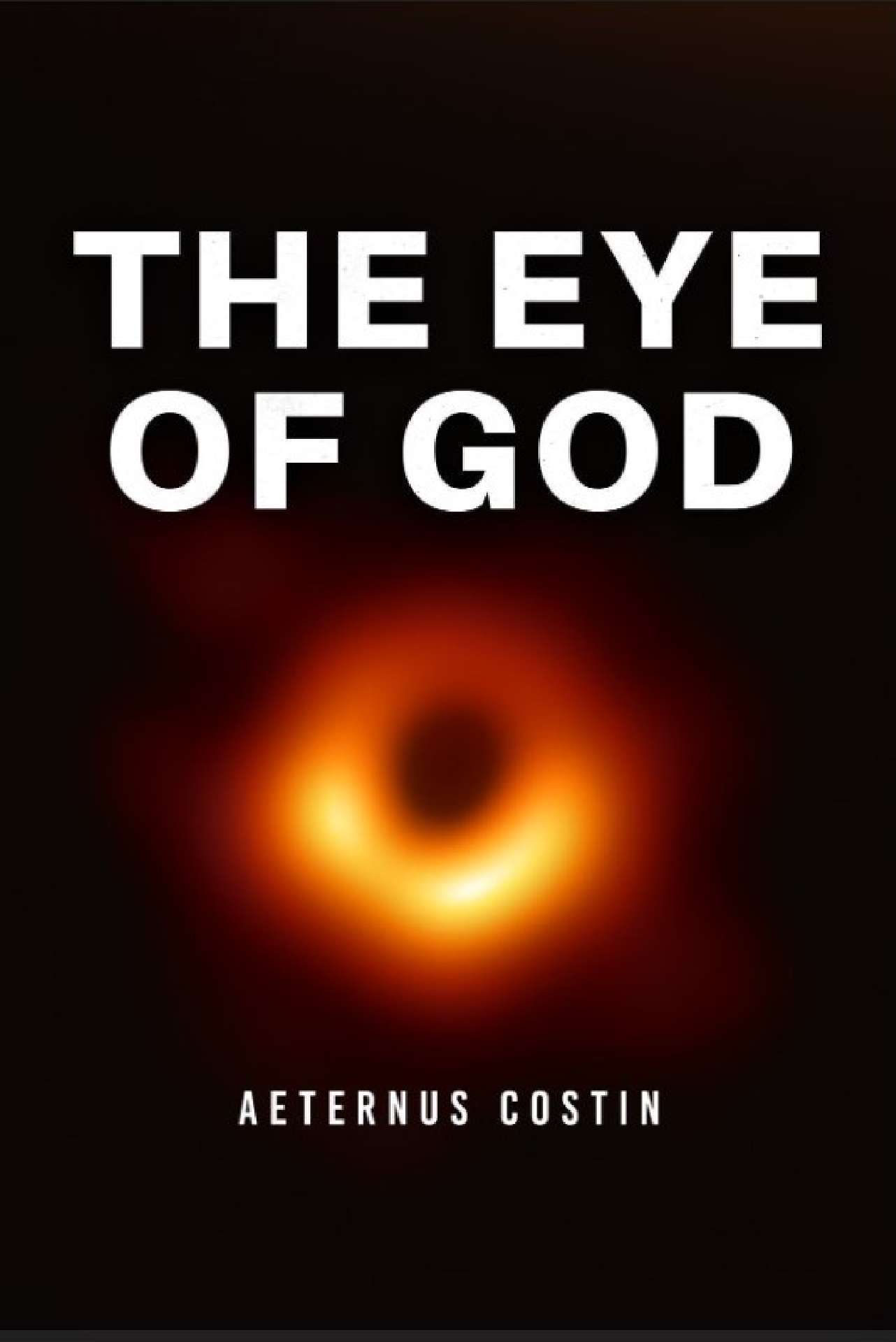




The Eye of God
Formats: E-Book, Audio, Paperback
Ages: 18+
What if the force that shaped the universe is the very God humanity has been seeking?
From the moment former atheist Aeternus Costin had a sudden epiphany, he set out to prove it. Not with superstition and spiritual arguments, but with facts and scientific evidence. In this comprehensive, holistic and meticulously researched study, Costin presents his radical yet simple theory: God and Gravity are one and the same.
Abandoning supernatural explanations in favor of logical reasoning, Costin journeys from his devout Baptist upbringing in the American Bible Belt to a transformative realization that redirected his life’s purpose. Inspired in part by Stephen Hawking’s assertion that gravity, not a deity, was sufficient to initiate creation, Costin asks a deeper question: What if Gravity itself is the transcendent mover behind all existence?
Through anthropology, philosophy, physics and theology, he dismantles traditional concepts of God, while illuminating striking parallels between the divine qualities attributed to Him and the properties of Gravity. Challenging teleological, ontological, cosmological and cultural arguments, Costin ultimately proposes a unified explanation of the divine, rooted in empirical evidence rather than faith, provable against the unprovable.
Both provocative and accessible, this compelling, fully referenced academic case-study invites believers, agnostics, sceptics and scholars alike to re-examine one of humanity’s oldest questions with fresh eyes. Whether you find his conclusions revolutionary, convincing or existentially unsettling, Costin promises a thought-provoking intellectual and philosophical journey, one that could reshape how we understand existence itself.
Reviews
THE EYE OF GOD by Aeternus Costin ‧ RELEASE DATE: April 30, 2024 An intriguing philosophical exploration of the intersection of science and religion. Costin, a self-taught philosopher, questions traditional notions of God in this debut nonfiction work. The author has lived his entire life in the U.S. Bible Belt and was raised in an evangelical Southern Baptist home with grandparents who traveled to various churches as part of a gospel singing group. “Growing up,” he writes, “I wasn’t aware of anyone not believing in God.” Blending memoir with metaphysical reflection on the nature of religion, Costin notes in the book’s early chapters that, despite his upbringing, his natural curiosity made him question things that other Baptists automatically embraced. Reading the Bible on a deeper level didn’t help, either, as it only made him question his denomination’s literalism. Attempts at discussing the essentials of the faith with peers quickly led to dead ends. Once, when he suggested that the Bible’s narrative might be “only stories told by people long ago and not the word of God,” one friend simply laughed and said, “What?!” It wasn’t until 2019 that the author, an information-technology professional, had an epiphany that now forms the thesis of this book: He argues that “what science calls the force of Gravity is what humans call God.” Like descriptions of the deity as an unchanging element across time and space, gravity exists, per the author’s logic, as the defining force of the universe. The book combines philosophy with scientific assessments of life, physics, and human development. Among the four fundamental forces in the universe (gravitational, electromagnetic, strong nuclear, and weak nuclear), the author asserts, gravity is the only one “that does not come from particles that we can find.” Indeed, per this book, “It is one of the great mysteries of physics that the origin of Gravity is unaccounted for.” Costin’s statement that this redefinition of the divine “unequivocally proves the existence of God” may not satisfy either skeptics or the religiously devout, but it does offer an intriguing meditation on God’s transcendence. It may also offer scientifically minded readers a way to rethink conceptions of God that eschew dogmatic aspects of faith. Costin has a firm grasp of the literature of classical philosophy, and he walks readers through the work of some of the discipline’s great thinkers, from Plato and Epictetus to Friedrich Nietzsche and Simone de Beauvoir. The book supports its philosophical footing with the writings of noted atheists, physicists, and social scientists, including more than 50 research endnotes and a five-page bibliography. At fewer than 120 total pages, this is an accessible book whose most absorbing passages are written in a clear, sensible style. It concludes with the practical application of its redefinition of God, arguing that if “Gravity is the man behind the curtain making the universe go,” then there’s ultimately “no great and powerful ruler to tell you how to live.” However, religious skeptics and others may be drawn to its final message of self-empowerment—a reference to The Wizard of Oz: “You don’t need to be helped any longer. You have always had the power.” An intriguing philosophical exploration of the intersection of science and religion.
Must read 🏆 Gravity is a new God, not created by the human mind but rather as an immutable and ever-existing natural phenomenon defying causal logic. Synopsis Aeternus Costin, a self-taught philosopher, finds enlightenment at the crossroads of science, technology, and deep metaphysical inquiries. Beginning with an epiphany during a casual summer day in 2019, Aeternus’ intellectual voyage spans across centuries of philosophical thought, from Plato to Einstein. This book stands as both a challenge to conventional religious dogma and a fervent call to reconcile logic with spiritual beliefs. By tenaciously arguing for the existence of God using logic and science, it aims to free humanity from antiquated religious ideologies while bridging the chasm between rationality and transcendence. Dive into a transformative exploration that not only seeks universal truths but also hopes to inspire readers to reflect upon reality and their role within it. Join in on a pursuit of knowledge, reason, and an unwavering quest for truth. The existence or absence of a holy deity has always been the discussion point between science and religion. We have heard many narratives about it, for instance, Nietzsche spoke “God is dead.” Or, some voices speak science as a new God aloud. This book sheds light on the same aspect of human life. The interesting thing is the narrative this book presents lies somewhat among already existing discourses when the author takes the position that may be not the whole science but at least one of the forces of this universe does have characteristics of God. That force is Gravity. The argument is interesting but not unchallenged. However, I acknowledge that this book has led me to discuss it with my friends on what they think about it. Maybe I was more sceptical or eager about it but that I would discuss later. Here, let me share the immediate response of my friends when they heard the central argument. But let me share the central argument of the author first. The author states and pins his whole debate around the universal characteristics of God that almost every religion entertains. Stating many of them in chapter 5th of a total of ten chapters, the emphatic ones are omnipresence, transcendence, non-physical, eternal, independent, constant, erroneous-less, and somewhat out of the shackles of the law of causality. About later, Stephan Hawking affirms too that “Because there is a law such as Gravity, the universe can and will create itself from nothing.” If we briefly look at what each chapter presents to the readers, we can find that chapter one sets the pace for the central argument on how this idea emerged in the mind of the author. The second chapter traces very precisely the origin and history of the concept of deity in the kingdom of humankind. The following chapter details how this belief system evolved and modified throughout the history of mankind. The fourth chapter introduces the main ingredient of the discussion; Gravity and the following chapter as mentioned above analyses the potentiality of Gravity as the modern God through the examples and quotes from religious scriptures. Chapter six of the book discusses the human idea of what God is and what is not. In this chapter, the author brings attention to the fact that God has been bestowed with human qualities by the human mind and has never been treated as an objective or neutral entity based on characteristics of natural phenomena. Chapter seven discussed the supremacy of science or the scientists who denied the existence of God. Chapter eight attempts to strike a balance between theism and anti-theism through the concept of Gravity God whereas the succeeding two chapters present the summary of the whole idea and argumentation and provide concluding thoughts. Coming back to the immediate response of people to whom I talked about the central argument was quite interesting yet debated. However, if I summarise, the responses ranged from “Science rather laws of Physics are new God,” or, “the argument is interesting yet debatable cause physics does not categorise gravity into forces and it is not as applicable to particle physics as to the celestial bodies.” Further, “Gravity is a physical fact and can be observed but not God, and we do not have any other evidence, so it is a too big hypothesis to rely on. As far as the principle of eternity is concerned it is not independent but rather related to this very universe.” In essence, all voices make sense but we can not discredit the author’s argument as well. However, I would like to challenge the principle of omnipresence that the author claims is the case with gravity and gives examples from the Bible to relate it to the characteristics of God. However, God is not more or less present in certain places as per the religion's explanations. On the other hand, Gravity is. It varies. Nevertheless, I suggest this book could be a very interesting read not only to those interested in religion and science but to those as well interested in a general and informative yet entertaining discussion. Reviewed by Dr. Asma Akbar
The Eye of God Aeternus Costin Publisher: Aeternus Costin Publications LLC Pages: 117 Price: (paperback) $15.00 ISBN: 9798989136001 Reviewed: April, 2024 Author Website: Visit » Aeternus Costin’s The Eye of God provides a thoughtful attempt at reconciling a conception of God with scientific orthodoxy. Costin is an autodidact, not a classically trained philosopher; nonetheless, he’s well-read and his arguments are considered, though still vulnerable to critique. Costin posits that gravity is God. His definition of gravity matches the scientific orthodoxy, but to make his theory work he must limit the conception of God to something more like a force of nature than an omnipotent being. He, thus, uses the word “entity” to describe gravity, arguing that gravity is a transcendent force, a first cause, and eternal by nature—yet nothing in these properties require it to be any sort of being. Substituting “entity” for “being” implies more than the author has proven, and theists would likely take issue with a God that amounts to no more than a property of the universe. To his credit, Costin anticipates this criticism, but his response is more side-step than rejoinder. Costin also refutes atheism, but his arguments only address “hard atheism” (those who believe they can know that there is no God), as opposed to soft atheists (a.k.a. non-believing agnostics), who hold that while they cannot know whether God exists, they find it most reasonable to believe He does not. While Costin does an admirable job refuting the first view, it would still leave “soft atheism” (which includes most self-identified atheists) intact. There are other minor quibbles (Nietzsche scholars might disagree with his interpretation of “God is dead”), but Costin shines in his scholarly exploration of religion’s origins, particularly Christianity. His personal odyssey led to an abandonment of faith, and his examination of that experience is particularly interesting. Costin’s work has room for growth, but his understanding of the topic is impressively sophisticated. There’s much to like and much to take issue with, leaving The Eye of God a thoughtful, if flawed, contribution to the scholarly conversation. Also available as an ebook and audiobook. Author's Current Residence Albuquerque, New Mexico